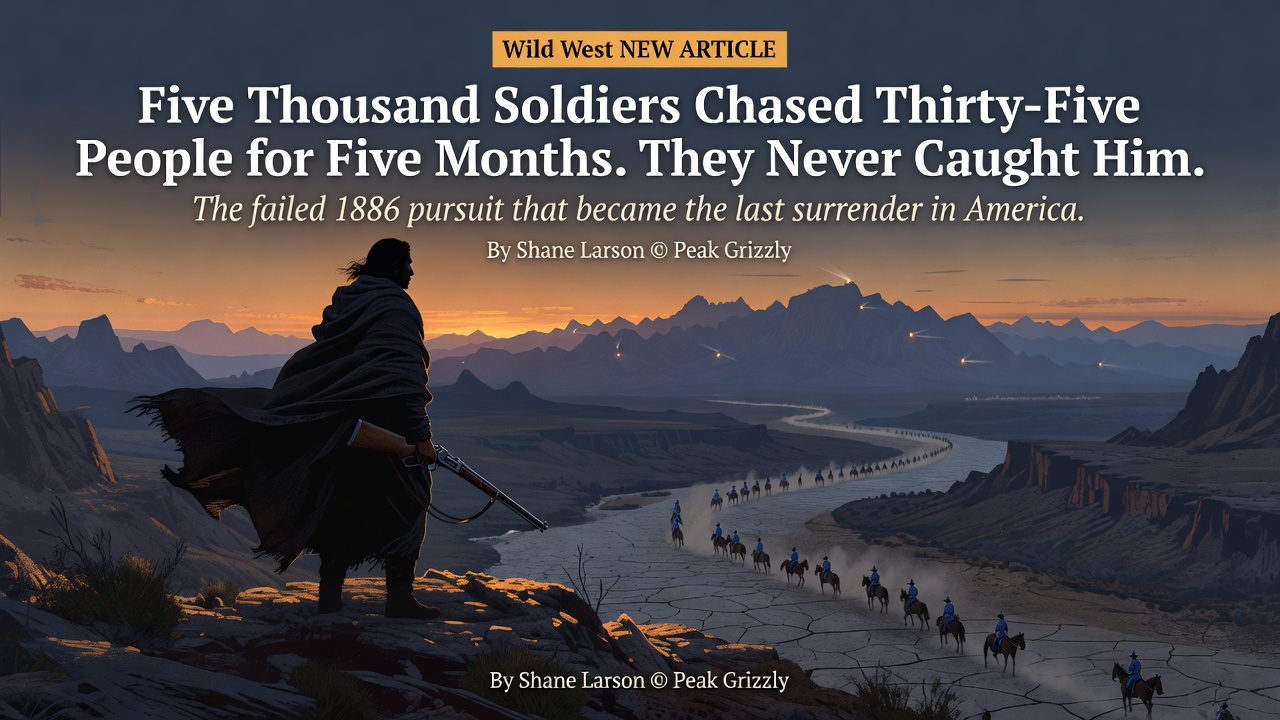
Five Thousand Soldiers Chased Thirty-Five People for Five Months. They Never Caught Him.
July 14, 2026 · 5 min read
In the summer of 1886, the United States Army had a single military priority, and it was not a foreign power. Roughly five thousand soldiers — about a quarter of the Army's entire fighting strength — were in the field in Arizona and New Mexico, supported by five hundred Apache scouts, roughly three thousand Mexican troops operating across the border, and the most advanced communications technology on earth: a network of heliograph stations flashing sunlight-coded messages between mountain peaks across two territories.
All of it was aimed at one band of Chiricahua Apaches hiding in the Sierra Madre. The band numbered about thirty-five people. Fewer than twenty were fighting men. Their leader was a widowed Bedonkohe shaman in his sixties whom the Mexicans, decades earlier, had started calling Geronimo.
For five months, the machine failed. The band moved through some of the harshest terrain in North America on knowledge no map contained — waterholes, relay horses, escape routes rehearsed across a lifetime — and the columns chasing them mostly found cold campfires. In the end, nobody caught Geronimo. A single lieutenant with two Apache scouts walked into his camp and talked. Geronimo negotiated a surrender on explicit promises: a short exile, reunion with his family, a return.
The government broke nearly every promise before his train had cleared Texas.
The Man Under the Name
Geronimo may be the most famous name in the history of the American West — paratroopers shouted it, Hollywood filmed it, a military operation borrowed it as recently as 2011 — and the man under it is almost unknown. Start with the most basic correction: he was not a chief. He said so himself, plainly, in the autobiography he dictated as an old man. Apache leadership held no thrones; authority was earned, local, and revocable, and Geronimo's particular authority was spiritual — what the Chiricahua called Power, a personal gift that, by his own testimony and that of the people who followed him, told him things and promised that no gun would ever kill him. No gun ever did.
His war did not begin with the United States. In 1851, Mexican soldiers from Sonora attacked a peaceful Apache camp outside Janos, Chihuahua, while the men were away trading. Among the dead were Geronimo's mother, his young wife Alope, and his three small children. His recorded account of returning to the bodies that night — and of the silence he kept for days afterward — is among the most devastating testimony the frontier ever produced. He was in his early twenties. He spent the next four decades inside a war with Mexico that was already generations old when he was born, fed by state scalp-bounty laws that literally priced Apache men, women, and children, and by massacres that poisoned every truce.
The American war came later, and — this is what the documents keep insisting — it was not inevitable. Cochise, the great Chokonen leader, tolerated a stage line running through the heart of his own country for years. It took a specific blunder — a green lieutenant seizing Cochise's family under a truce flag in 1861 over a kidnapping Cochise truthfully denied — to ignite a decade of war. Two years later, the aging statesman Mangas Coloradas came in to talk peace under a white flag and was taken prisoner, tortured with heated bayonets, shot "trying to escape," and mutilated after death. At nearly every escalation of the Apache wars, the record shows an avoidable failure of American judgment, usually followed by an Apache response the newspapers called savagery and the Army called war.
Geronimo and the Apache Wars
The Betrayal
The endgame, when it came, was not a battle. In September 1886, at Skeleton Canyon, Geronimo surrendered to General Nelson Miles on explicit terms. What followed is documented item by item, and it is worth stating plainly.
The families were not reunited as promised; the men were shipped to Fort Pickens, Florida, their wives and children to a separate fort hundreds of miles away. The "brief" exile became twenty-three years. And in the detail that even hardened contemporaries found shameful, the Army's own Chiricahua scouts — the men who had loyally guided the pursuit, without whom it could never have functioned — were arrested and shipped to prison in Florida alongside the very men they had helped hunt.
One American officer refused to be part of it. General George Crook — who had fought the Apaches by enlisting them, negotiated face to face, and considered his word a military asset worth more than a regiment — had already asked to be relieved of command rather than break surrender terms he had personally guaranteed a few months earlier. He spent the last years of his life publicly campaigning for the Chiricahua prisoners, testifying and writing against his own government's breach, until his death in 1890. His replacement, Miles, took the credit, the promotion, and the parade.
The Souvenir Stand at the End of the Frontier
Then comes the act nobody expects — the one most tellings skip, and where the story's real meaning lives.
For twenty-three years, Geronimo remained legally a prisoner of war: Florida, Alabama, finally Fort Sill, Oklahoma. The confinement was lethal — tuberculosis and malaria killed Chiricahuas by the score, and the children sent east to the Carlisle boarding school filled a Pennsylvania cemetery. And during those same years, the prisoner became a national celebrity. He appeared at the Omaha and Buffalo expositions. At the 1904 St. Louis World's Fair he did brisk business selling autographed photographs of himself for a quarter. In 1905 he rode in Theodore Roosevelt's inaugural parade down Pennsylvania Avenue, cheered by the citizens of the nation that held him captive.
Days after the parade, he met Roosevelt and asked for the only thing he ever asked for: to go home to Arizona to die. Roosevelt refused — the old hatreds in Arizona were real, and so was the politics. Geronimo died at Fort Sill in February 1909, of pneumonia after a fall from his horse, still a prisoner of war. On his deathbed, by his nephew's account, he said his one regret was that he had ever surrendered at all.
The frontier did not end at Little Bighorn, which was a Native victory, or at Wounded Knee, which was a massacre. As a matter of documented surrender — the last man to give up arms against the United States — it ended with Geronimo, at a canyon on the border, on promises that lasted less time than the train ride east. My new book, Geronimo and the Apache Wars: The Last Free Man in America, tells the whole arc from the record and the recorded Apache testimony: the world, the wound at Janos, the blunders, the reservations, the breakouts, the pursuit, the betrayal, and the long, strange captivity of a man America paid to look at but would not free.
Geronimo and the Apache Wars
New posts and releases, straight to your inbox. No spam, unsubscribe anytime.