Deadwood Was an Illegal City — and Its Most Famous Murder Trial Was Ruled Void Because the Town Didn't Legally Exist
July 13, 2026 · 5 min read
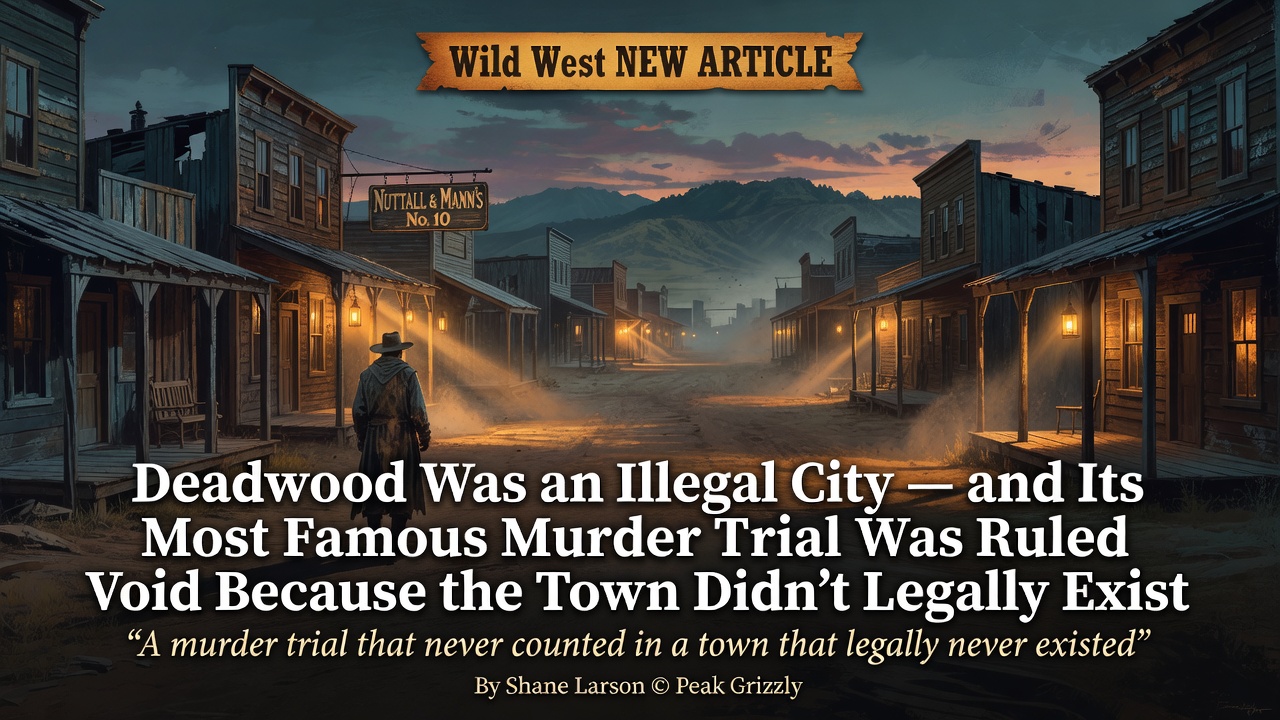
On August 2, 1876, a drifter named Jack McCall walked into Nuttall & Mann's No. 10 saloon in Deadwood, Dakota Territory, raised a .45 to the back of Wild Bill Hickok's head, and fired. Hickok died instantly, holding — according to a legend that took decades to harden — two pair, aces and eights.
Everyone knows that part. Here's the part almost nobody knows: McCall was tried for the murder twice, by two different courts, and the reason the second trial didn't count as double jeopardy is the single most revealing fact about the most famous town in the Old West.
The first trial happened the next day, in Deadwood, before a miners' court — an improvised tribunal of a judge and jury drawn from the camp. McCall claimed Hickok had killed his brother back in Kansas (a brother no researcher has ever verified), and the jury acquitted him in under two hours. McCall left town a free man and, being a fool, bragged about the killing across the territory.
So federal authorities arrested him and tried him again, at Yankton. His lawyers argued the obvious: he'd already been acquitted. The court's answer: no, he hadn't — because Deadwood sat inside the Great Sioux Reservation, on land guaranteed to the Lakota by federal treaty, where no legal court could exist. The miners' trial wasn't overturned. It was ruled to have never legally happened. McCall was convicted and hanged in March 1877, the first man executed by federal authority in Dakota Territory.
One murder. Two trials. And a formal ruling from the United States that a city of thousands — with theaters, newspapers, banks, and a post office on the way — was legally nowhere.
The Town That Was a Trespass
Deadwood's founding condition, the fact that explains everything else about it, is that it was illegal. Not rowdy-illegal, not frontier-lax — actually, formally illegal. The Fort Laramie Treaty of 1868, signed after the United States lost Red Cloud's War, set apart the Black Hills for the "absolute and undisturbed use" of the Sioux and barred whites from settling or even passing through without consent. Eight years later, after Custer's 1874 expedition confirmed gold, roughly twenty-five thousand people were living in the hills anyway. The government tried evicting miners for about a year, gave up, tried to buy the hills, was refused, and then — in a quiet Washington decision in late 1875 — simply stopped enforcing its own treaty.
That meant the boomtown filling Deadwood Gulch had no legal existence of any kind. Dakota Territory's courts had no jurisdiction. No federal land office would record a claim or a deed. Every property transaction in town transferred nothing. Every business license was theater. You could not sue, foreclose, probate a will, or prosecute a murder. Every institution that civilization is supposed to require — absent, all at once, in a city of thousands of armed strangers holding gold dust.
Which is exactly what makes Deadwood the best natural experiment the American frontier ever ran.
Order Without Law
Here's what happened in the vacuum — and it's stranger than lawlessness. Deadwood improvised nearly everything a government does, years before it had a government.
Deadwood
Miners' districts elected claim recorders who kept meticulous registries of property that was legally void — and the registries worked, because every fortune in the gulch depended on everyone agreeing to pretend the paper was real. Property by consensus, enforced by social pressure and the practical fact that a claim-jumper had to live among his victims. Miners' courts, for all their whiskey-soaked flaws (see: McCall, acquittal of), resolved disputes fast and with local buy-in. When smallpox hit the camp in the summer of 1876, a town with no legal authority organized a Board of Health, built a pest house up Spruce Gulch, and ran quarantines — public health administered by a government that did not exist. When fire leveled three hundred buildings in a single night in 1879, the town rebuilt in brick and kept going, surviving what routinely killed other boomtowns.
The gulch even developed its economic truth early: the reliable money was never in the pans. The placer gold was largely exhausted within two years; the prospectors mostly went broke or earned wages. The durable fortunes went to the freighters, the sawmills, the saloons — and to George Hearst, who bought the Homestake claim in nearby Lead for $70,000 and turned it into the most profitable gold mine in American history. It operated until 2002. The fortune, as always, left town wearing a suit.
Two Legends Deep
Deadwood is unusual among Western towns in having been mythologized twice. The dime novels got there first — the fictional hero "Deadwood Dick" debuted in 1877, when the real camp was barely a year old, and became so famous that actual Deadwood men later spent their old age claiming to have been him. Calamity Jane learned to perform the character the novels invented for her; nearly everything she claimed about herself — scouting for Custer, riding for the Pony Express, romancing Wild Bill — dissolves on contact with the record, which shows instead an orphaned, itinerant, generous, alcoholic woman the gulch treated with rough charity. Then, a century and a quarter later, HBO gave the town a second mythology — magnificent television that made Al Swearengen a charismatic antihero. The documented Swearengen ran the Gem Theater for twenty-two years on the trafficking and debt bondage of desperate women recruited under false pretenses, and died broke, far from Deadwood. The record is darker than the show, and it deserves to be read straight.
And the town's original fact never went away. In 1980 — United States v. Sioux Nation — the Supreme Court ruled the taking of the Black Hills illegal and awarded compensation. The Lakota refused the money. It sits in an account to this day, compounding past a billion dollars, unclaimed, because the position hasn't changed in a century and a half: the hills were never for sale.
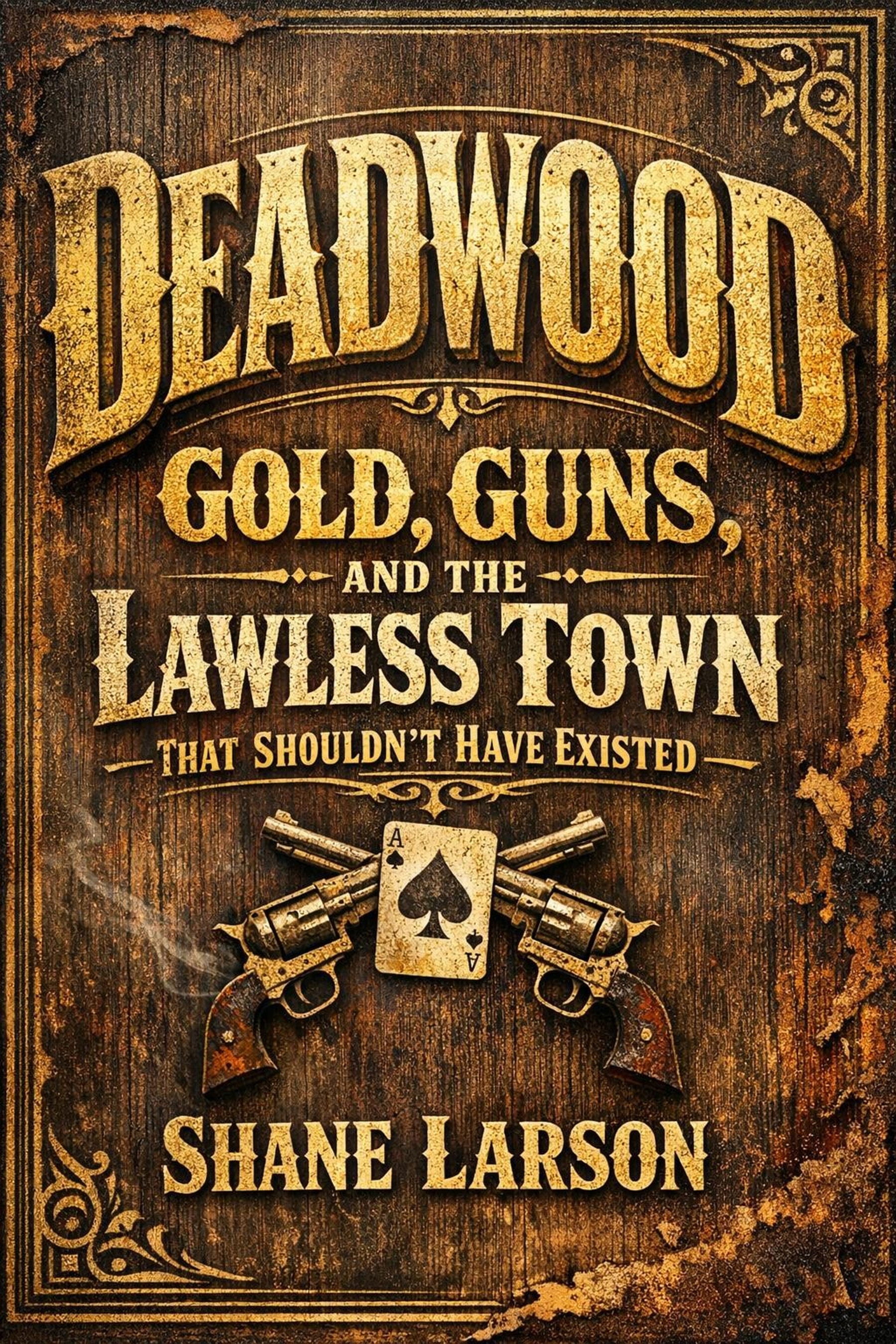
My new book, Deadwood: Gold, Guns, and the Lawless Town That Shouldn't Have Existed, tells the whole documented story — the treaty and the taking, the rush, the gold economics, the improvised law, Wild Bill's three weeks, the two trials, the real Swearengen, Seth Bullock's arrival of order, the Chinese community the legends erased, the fires and epidemics, and the town's long afterlife as a manufacturer of its own myth. It's the first place book in my Wild West series — the world the gunfighters moved through.
Deadwood
New posts and releases, straight to your inbox. No spam, unsubscribe anytime.