In 1963, Archaeologists Found the World's Oldest Temple — and Filed It as a Medieval Graveyard
August 1, 2026 · 6 min read
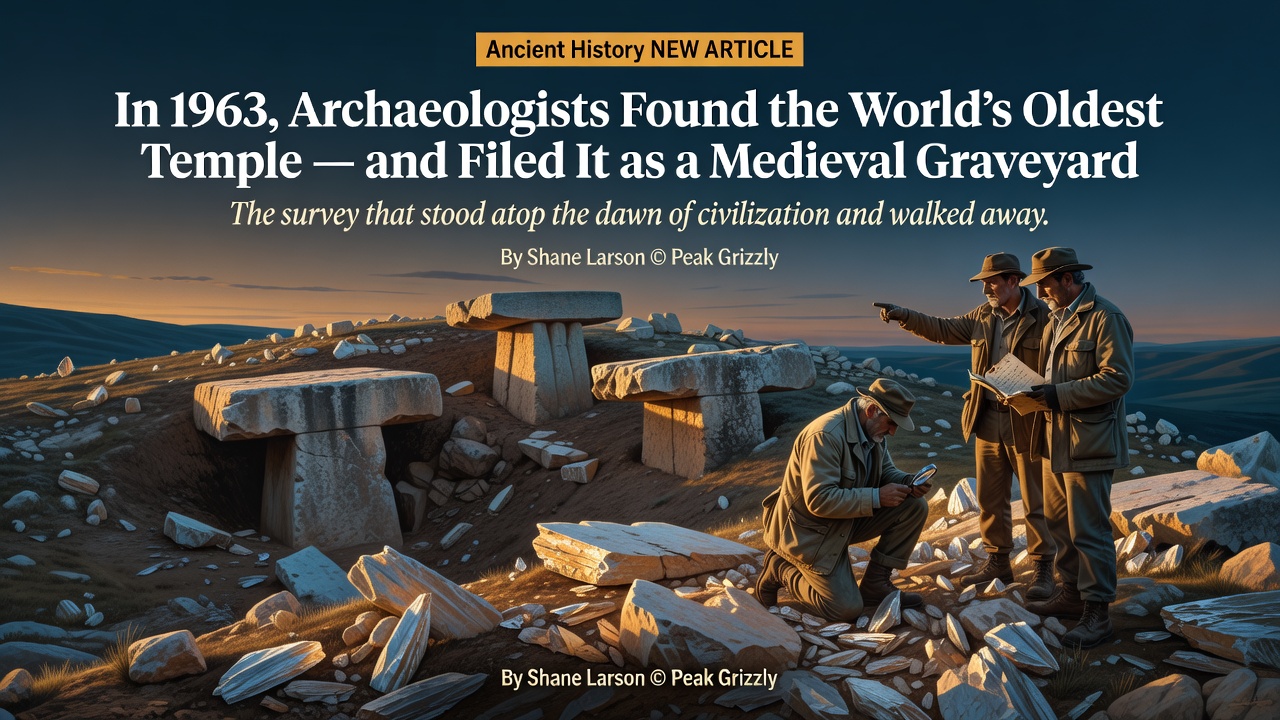
In 1963, a joint American-Turkish survey team walked over a low hill in southeastern Turkey called Göbekli Tepe — "Potbelly Hill." They noticed some broken limestone slabs and a scatter of flint. They concluded they were looking at an abandoned medieval cemetery, wrote a brief note, and moved on.
They were standing on top of the oldest monumental architecture ever discovered — by a margin of six thousand years.
The slabs they dismissed were the tops of carved stone pillars that had been standing since around 9600 BC. It took another thirty years for anyone to realize it. When the German archaeologist Klaus Schmidt visited the same hill in 1994, he recognized in an afternoon what the earlier survey had missed: those weren't medieval gravestones. They were the crowns of enormous Neolithic pillars, buried up to their shoulders, and they were older than anything that was supposed to be possible.
The reason the first team got it so wrong isn't incompetence. It's that what's actually there was, by every rule of archaeology at the time, impossible.
The Date That Shouldn't Exist
Here is the sequence every one of us was taught for how civilization begins. First, people invent agriculture. Farming produces a food surplus. The surplus lets populations settle down and grow. Settled, well-fed populations develop social hierarchy — chiefs, priests, specialists. And only then, with organized labor and stored wealth to draw on, does a society build monuments: temples, tombs, standing stones.
Farming first. Monuments last. It's a tidy, logical staircase, and it was the bedrock of how we understood the birth of the modern human world.
Göbekli Tepe stands the staircase on its head.
The people who built it were hunter-gatherers. They had no agriculture. No domesticated animals, no pottery, no metal, no writing, and no wheel. And yet they quarried limestone pillars up to five and a half meters tall and sixteen tons in weight, carved them in relief with foxes, vultures, snakes, and scorpions, and arranged them into great circular enclosures — and then did it again, and again, across the hilltop and across the whole surrounding region.
The monuments came first. The farming came after. In fact, the wild ancestors of wheat grow on the hills within sight of the site, and some of the earliest domesticated grain in the world appears nearby not long afterward. That geographic coincidence is the seed of the most provocative idea in modern archaeology: that the effort of building and gathering at places like this is part of what drove people to start farming in the first place — that the temple came first, and the city followed it.
That may or may not be right. What's no longer in doubt is the part that broke the textbook: monumental religion did not have to wait for agriculture. It came before.
Labor Without Kings
Sit with the practical problem for a moment, because it's the part that gets glossed over.
Move a sixteen-ton block of stone. You have no wheels. No draft animals — no oxen, no horses. No metal tools; your hardest edge is knapped flint. No pulleys, no iron, no mortar. And no state: no king who can conscript a workforce, no bureaucracy to feed and house them, no granary of stored surplus to pay them with. Hunter-gatherer bands are small and mobile almost by definition. Pulling together the hundreds of person-hours it takes to quarry, carve, haul, and raise one of these pillars — let alone a whole enclosure of them — is not something a few dozen foragers do on a whim.
So how did it happen?
Göbekli Tepe
The best current answer is that belief and feasting did the work that money and coercion do in later societies. The evidence at Göbekli Tepe includes enormous stone vessels, grinding stones, and huge quantities of butchered wild game — the residue of large gatherings. People seem to have assembled, probably seasonally, to build and to feast together. The gathering created social obligations; the obligations pulled more hands in; the feasts rewarded the effort. It's cooperation organized by shared ritual rather than by a ruler — which, if it's right, means the first monuments were built not to display power but to create community.
That's a genuinely different picture of early humanity than the one most of us carry, and it comes straight out of the dirt.
Why the Fringe Loves It — and Gets It Wrong
Search "Göbekli Tepe" and you'll drown in it: lost super-civilizations, ancient astronauts, a comet that wiped out an Atlantis whose survivors built the site as a warning. The place has become the crown jewel of pseudo-archaeology, and it's easy to see why. It's genuinely astonishing, it's genuinely old, and most of it — over ninety percent — is still buried and unexcavated. Mystery plus incompleteness is exactly the vacuum that fantasy rushes to fill.
But the fantasies all make the same mistake: they assume that something this impressive must have been built by someone more advanced than Stone Age foragers. The real finding is the opposite, and it's far more interesting. Ordinary hunter-gatherers — people like us, with our brains and our hands and none of our infrastructure — organized monumental labor around belief. You don't need to import aliens or a lost Atlantis to explain Göbekli Tepe. You need to give actual Neolithic people the credit the fantasies won't.
The documented story is stranger than the invented ones. It usually is.
And Then They Buried It
The last act is the strangest of all.
When the builders were finished with an enclosure, they didn't abandon it and let it weather away. They deliberately filled it in — packing the whole structure with rubble, flint debris, animal bone, and earth until the great pillars vanished under the hill. That deliberate backfilling is why the site survived at all, sealed and protected for eleven thousand years. But it raises a question we can't yet answer: why would a people entomb their own temples on purpose?
We don't know. There are theories — ritual "closing" of a sacred space, structural management, something else entirely — and the honest position is to hold them loosely. But there's something haunting in the image regardless: a society that built the first monuments in human history, and then, for reasons of its own, chose to bury them and walk away.
Less than a tenth of Göbekli Tepe has been excavated. Ground-penetrating radar shows more enclosures still down there, and a whole cluster of related sites — Karahan Tepe and the others archaeologists now call the Taş Tepeler — is only beginning to be dug. The oldest chapter of the human story is still mostly underground.
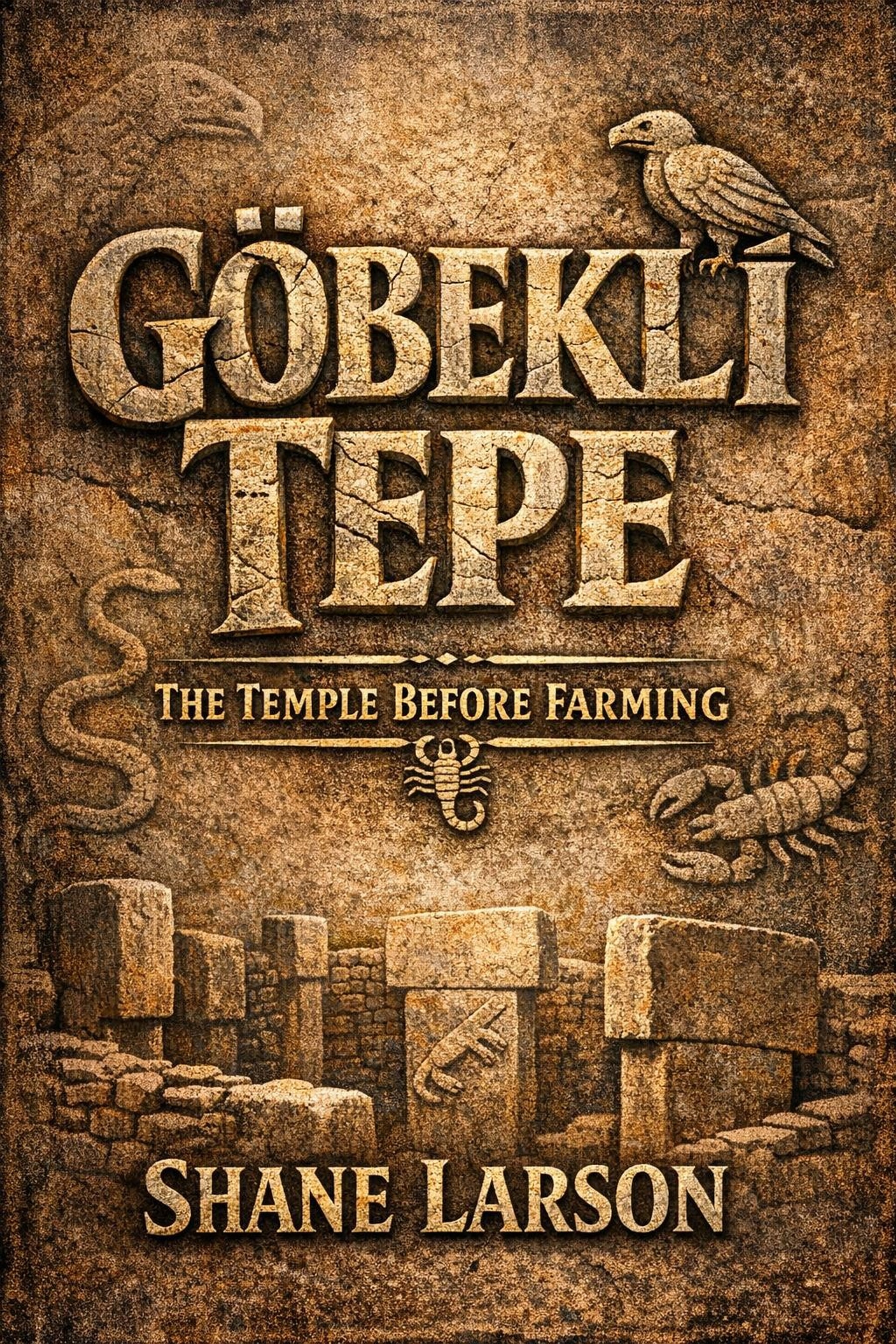
That's what my new book is about. Göbekli Tepe: The Temple Before Farming tells the whole thing — the accidental near-miss in 1963, the reversal that broke the textbook, the engineering, the carved animals, the feasts, the skull cult, the argument that hunger built the temple and the temple built farming, the deliberate burial, and the buried world now emerging around it — told straight, without the mysticism, and honest at every step about what we know, what we suspect, and what's still under the hill.
Göbekli Tepe
New posts and releases, straight to your inbox. No spam, unsubscribe anytime.