The City Colonial Archaeologists Dug Up — and Threw Away to Prove a Lie
June 15, 2026 · 5 min read
There is a wall in southeastern Africa that should be as famous as the Colosseum.
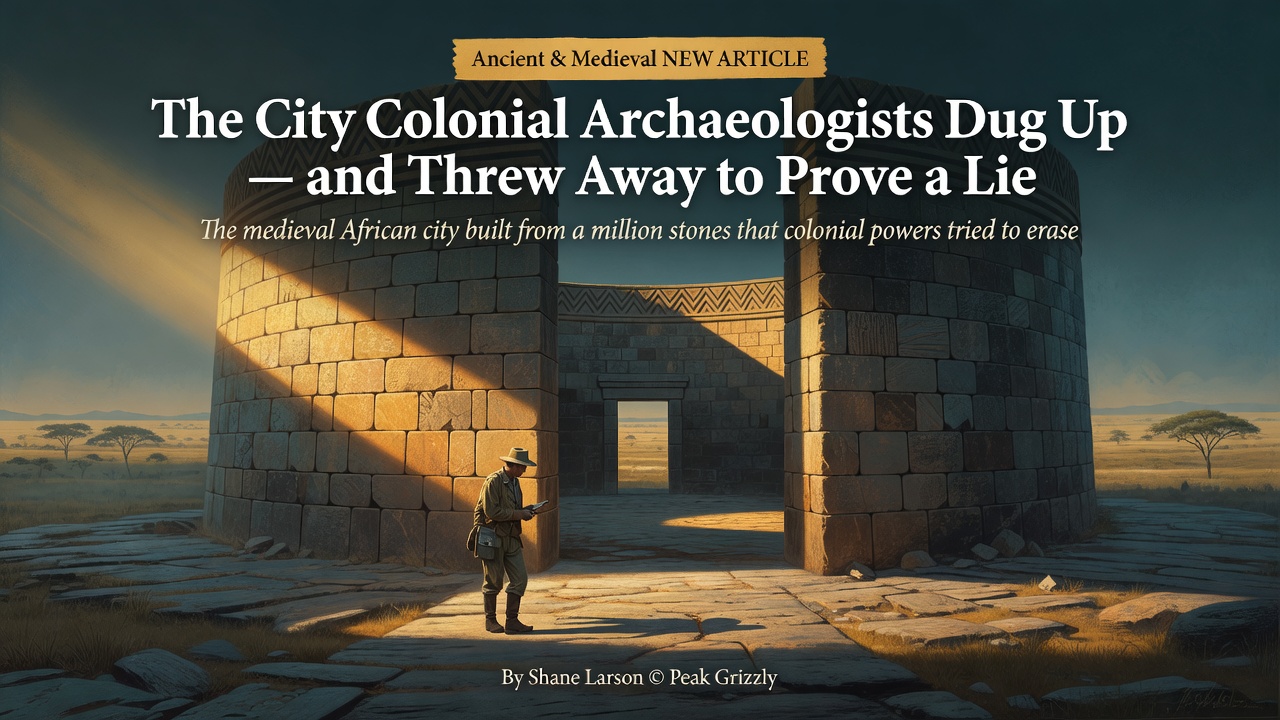
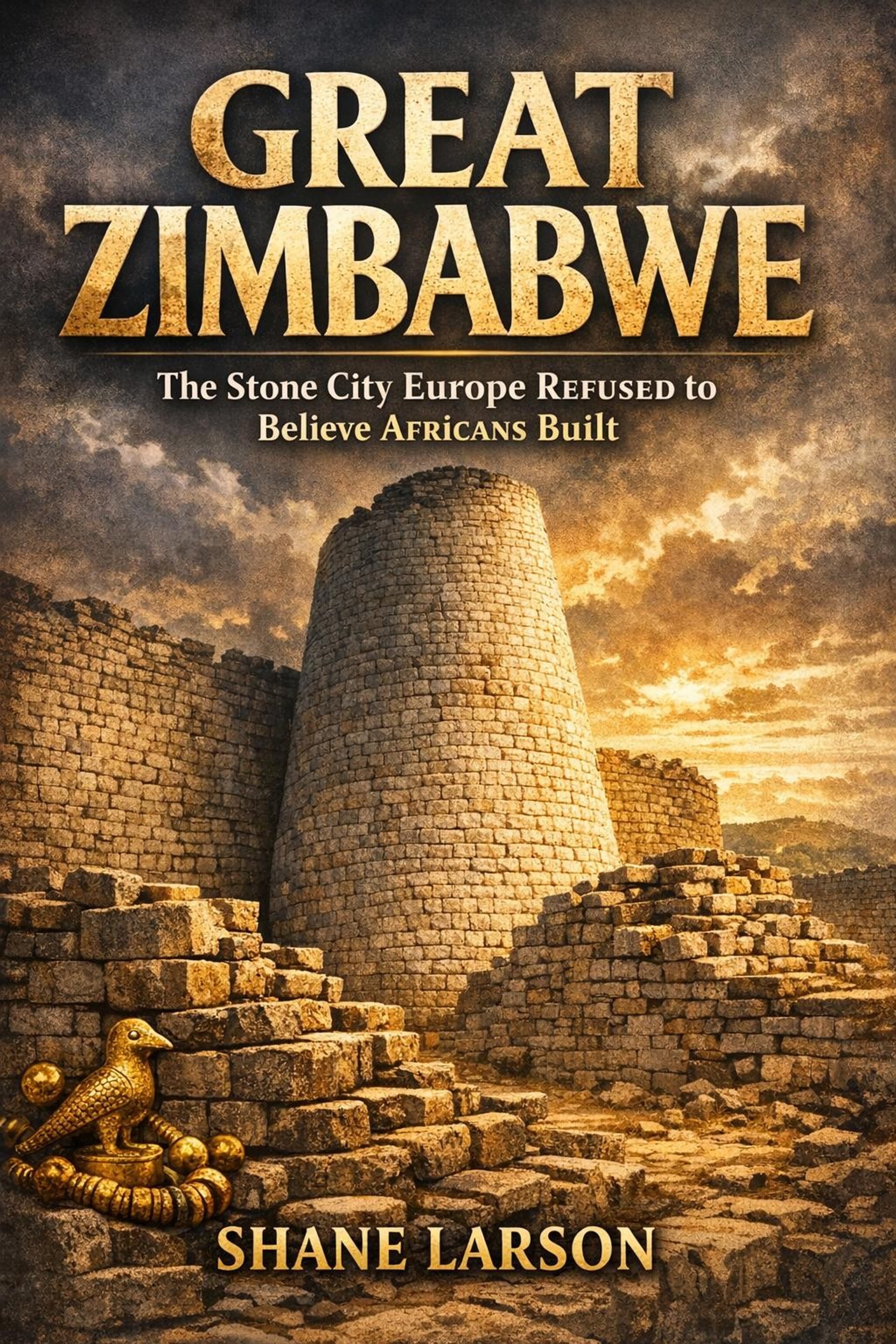
It is part of a structure called the Great Enclosure, on a granite plateau between the Limpopo and the Zambezi rivers. It was built from somewhere near a million dressed granite blocks, fitted together without a drop of mortar, rising in places more than thirty feet and running over eight hundred feet around. Along the top of it runs a decorative chevron pattern — put there for no structural reason at all, simply because the people who raised the wall wanted it to be beautiful. It is the largest ancient structure in Africa south of the Sahara. Around the year 1300, the city it anchored held perhaps eighteen thousand people.
Most people outside of southern Africa have, at best, half-heard the name. There is a reason for that, and the reason is the actual subject of this piece. It is not that Great Zimbabwe is obscure. It is that it was made to seem obscure — deliberately, as a matter of government policy, for the better part of a century.
A city that traded gold as far as China
Start with what the place actually was, because the achievement is the thing the myth was designed to hide.
The people of the plateau were Shona-speaking farmers and cattle-herders whose ancestors had lived in the region for many centuries. They were not isolated. They mined gold from the reefs that run through the plateau — dangerous, labor-intensive work in narrow shafts — and they herded cattle, which on the plateau was the real measure of wealth and power. And they traded. The gold and ivory moved down the river valleys to the Mozambique coast, to a Swahili port called Sofala, and from there into one of the great commercial systems of the pre-modern world: the Indian Ocean trade, driven by the monsoon winds that linked East Africa to Arabia, India, Southeast Asia, and China.
We are not guessing about this. Archaeologists have pulled the proof out of the ground at Great Zimbabwe: Chinese celadon from the Song dynasty, glass from Persia, glass beads from India. A shard of Chinese porcelain, a thousand miles inland in Africa, is not a curiosity. It is a receipt. It proves that this city, deep in the interior of a continent that European textbooks long treated as a blank, was plugged into a network that reached halfway around the planet — and that it had something the rest of that planet wanted, which was gold.
This was a real state, with a real economy, a real ruling class secluded behind those famous walls, and real reach. And it was, from top to bottom, African.
The lie that became law
Now the second story, the one you cannot separate from the first.
When the Portuguese first heard rumors of stone ruins and gold in the African interior in the sixteenth century, they reached for the only framework they had: this must be Ophir, the biblical land where King Solomon got his gold. The assumption underneath that guess — that monumental building and gold wealth in Africa must trace back to some outside, non-African people — would prove remarkably durable.
Great Zimbabwe
In 1871, a German explorer named Karl Mauch reached the ruins. He took one look and concluded that Africans could not possibly have built them. His reasoning, such as it was: he decided that a wooden lintel at the site smelled like, and therefore must be, Lebanese cedar. Cedar meant Phoenicians. Phoenicians meant Solomon and the Queen of Sheba. That was the chain of logic. It was nonsense, and it electrified European audiences.
Then it got worse, because then it got powerful. When Cecil Rhodes's British South Africa Company seized the region in 1890 and named it Rhodesia, the question of who built Great Zimbabwe stopped being idle speculation and became useful. A settler state taking land from Africans had an obvious interest in the idea that Africans had never built anything worth respecting — that they were, in effect, squatting in someone else's ruins. Treasure hunters working with official blessing dug through the site looking for the "ancient" civilization and shoveled out the "native" deposits as worthless rubble, destroying irreplaceable archaeological evidence in the process. The foreign-builder story was taught to tourists, printed in guidebooks, and defended as if it were a matter of national security.
Here is the part that should bother you most. The science was never actually in doubt. In 1929, a rigorous Cambridge-trained archaeologist named Gertrude Caton-Thompson excavated the undisturbed corners the treasure hunters had been too greedy to bother with, found datable imported trade goods in clear association with local material, and established beyond reasonable dispute that the site was medieval and African-built. She said so plainly. Archaeologists accepted it. And the Rhodesian state went right on promoting the myth for another fifty years — even pushing a government archaeologist out of his job in the 1970s for refusing to lie about it.
Why this is the story that matters
The reason I wrote a whole book about Great Zimbabwe is that it is the clearest case study we have of a crime that is usually invisible: the deliberate erasure of a real history.
Most erasures leave no receipts. The history simply isn't there anymore, and we never know what we lost. Great Zimbabwe is different. We can watch the whole thing happen, step by step, in the documentary record — the myth invented, the evidence destroyed, the truth established and then suppressed, the honest scholars silenced, and finally the vindication. In 1980, when the country won its independence, it reached past ninety years of official falsehood and named itself Zimbabwe, after the houses of stone its rulers had insisted Africans were too primitive to build.
That makes the city a kind of lesson you can hold in your hand. Because the same machinery operated everywhere colonial power met a past it found inconvenient — and most of the time, it left no wall standing to argue back. Great Zimbabwe argues back. The wall is still there. The chevron pattern is still along the top. And we now know exactly who put it there, and exactly who spent a century pretending otherwise, and why.
The blank spaces on the old maps were rarely empty. Sometimes someone emptied them on purpose.
Great Zimbabwe
New posts and releases, straight to your inbox. No spam, unsubscribe anytime.