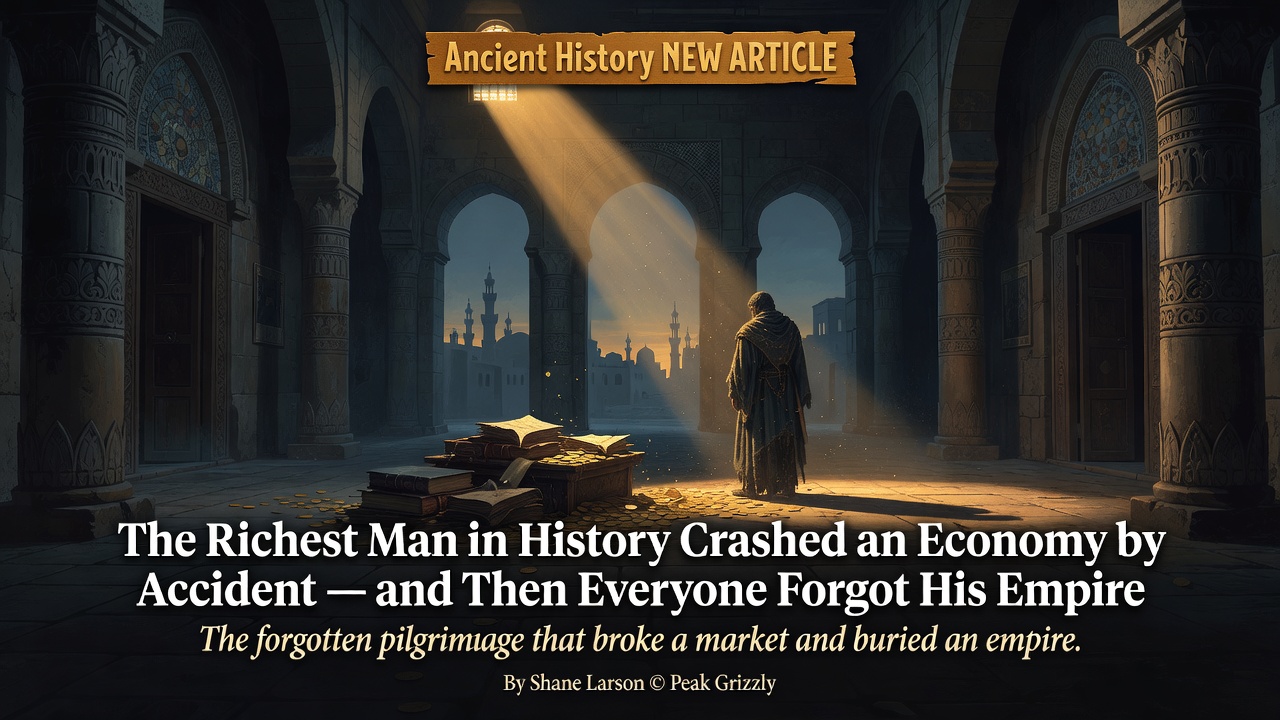
The Richest Man in History Crashed an Economy by Accident — and Then Everyone Forgot His Empire
June 2, 2026 · 6 min read
You have almost certainly seen the headline. It cycles through your feed every few months, usually attached to a graphic of robed figures and a pile of gold: the richest person in history wasn't Rockefeller, or Bezos, or some oil sheikh — it was a 14th-century African emperor named Mansa Musa, and his wealth was so vast it can't even be measured.
The headline is right about the conclusion and wrong about almost everything else. "His wealth can't be measured" is the giveaway — it's the kind of thing people say when they don't actually know the story and want to sound impressed. The real story is more specific, better documented, and far more interesting than the meme. And the most interesting part isn't how rich Mansa Musa was. It's what happened to the memory of the empire that made him rich.
The pilgrimage that dented a continent's economy
In the summer of 1324, Mansa Musa, the ninth ruler of the Empire of Mali, set out across the Sahara to perform the hajj. He did not travel light. The Arabic chroniclers who recorded the journey give numbers that have been argued over ever since — tens of thousands of attendants, servants in Persian silk, baggage camels bent under sacks of gold dust. The figures are almost certainly inflated. But the men writing them down were not inventing a fairy tale. They were straining the vocabulary they had to describe something they, or their informants, had actually watched cross their world.
When the caravan reached Cairo — then the largest and richest city in the Mediterranean world — Musa did something that turned him from a wealthy foreign king into a legend. He spent. He gave gold to the sultan's officials, to the merchants in the bazaars, to scholars and beggars and anyone who came near his lodgings at the foot of the pyramids. He gave on a scale the city had never had to absorb before.
And here is the part the meme always fumbles: Cairo's economy couldn't digest it. The price of gold in Egypt fell and stayed depressed — by the reckoning of the chroniclers, for something like twelve years. This is not magic. It's supply and demand. When you flood any market with a huge new quantity of a thing, the price of that thing drops. Musa had injected so much gold into the Egyptian economy, in gifts and spending, that he caused what an economist would now recognize as a supply shock. One man, performing an act of religious devotion, had reached across a continent and dented the economy of the richest city on the Mediterranean.
We know about this in unusual detail because about a decade later, an Egyptian official named al-Umari went looking for people who had met the West African king and wrote down what they remembered. That's the kind of source historians dream about — not a legend handed down through centuries, but the recollections of eyewitnesses, recorded while they were still alive to be asked.
The empire behind the gold
It's easy to let Mansa Musa collapse into a single dazzling image: the man on the camel, the gold raining down on Cairo. But behind that image stood something far more impressive than one rich king. It stood an empire.
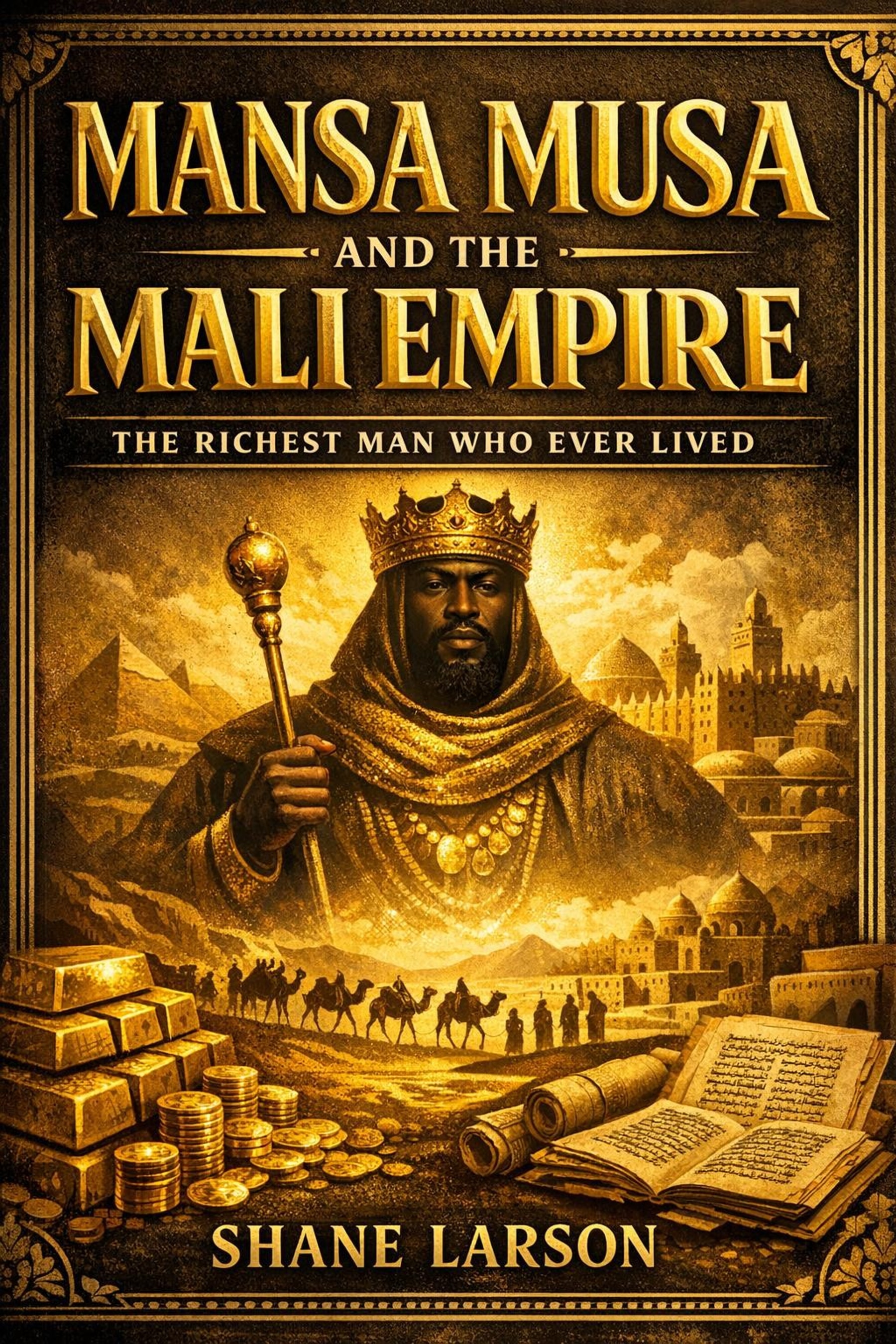
Mansa Musa and the Mali Empire
Mali at its height was larger than Western Europe. It stretched across the territory of a dozen modern nations. It controlled — or taxed — the gold fields of Bambuk and Bure, which supplied something on the order of half of all the gold circulating in the medieval Old World. That gold paid for the gold coins of Cairo and Damascus and the florins of Florence. It moved north across the desert in exchange for one of the few things the savanna couldn't produce: salt, cut into slabs in the deep Sahara and carried south, where it was worth its weight in gold.
The whole system ran on camels, on the hard-won knowledge of how to cross a sea of sand, and on trust extended across enormous distances between people who would never meet. Mali sat at the southern end of that system and grew rich by controlling more and more of it.
And the wealth bought more than spectacle. Musa brought scholars and architects back from his pilgrimage. He patronized building. Within a few generations, Timbuktu — a name that has become, in English, a synonym for the absolute middle of nowhere — was a city of mosques and madrasas and libraries, where a scholar could make a living and manuscripts were among the most valuable goods you could trade. In 1375, when a cartographer in Mallorca drew the most sophisticated map of the age, he placed a Black king on a golden throne in the middle of West Africa, a gold nugget in his hand, and labeled him the lord of the richest land in the world. He was the only sub-Saharan ruler the mapmaker chose to draw. Europe knew Mali was there. Europe knew it was rich.
So why did we forget?
Here's the question that actually drove me to write the book. If Cairo knew about Mali, and Fez knew about it, and the courts of Aragon and Portugal knew enough to paint its king on the finest map of the century — how did educated Westerners end up, a few hundred years later, sincerely believing that Africa south of the Sahara had no history at all? No states, no cities, no scholarship, nothing before Europeans arrived to write it down?
The comfortable answer is that the records were just lost, that it was an innocent gap. The honest answer is uglier. The blankness that settled over sub-Saharan Africa in the Western imagination didn't arrive by accident. It arrived alongside the Atlantic slave trade and the racial ideologies built to justify it — ideologies that required Africa to be a place without a past, so that what was being done to Africans could be told as a story without a crime. An empire that had produced Mansa Musa was an inconvenient fact. So the fact was mislaid, on purpose, and it stayed mislaid for a very long time.
The recovery of that history is its own remarkable story. The griots — the hereditary singer-historians of the Mande world — never stopped reciting the founding epic. The chronicles of Timbuktu survived in family trunks, and were smuggled to safety again as recently as 2012, when extremists occupied the city and local librarians quietly moved tens of thousands of manuscripts out from under them. Archaeologists keep digging. Historians went back to the Arabic sources and read what had been sitting there all along.
The internet meme, for all its crudeness, is a small piece of that recovery. It gets the scale wrong and the man flat. But it gets one thing right almost by accident: it insists that the richest person who ever lived was a Black African king, and it dares anyone scrolling past to argue.
That's worth more than it looks. The blank spaces on old maps were rarely empty. Mostly they were just unexamined — and sometimes they were unexamined on purpose.
Mansa Musa and the Mali Empire
New posts and releases, straight to your inbox. No spam, unsubscribe anytime.