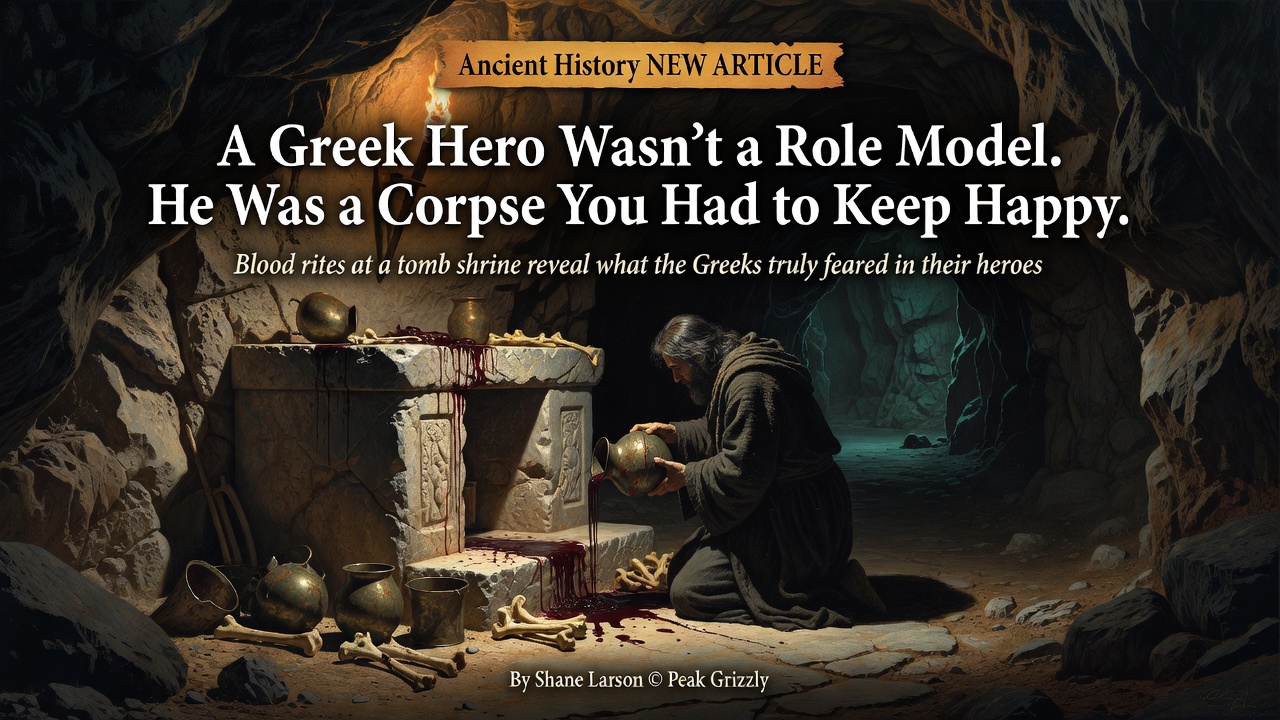
A Greek Hero Wasn't a Role Model. He Was a Corpse You Had to Keep Happy.
July 25, 2026 · 8 min read
We use the word "hero" so casually that it has almost no content left. Firefighters are heroes. Athletes are heroes. The guy who returns your wallet is a hero. Underneath all of it sits a vague inherited idea that we got from the Greeks: a hero is an exceptional person you admire and try to be like.
The Greeks would have found that idea baffling — and possibly dangerous.
To an ancient Greek, a hero was not primarily someone you admired. A hero, in the precise religious sense that governed actual practice, was a powerful dead person: a specific corpse, buried in a specific patch of local earth, who had not entirely stopped acting in the world. Heroes could bless your fields, protect your city, and heal your diseases. They could also blight your crops, poison your wells, and kill you. The point of hero cult — the offerings, the shrines, the annual rites — was not aspiration. It was management. You kept the hero happy for the same reason you keep a fire fed and contained: because the alternative was worse.
Once you understand that, an enormous amount of Greek religion snaps into focus. And one archaeological site in particular — a collapsed cave on the island of Ithaca, stuffed with a thousand years of gifts addressed to Odysseus — stops looking like a charming curiosity and starts looking like a window into a lost way of experiencing the world.
Blood Goes Down, Not Up
Start with the mechanics, because the mechanics tell you everything.
When a Greek sacrificed to an Olympian god — Zeus, Athena, Apollo — the ritual pointed up. The sacrifice happened in daylight at a raised altar. The animal's throat was turned toward the sky. The fat and bones were burned so the savor would rise to the god, and the rest of the meat was cooked and shared out among the worshippers. A sacrifice to a god was, among other things, a barbecue. You ate with the divine.
A sacrifice to a hero pointed down. It often happened at night, or in the evening. The altar was low, or was not an altar at all but a pit or a hearth dug toward the earth — because that is where the hero was. The animal's blood was not splashed against a sky-facing altar; it was poured downward, into the ground, to seep toward the dead man who wanted it. In the starkest form of the rite, the worshippers did not share the meal at all. The victim was burned whole. You do not dine with the restless dead. You feed them, and you leave.
The Greeks even used different verbs for the two acts — one word family for sacrificing to the gods above, another for making offerings to the powers below. This is not a subtle distinction that only scholars can see. It is a wall running through the middle of Greek religion, and everyone on both sides of it knew exactly which kind of transaction they were performing.
What sits on the far side of that wall is not a role model. It is something much closer to a ghost with an address.
The Hero Who Demanded a Girl a Year
If you want to feel how un-modern the Greek hero really was, there is a story preserved by the travel writer Pausanias — retold here in my own words, as all ancient sources are in my books — about the town of Temesa in southern Italy.
The story goes that when Odysseus's ship touched at Temesa, one of his crewmen got drunk and assaulted a local girl. The townspeople stoned him to death — rough justice, case closed. Except the case did not close. The dead sailor's ghost began killing the people of Temesa, indiscriminately, until the town was ready to abandon the site entirely. The oracle at Delphi told them there was only one way to survive: build the dead man a precinct and a temple, and give him, every year, the most beautiful maiden in Temesa as his bride.
The Temesans did it. According to the story, the annual tribute continued for centuries — until a famous boxer named Euthymus arrived, fell for that year's victim, armed himself, waited in the shrine, and beat the hero in a fight so thoroughly that the ghost fled into the sea and never returned.
Set aside the folktale flourishes and look at the structure, because the structure is the theology. The hero of Temesa is not virtuous — he is a criminal, killed for a crime. He receives worship anyway, and not despite his violence but because of it. His power to harm is precisely what makes him a hero in the cultic sense; the shrine and the tribute are a negotiated settlement with a hostile power. Nobody in Temesa was trying to be like him. They were trying to survive him.
That is the institution. The admirable heroes — the Achilleses and Theseuses — sat inside the same ritual frame. The dead were strong. The strong dead were local. And the local strong dead had to be dealt with.
A Thousand Years of Gifts in One Cave
Which brings us to the cave, and to the strangest documented case of hero worship in the Greek world.
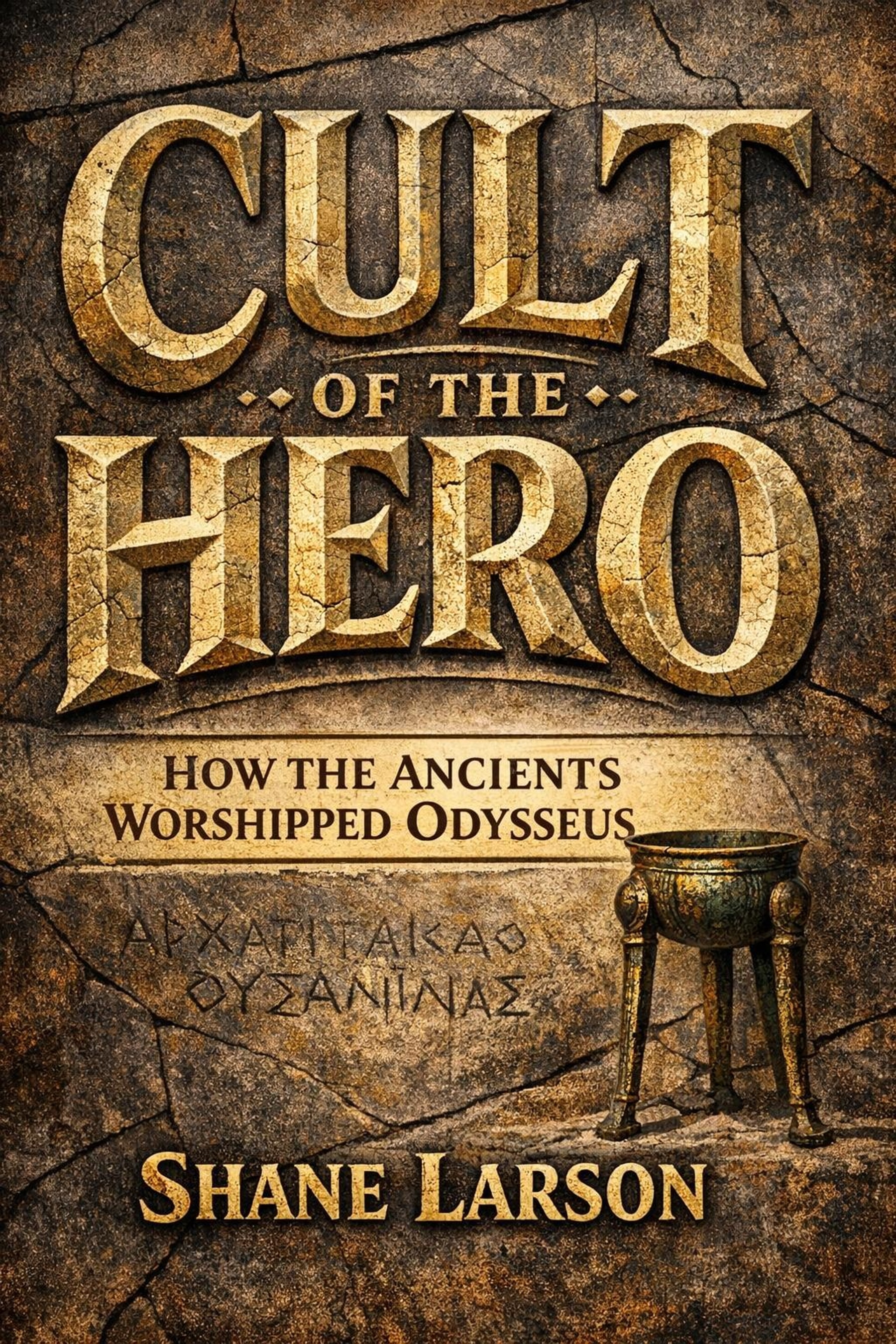
Cult of the Hero
Above a bay called Polis on the north coast of Ithaki — the small Ionian island that has carried the name Ithaca since antiquity — there was a cave. Its roof fell in long ago, and a 1953 earthquake wrecked what was left, so today it is little more than a hollow in the hillside. In the 1930s, a British archaeologist named Sylvia Benton excavated the debris on its floor. What came out of the ground has been quietly astonishing specialists ever since, while remaining almost unknown to general readers.
She found bronze — including the remains of roughly a dozen large tripod-cauldrons, the three-legged vessels that were the ultimate prestige gift of the early Greek world. Readers of the Odyssey may feel a chill here: tripods and cauldrons are exactly the treasure the poem says the Phaeacian nobles piled aboard the ship that carried Odysseus home, treasure he hid in a cave on his arrival. She found offering pottery in enormous quantities. She found figurines and other votives. And she found a broken piece of ceramic on which someone had scratched a dedication whose most natural reading makes it a gift — addressed, by name, to Odysseus.
Addressed to him. That is dedication language, the formula you use for a being capable of receiving a gift — a god, or a hero in his cultic sense. Somebody carried an object up that hill, into the dark, and handed it to a man from a poem.
And here is the detail that turns an oddity into a genuine historical problem: the deposit is not one generation's enthusiasm. The material in the cave spans from the Mycenaean Bronze Age — the world the Odyssey dimly remembers — down through the Greek Dark Ages, the Classical period, and into the Hellenistic age. Whether the cult ran genuinely unbroken across that entire span, or whether later Greeks revived the site while reaching back toward a heroic past they had partly invented, is a real scholarly fight, and an honest account has to present both readings. But under either reading, the headline fact stands: across a span of many centuries, through the collapse of one civilization and the construction of another, real people kept bringing gifts to that cave for Odysseus.
Not reading him. Not admiring him. Supplying him — the way you supply the powerful dead.
And it makes a dark kind of sense that sailors and islanders would choose this hero. Odysseus is not a glorious martyr; he is a survivor, a trickster, the man who got home. For people whose lives depended on the sea, a dead man whose entire legend was the successful return voyage was the most useful ghost imaginable. You pray to the specialist.
The Question the Cave Forces
The comfortable move is to file all this under ancient superstition and feel modern. Resist it, because the cave is asking a sharper question than "how could they believe that?"
The people who climbed to Polis Bay were not confused about what stories were. They had poetry, and they knew it was poetry. What they did not have — what they never built — is our wall between "history" (real people, real events) and "myth" (made up, therefore inert). Their legendary past was continuous with their present: it was in their genealogies, their place-names, their politics, and their soil. Athens did not "commemorate" Theseus the way we put up a statue; it sailed to the island of Skyros, dug up a set of large ancient bones, declared them Theseus, and carried them home in state to function as a working piece of civic infrastructure. The heroic dead were not remembered. They were used, feared, fed, and lived with.
Whether Odysseus ever existed is our question, and it may be unanswerable. What the cave answers is a different and arguably better question: what did it mean that the ancients worshipped him — a man who may never have lived — with pits and gifts and bronze, for something on the order of a thousand years? Answering it means reconstructing an entire lost category of religious experience, and following the evidence through some of the strangest material the ancient world left behind.
That reconstruction is what my new book does. Cult of the Hero: How the Ancients Worshipped Odysseus starts on the floor of Benton's cave and works outward — through the tripods and the scratched dedication, through the anatomy of hero cult and the eighth-century explosion of offerings at forgotten Bronze Age tombs, through the parallel cults of Achilles on the Black Sea, Menelaus and Helen at Sparta, and Theseus at Athens — to the question of how the Greeks actually thought about their own deep past. It is the third book in the Homer's World series, and it stands entirely on its own.
The Greeks kept their heroes the way you keep anything powerful and dead: close, honored, and carefully fed. It turns out that is a better story than admiration ever was.
Cult of the Hero
New posts and releases, straight to your inbox. No spam, unsubscribe anytime.