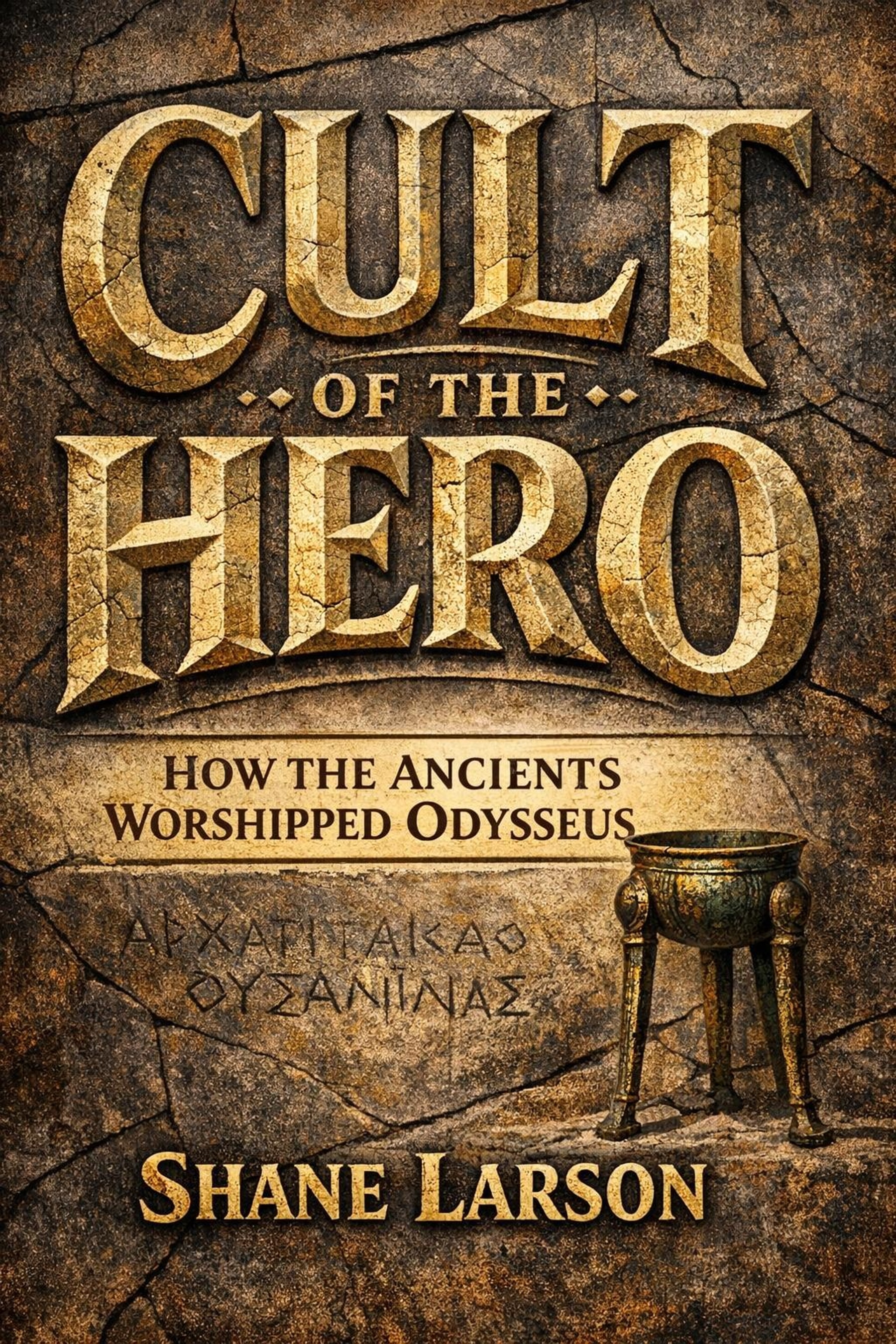
Cult of the Hero
How the Ancients Worshipped Odysseus
By Shane Larson
About This Book
Picture a man on the north coast of Ithaca, some twenty-five centuries ago, climbing a hill path above a quiet bay as the light goes off the water. He is carrying something valuable — a bronze vessel, a figurine, a jar of good oil. At the top of the path is the mouth of a cave. He goes in, sets his gift down in the dark, says whatever he came to say, and walks back down. He has not visited the grave of a father or a grandfather. The gift he just left is addressed to Odysseus.
Now change the date. Depending on which layer of the cave floor our climber stands on, this is happening while Mycenaean palaces still run the Aegean — or in the illiterate Dark Ages — or while Socrates argues in Athens — or under Alexander's successors. The same cave, the same hero, generation after generation, across a span of time longer than the entire history of English as a language.
This is not a legend about a legend. It is excavated fact, dug up in the 1930s, published, and then largely forgotten outside specialist circles. Cult of the Hero is the first book written for general readers about what that cave contains and what it means.
The dig itself is a story worth telling. Sylvia Benton, a formidable British archaeologist with the British School at Athens, spent several seasons cutting into the collapsed cavern on Ithaki. Out of the rubble came a cluster of great bronze tripods — the three-legged cauldrons that were the supreme prestige gift of the early Greek world, and, not incidentally, the very treasure the Odyssey says the Phaeacians loaded onto Odysseus's homebound ship. Out of it came votive pottery in staggering quantity spanning the Bronze Age to the Hellenistic era, and a broken piece of ceramic bearing a scratched inscription whose most natural reading names the hero himself as the recipient of a gift.
To make sense of those objects, you have to recover a lost religious category. A Greek hero, in the technical sense that governed actual worship, was not an admirable role model. He was one of the powerful dead: a specific corpse in a specific patch of local earth, capable of blessing the harvest or blighting it, honored with nighttime rites and offerings poured downward into pits rather than up to the sky-gods. Hero cult was closer to managing a haunting than to running a fan club. Once you grasp what the Greeks thought was in the ground, the cave stops being a curiosity and becomes a window into an entire way of experiencing the past.
And Ithaca was not unique. The book tests its case across the Greek map: Achilles receiving sailors' offerings on a desolate island in the Black Sea; Menelaus and Helen worshipped above Sparta at a shrine built over a genuine Bronze Age mansion; Athens staging the triumphant homecoming of bones it declared to be those of Theseus. Odysseus's cult was one instance of an institution that ran everywhere Greeks lived, one that reveals, better than any text, where the boundary between legend and real past ran for the Greeks. Which is to say: not where we put it.
What's Inside
- A full narrative reconstruction of Sylvia Benton's Polis Bay excavation — what she found, layer by layer, and why it rearranged what scholars thought they knew about Greek belief.
- The tripod problem, examined honestly. Are the cauldrons in the cave a coincidence, an echo of the poem, or evidence that Ithacans deliberately reenacted the Phaeacian gifts?
- A forensic look at the famous dedication — how a scratched inscription is dated, what it can and cannot prove, and the strongest skeptical case against the cult reading.
- The anatomy of Greek hero cult: why heroes got separate altars, nighttime rites, and blood poured into the earth, and why the local dead were feared as much as loved.
- The eighth-century explosion of tomb cult, when Greeks across the mainland began leaving offerings at Mycenaean graves whose original occupants they had completely forgotten.
- Why Odysseus, of all heroes — what a trickster-survivor and patron of sailors offered worshippers that the glorious dead of Troy could not.
- Three comparative cults in depth — Achilles at Leuke, the Menelaion at Sparta, and Theseus's bones at Athens — turning one strange cave into evidence for a whole civilization's practice.
- The Hellenistic afterlife of the cult, when scholars, kings, and civic pride gave Ithaca fresh reasons to keep its hero alive.
Why I Wrote This
I have spent most of my writing life in the rubble of the Bronze Age collapse — the Sea Peoples, the burned palaces, the world that ended around 1200 BC. Those books are about how a civilization dies. Somewhere along the way I stumbled over the Polis Bay cave in an excavation report, and it asked a question none of my collapse books could answer: what happens to a dead world's memory? Here were people bringing gifts to a hero of that vanished age for a thousand years after everything that made him was ash — through dark ages, new alphabets, new empires. That is not nostalgia. That is religion, sustained and physical and strange. The cave would not leave me alone, and eventually I stopped trying to make it. This book is what happened when I finally climbed up to look.
Frequently Asked Questions
Did the ancient Greeks really believe Odysseus was a real person?
Not in the way that question assumes. The Greeks did not sort figures into our boxes of "historical" and "fictional" — the heroic age was simply their deep past, continuous with the present through genealogy, landscape, and cult. Asking whether they "believed in" Odysseus is a bit like asking whether a medieval pilgrim "believed in" a saint whose relics healed the sick. The worship itself is our best evidence for how they actually thought.
Was the cult at Polis Bay really unbroken for a thousand years?
Honestly: that is contested, and the book does not hide it. The deposit contains material from the Mycenaean era through the Hellenistic period, but some scholars read the sequence as an eighth-century-and-later cult reaching back toward a heroic past, rather than a continuous practice. The book makes that skeptical case in full before weighing what survives it. Either reading is remarkable — a revival is, in its own way, as strange as continuity.
Do I need to read the other Homer's World books first?
No. This is the third entry in the series, but it stands completely alone. The Search for Ithaca asks where Odysseus's home was; The Real World Behind the Odyssey asks how much of the voyage was real. This one asks what ancient people themselves actually believed, and you can start here without missing anything.
Is this a retelling of the Odyssey?
No, and that is the point. The poem appears constantly, but always as evidence to be tested against the archaeology, and always paraphrased in the author's own voice rather than quoted from modern translations. This book is about the cave underneath the poem.
Does the book assume any background in Greek history or archaeology?
None. Every technical term — chthonic rite, heroön, stratigraphy — is explained in plain English on first use, and Appendix A is a field guide to the vocabulary. If you can follow a well-built detective story, you have all the preparation you need.
If You Liked This, You Might Like
- The Mycenaeans — the civilization whose ruined tombs and half-remembered kings became the raw material Greek hero cult was built from.
- Ancient Apocalypse — the collapse of c.1200 BC that turned Odysseus's world into the lost heroic age later Greeks spent centuries worshipping.
- Iron Age Dawn — the rebuilt world of the centuries after the collapse, including the eighth-century moment when tomb cult exploded across Greece.
- Gilgamesh — an older civilization's answer to the same question: how a king becomes something more than a man after death.
A poem records what one singer imagined. A cave floor records what ordinary people did in the dark, with their own hands, for a man they never met and never doubted. This book reads the floor.
The third book in the Homer's World series.
Included with Kindle Unlimited — read it free if you're a member.
New Ancient History releases and free chapters — no spam, unsubscribe anytime.