The Greeks Looked at Their Own Ancestors' Walls and Concluded Giants Built Them
August 5, 2026 · 5 min read
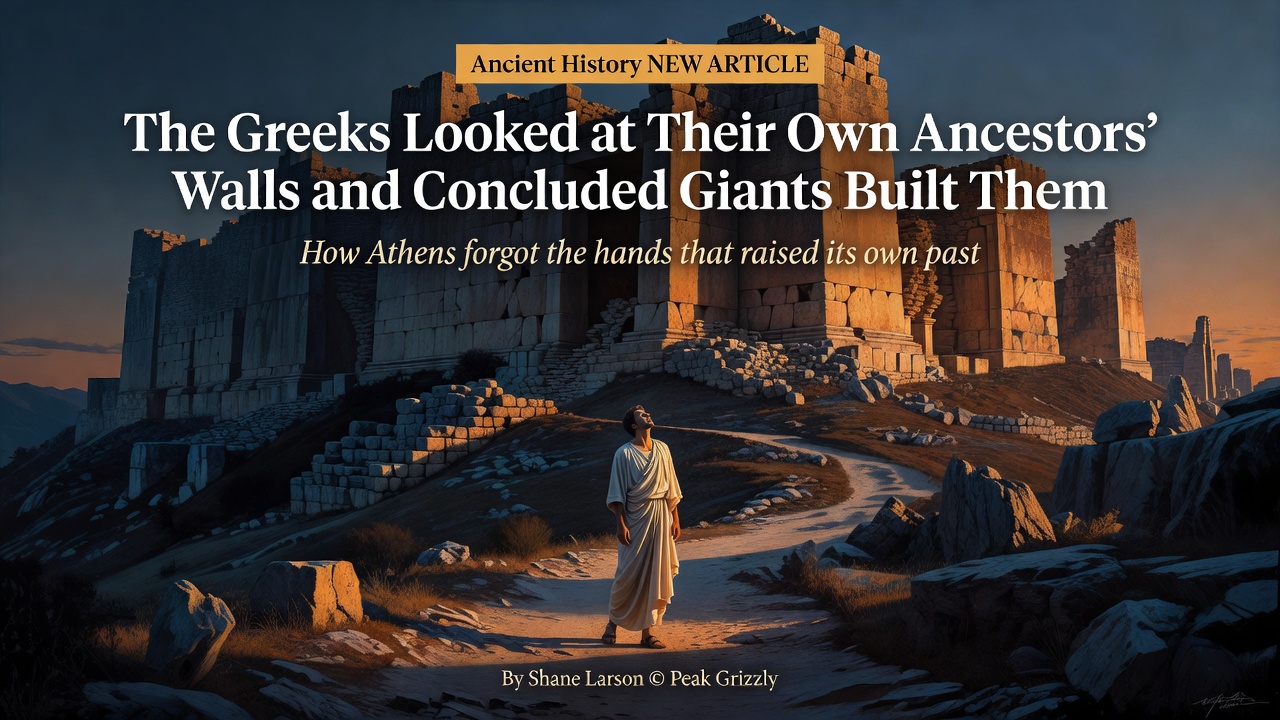
The walls of Mycenae were still standing in the fifth century BC. Anyone could walk up the hill and look at them: blocks of limestone so large that no obvious human method could account for moving them.
The Greeks of the classical period had an explanation. Giants had built them. Specifically the Cyclopes, which is why the style is still called cyclopean masonry today.
Those walls were built by their own direct ancestors, roughly seven hundred years earlier, in a civilization that spoke Greek.
They had no idea.
What a Dark Age Actually Is
The phrase gets used loosely, and the useful definition is narrow: a dark age is a period from which we have little written evidence, because the people living through it stopped writing.
For Greece, that runs from roughly 1200 BC to about 800 BC.
Before it: a literate palace civilization keeping detailed administrative records in a script we call Linear B, operating inside an international system of diplomacy and trade that reached across the eastern Mediterranean.
After it: an oral culture with no writing at all, no access to any records, and no institutional memory of what had preceded it.
The scripts did not evolve or degrade. They stopped. Linear B was a specialist technology, used by professional scribes for palace accounting, and when the palaces burned there was no longer anyone whose job it was to know it. Within a generation or two, nobody could read it. Within four centuries, nobody knew it had existed.
It was not read again until 1952, when Michael Ventris demonstrated that the language behind it was an early form of Greek — that the tablets were not some lost foreign tongue but the record-keeping of the Greeks' own predecessors.
What Survived and What Didn't
The pattern of loss is oddly specific, and it tells you something about how cultures actually remember.
What survived was narrative. The Greeks retained the stories. Troy, Mycenae, Agamemnon, a heroic age of great kings and greater wars. Oral tradition is durable — verse is structured to be memorised, and it passes down generations without institutional support.
What vanished was everything administrative. The writing system. The palace records. The knowledge of who traded with whom, and how the accounting worked, and what the political relationships were. The techniques of monumental construction, of fresco painting, of certain crafts.
Which produces the strange asymmetry of Greek historical memory: they knew about heroes and knew nothing about the society those heroes supposedly ruled. They remembered that there had been kings at Mycenae, and had no concept of the bureaucracy that made Mycenae function.
The reason is that stories are transmitted by everyone and records are maintained by institutions. Destroy the institutions and the records go immediately. The stories keep going, drifting, accumulating, and turning into myth.
The Simplification Was Real
The archaeology of the period is a study in things getting smaller.
Population fell substantially — settlements shrink, and many disappear entirely. Monumental construction stops. Imported goods largely vanish from the record, which means the trade networks are gone. Craft specialisation declines: pottery becomes simpler, metalwork less ambitious, and the range of things being produced narrows to what a village can make.
This was catastrophic for the people who had depended on the old system, and it is worth noting that it was not uniformly catastrophic for everyone. Palace economies are extractive. When the palace at the top of the hill stops existing, the people who had been feeding it keep farming, and quite a few of them are materially better off without the tax.
That is the awkward finding that runs through most collapse research: the loss of complexity is a disaster for the elite and a mixed result for the population, and the sources that survive are all written from the elite's point of view. Except here there are no sources at all, which is precisely what makes the period dark.
How It Ended
Recovery came, and the mechanism is worth knowing, because it did not involve rediscovering anything.
The Greeks did not recover Linear B. They imported a completely different system — the Phoenician alphabet, adopted around the eighth century BC and adapted by adding vowel signs.
The new system was not merely a replacement. It was structurally better for the situation Greece was in. Linear B had roughly ninety signs plus a large set of ideograms, and required professional training; it was a tool for a scribal class attached to an institution. The alphabet has around two dozen letters and can be learned by an ordinary person in a reasonable amount of time.
So literacy after the dark age was not a restoration of what had been lost. It was a different thing, distributed far more widely, no longer dependent on a palace to sustain it — and the culture that then produced Homer in written form, and philosophy, and history, and drama, was built on it.
The dark age destroyed a writing system used by accountants and produced a society where merchants, poets, and eventually ordinary citizens could write.
The Thing Worth Sitting With
Four hundred years is not very long. It is roughly the distance between us and the early 1600s.
In that span, a literate civilization with international diplomacy became a collection of villages that could not read, and then became a civilization again — one that looked at the physical remains of its own ancestors and could not conceive that people had built them.
The Parthenon and the Lion Gate are separated by less time than separates the Lion Gate from us. The Athenians who built the first had no functional memory of the people who built the second.
Whatever a culture actually knows about itself is held in institutions, and institutions are much easier to destroy than anyone expects.
The First Dark Age covers the whole period — who survived, the great simplification, the lost arts, how people actually lived, the migrations, what the Greeks forgot, the arrival of iron, the alphabet revolution, and the slow recovery.
New posts and releases, straight to your inbox. No spam, unsubscribe anytime.