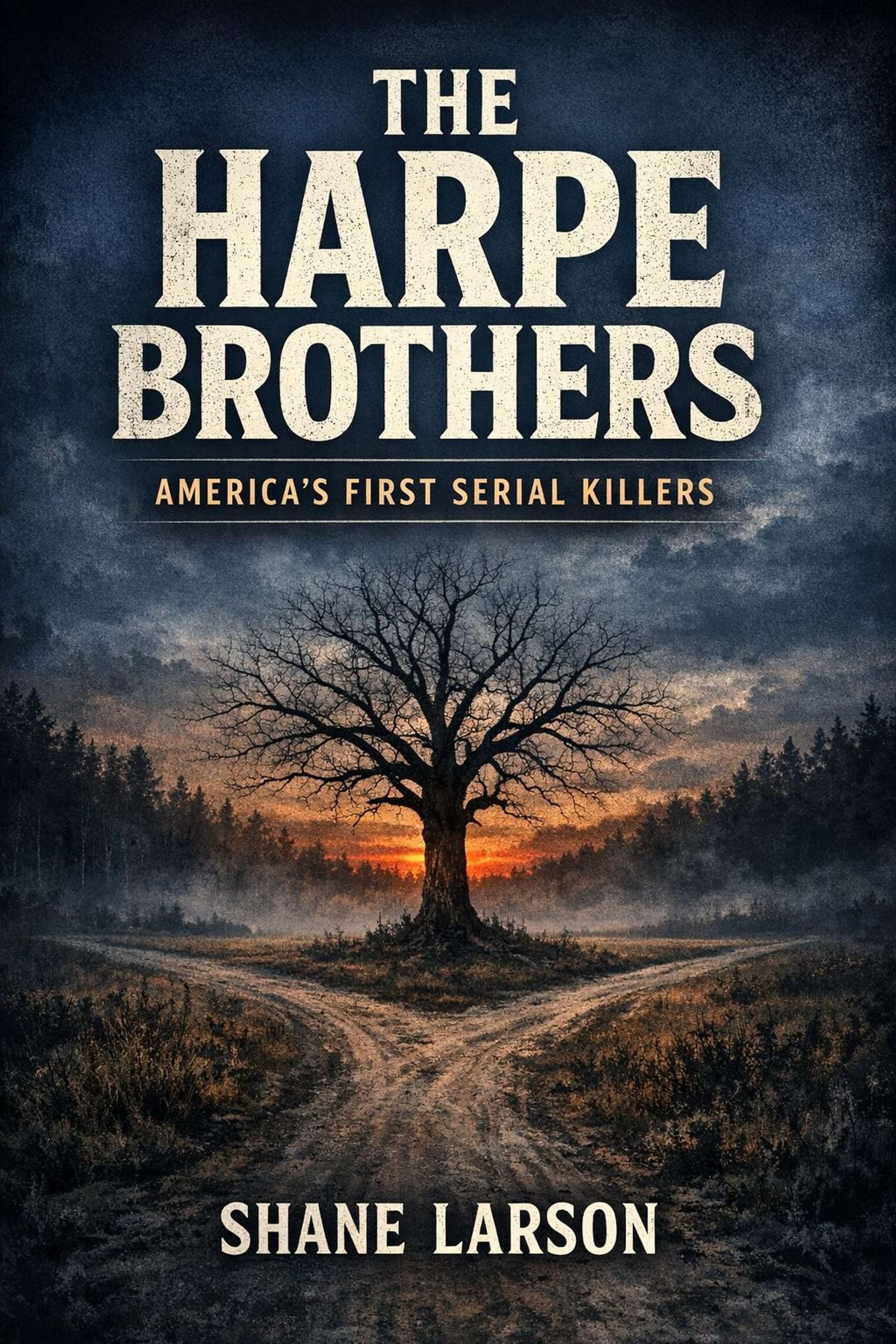
The Harpe Brothers
America's First Serial Killers
By Shane Larson · The Wild West Series (Book 25)
About This Book
The America of 1798 had no word for what was moving through its backcountry. There was no phrase for a man who killed strangers he had no quarrel with, no reason to rob, no way to profit from. There was no state police, no coroner's science, no telegraph to carry a warning ahead on the road. When two brothers began leaving bodies weighted with stones in the creeks of Kentucky and Tennessee, the settlers who found them reached for the only explanations they had — Indian raids, highway robbery, private grudges — because the truth was something the language of the frontier could not yet hold.
That truth was Micajah and Wiley Harpe. For roughly two years at the close of the 1790s, "Big" and "Little" Harpe killed their way along the Wilderness Road and the Natchez Trace in a manner that unsettled even a country long accustomed to violence. They killed for the contents of a saddlebag, and then they killed for nothing at all. They killed men who had shared their fire an hour earlier. What the record preserves is not a gang, not a rebellion, not a feud — it is a pattern of predation that later historians would recognize by a name no one in 1799 possessed.
This is the account of who they were, what they did, and how a frontier with almost no courts finally stopped them.
The Argument
The Harpes are usually remembered, when they are remembered at all, as a lurid footnote — a campfire horror story from the edge of the map. This book takes them seriously as history instead. Micajah and Wiley came out of the losing side of the Revolution, Loyalist sons stranded in a republic with no place for them, and they drifted into the ungoverned country west of the Appalachians just as the old colonial order collapsed and no new one had arrived to replace it. The violence was singular, but the conditions that let it run unchecked for two years were structural. Understanding one requires understanding the other.
The narrative follows the brothers and the three women who traveled with them out of the Carolina backcountry, into the criminal underworld of Cave-in-Rock on the Ohio River, and across a landscape where a body dropped into a river might not be found for weeks and a killer could be four counties away before anyone raised an alarm. It reconstructs the rampage as the sources support it — no more, no less — and it is honest about where they fail. Two centuries of retelling have hardened rumor into fact and multiplied the body count with every printing, and part of the work here is separating what happened from what was later said to have happened.
It ends where the frontier's patience ended: with a posse, a rifle, and a severed head wedged in the fork of a tree at a crossroads, and then, months later and hundreds of miles south, with a second reckoning on the Natchez Trace. The manner of those deaths was itself a verdict — the improvised justice of a country that had not yet built the institutions to deliver any other kind.
What's Inside
- The origins of two Loyalist outcasts and how the unhealed wreckage of the Revolution produced men with no country and no restraint on the far side of the mountains.
- The rampage of 1797 to 1799 traced route by route along the Wilderness Road and the Natchez Trace, the killings placed in sequence rather than piled up for shock.
- Cave-in-Rock and the river pirates — the organized criminal world of Samuel Mason that the Harpes joined briefly and were expelled from, too violent even for the men who robbed and murdered for a living.
- The method — knife, tomahawk, and gun, and the practice of weighting the bodies to sink them, a detail that shaped how few of the dead were ever counted, alongside the three women who rode with the brothers and whose testimony survived them.
- The hunt and the killing of Big Harpe in the Kentucky barrens, and why the man who took his head chose to display it at a crossroads.
- Little Harpe's long flight south, his years under other names, and the bounty scheme that finally exposed and hanged him.
- The problem of the record — how to weigh a two-hundred-year-old story in which the most infamous claims are also the least documented, including the killing of Big Harpe's own infant.
Why I Wrote This
I kept running into the Harpes sideways — a paragraph here, a sentence there, always in the same breathless register, always with the body count nudged a little higher than the last time. Nobody seemed interested in them as people who had actually existed in a real place at a real moment. They were a ghost story that happened to have footnotes.
That bothered me, because the actual history is stranger and harder than the legend. It sits at the exact seam where the colonial world ended and the American one had not yet begun, in a country with no functioning law at all. I wanted to know what the sources genuinely support before the embellishment sets in, and to write the brothers down soberly — to treat the dead as people rather than props. Writing about violence this extreme, the temptation is always to perform horror. I tried to do the opposite: keep the temperature low, stay with the record, and let the plain facts carry the weight they already have.
Frequently Asked Questions
Is this book a sensationalized true-crime thriller?
No, and it is deliberately built not to be. The killings were genuinely horrific, and the book does not soften them, but it handles them as documented events rather than entertainment — no invented scenes, no imagined dialogue, no lingering over suffering for effect. Where the record is thin or contested, the text says so plainly.
Were the Harpes really the first serial killers in America?
Most historians who have examined the case think so, with caveats. "First" always means first documented, and the definition matters — the Harpes killed repeatedly, across time, often without material motive, which is the pattern the modern term describes. The book explains why the label fits while staying candid about the limits of eighteenth-century records.
Do I need to have read the rest of the Wild West series first?
No. This is the earliest story chronologically in the series — decades before the gunfighters and cattle towns most people picture — and it stands completely on its own. If anything it reads as the origin point: the frontier before there was law to break.
How much of the traditional Harpe legend is actually verified?
Less than the popular retellings imply, and sorting that out is part of the book's purpose. Some episodes are well attested in court papers and contemporary accounts; others rest on a single secondhand source repeated for two centuries; the most shocking claim of all is nearly impossible to confirm. The text flags which is which rather than presenting the whole as settled fact.
Does it cover Cave-in-Rock and the river pirates?
Yes. The Harpes' brief, failed association with Samuel Mason's Cave-in-Rock operation is a full part of the story — a window into the organized frontier crime of the era, and a measure of how far outside even its norms the brothers fell.
If You Liked This, You Might Like
- The Bloody Benders — another family that killed travelers on a lonely road and vanished into legend, told with the same refusal to trade the documented record for the campfire version.
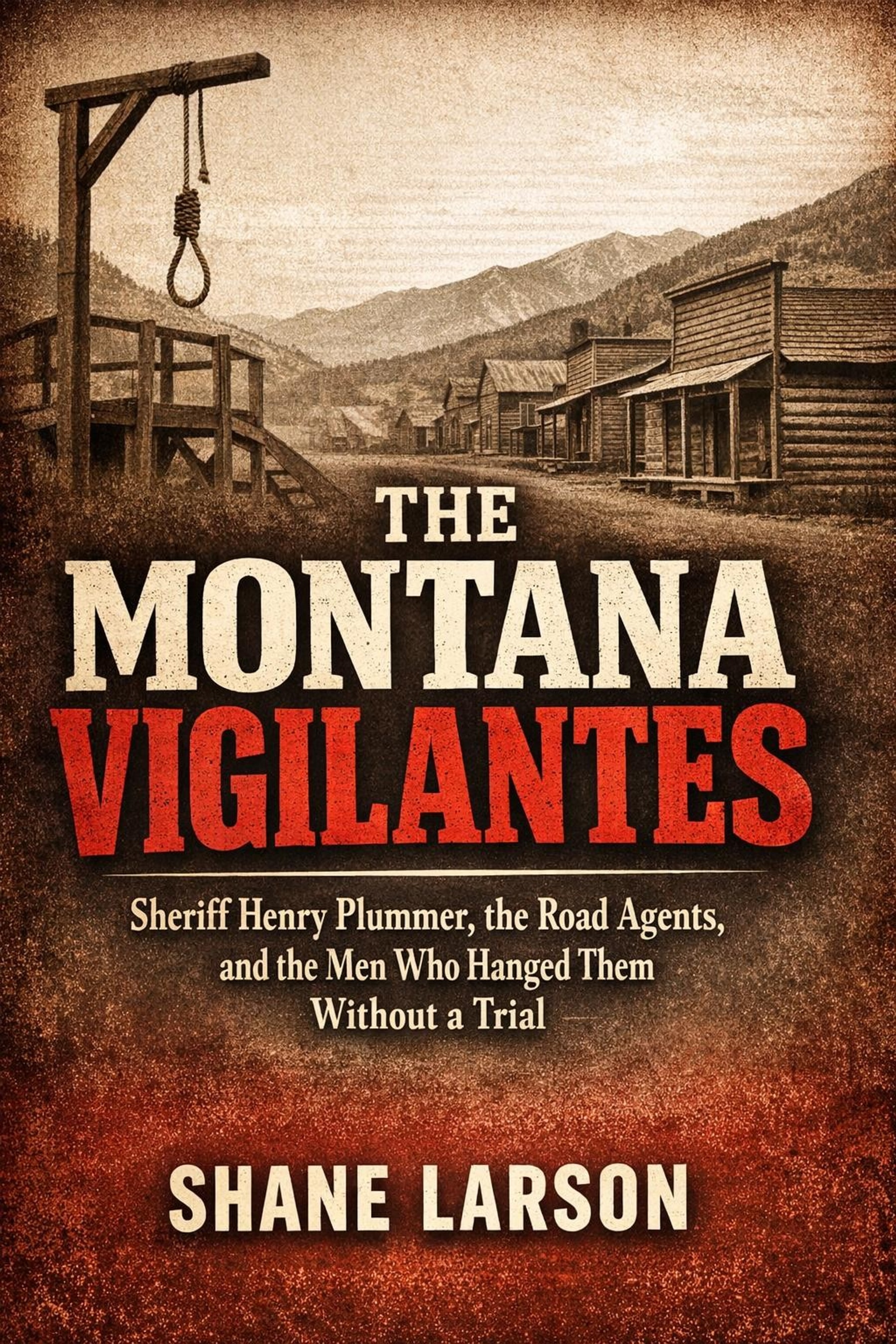
- The Montana Vigilantes — what frontier justice looked like when there were no courts to deliver it, the same improvised reckoning that ended the Harpes carried out a continent and half a century away.
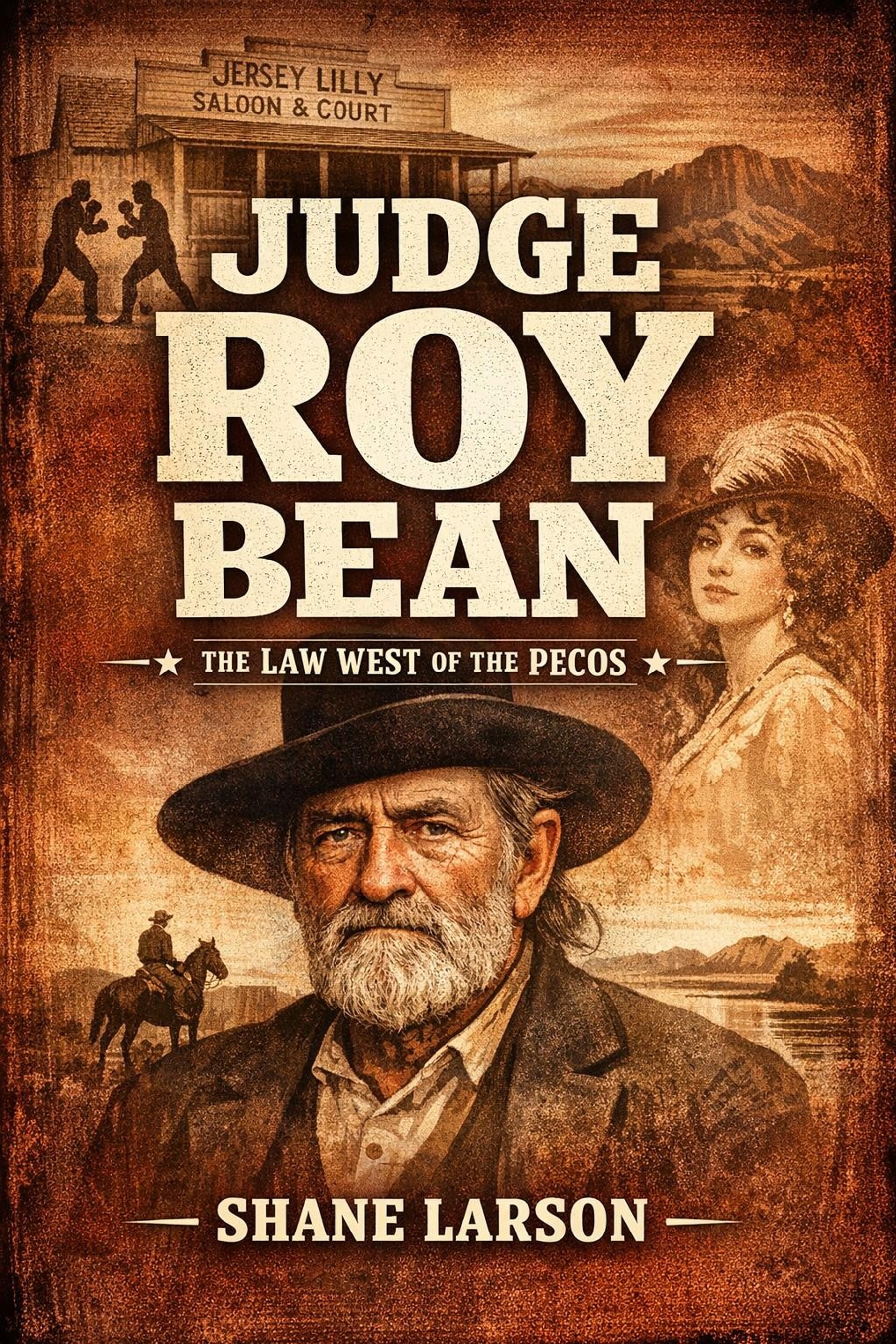
- Judge Roy Bean — the long, uneven road from the lawless country the Harpes exploited to something that could at least call itself a courtroom.
The Harpes belong to a frontier that had not yet decided what to do with men like them. This is the record of what they did, drawn as close to the sources as they allow, and of the rough justice that finally answered it.
Book 23 in the Wild West series.
New Wild West / American Frontier History releases and free chapters — no spam, unsubscribe anytime.
More in The Wild West Series
View series →