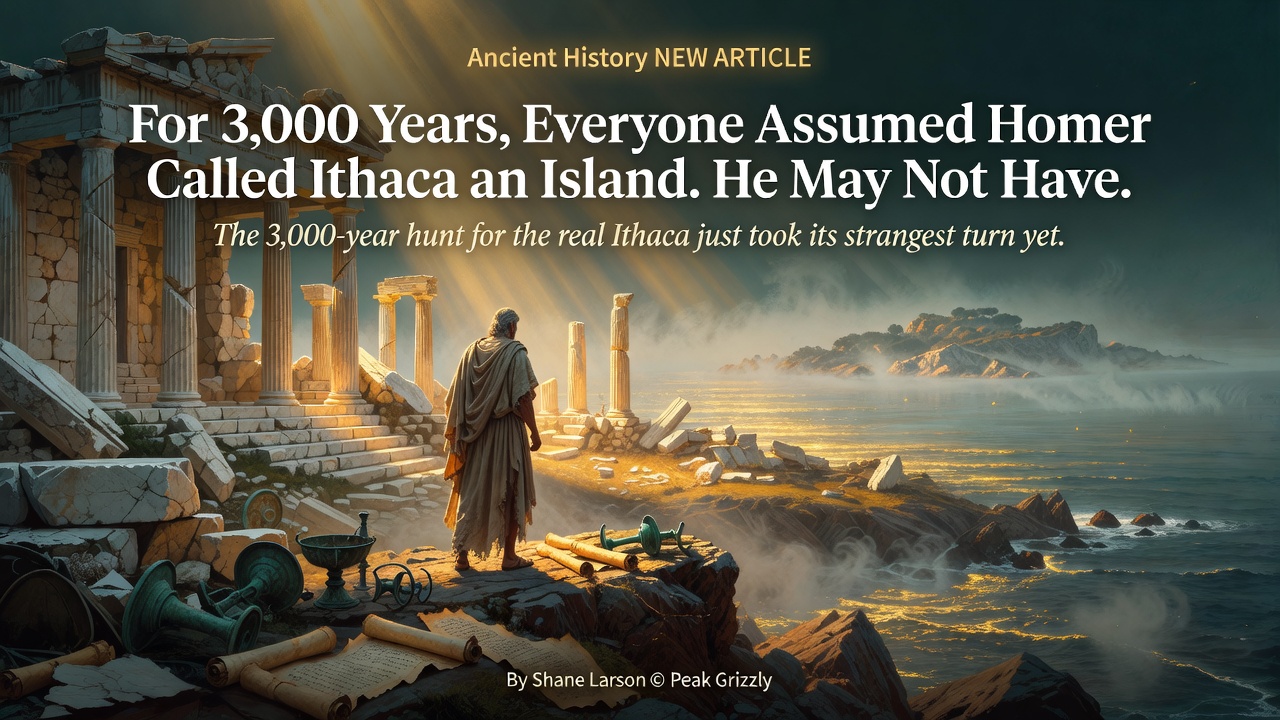
For 3,000 Years, Everyone Assumed Homer Called Ithaca an Island. He May Not Have.
July 22, 2026 · 8 min read
There is a Greek island called Ithaki. It has carried the name Ithaca for as long as anyone has kept records. Ferries run to it. There are statues of Odysseus on the waterfront and tavernas named after the Odyssey. If you want to stand on the home of the most famous homecoming in Western literature, you buy a ticket and you go.
There is only one problem, and people have been quietly pointing at it for three thousand years: the island barely matches the poem.
Homer describes Odysseus's kingdom with odd, specific detail. It is low-lying. It lies farthest out to sea, toward the dark of the west, while its neighboring islands sit back toward the dawn. That is a strange thing to invent and then repeat. And modern Ithaki fails it on the plainest reading. It is mountainous, not low. It sits behind its neighbors, tucked against Kefalonia, not thrust out past them toward the sunset. The most famous address in literature does not appear to be where the sign says it is.
This is the oldest cold case in the Western canon, and the most interesting thing about it is not that it is unsolved. It is that the assumption everyone argued from — the thing no side ever thought to question — may itself be the mistake.
The problem the ancients already noticed
We tend to imagine that doubts about Homer's geography are a modern hobby, the kind of thing that arrives with satellite maps and too much free time. They are not. The discomfort is ancient.
Strabo, the Greek geographer writing around the turn of the first millennium, knew the description and knew the island, and you can feel him working to reconcile them — reaching for explanations, stretching the words, doing the thing a careful reader does when the evidence and the map won't sit still together. He is not a skeptic trying to debunk Homer. He is a believer trying to make the furniture fit, and having to shove.
Another ancient scholar, Eratosthenes, took a harder line about the whole project of mapping the Odyssey. His famous jab was that you'll locate the sites of Odysseus's wanderings the day you find the leather-worker who stitched the bag that held the winds — his way of saying the geography is poetry, not cartography, and you are a fool to survey it. Twenty-two centuries later that remains the smartest objection anyone has raised, and the book I wrote about this argument takes it seriously rather than waving it away.
But here is what keeps the case open: Homer is not vague about Ithaca the way he is vague about the monsters and the enchantresses. The wanderings are dreamlike and unplaceable. The description of home is precise, repeated, and internally consistent. A poet who wanted to gesture at "an island, somewhere out west" does not keep specifying low-lying, farthest out, toward the dusk. That precision is either a real memory of a real place, or it is a deliberate literary construction. Either way, it is doing something, and it deserves to be read closely rather than admired from a distance.
For most of the last two centuries, reading it closely meant picking a different island. Maybe Homer meant Lefkada — that was the German archaeologist Wilhelm Dörpfeld's life's work, and he dug at Nidri to prove it, and he convinced almost no one. Maybe the tradition attached to modern Ithaki is simply older and truer than the poem's own words, and we should trust the name. Every candidate island in the Ionian lineup has a case. Every one of them also has a fatal objection. It is a police lineup where no suspect quite matches the description, and the temptation is always to force the closest one and call it done.
The businessman who reopened the file
In 2005 an outsider walked into this very old, very academic argument and blew it open.
Robert Bittlestone was not a classicist. He was a British management consultant with a serious amateur's obsession, and he noticed something the professionals, staring at the four familiar islands, had stopped seeing. If you stop demanding that Homeric Ithaca be one of the present-day islands, and instead ask which piece of this coastline actually fits "low-lying" and "farthest toward the dusk," there is a clean answer. It is the Paliki peninsula, the western thumb of Kefalonia. It is low. It is the farthest land to the west. It faces the sunset. It fits the poem where the poem has never fit before.
There is only one catch, and it is a big one: Paliki is not an island. It is joined to the rest of Kefalonia by a neck of rugged land called the Thinia isthmus.
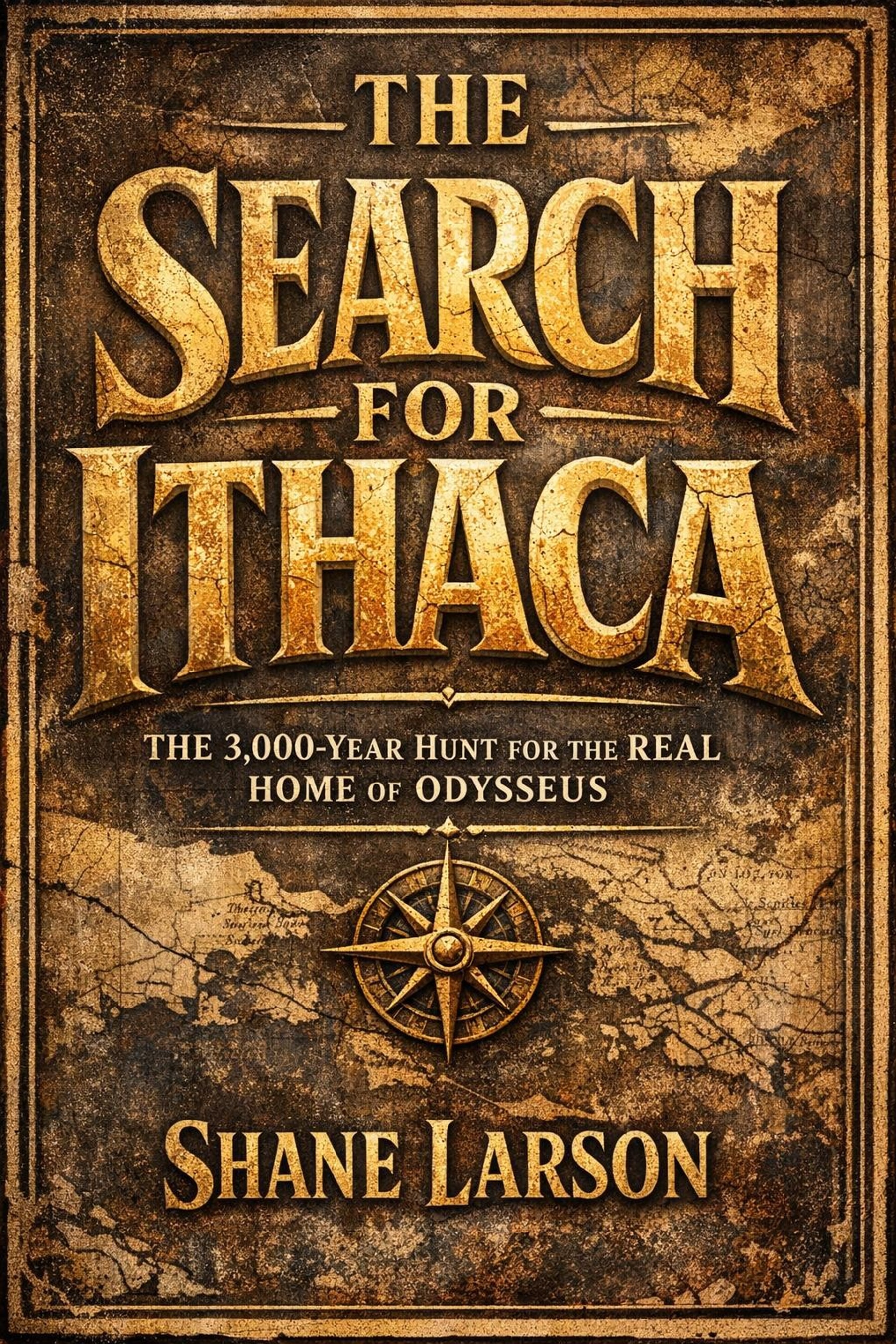
The Search for Ithaca
Bittlestone's answer was audacious enough that it should have been laughed off, except that it turned out to be testable. His claim was that Paliki used to be an island — that a marine channel once ran clean through what is now that isthmus, and that this channel was buried in the intervening three thousand years by one of the most seismically violent landscapes in Europe. Earthquakes here don't nudge the ground; they rearrange it. In 1953 a sequence of quakes flattened much of the region and visibly moved the land. Run that process across thirty centuries and the idea of a strait choked shut by collapsing rock stops sounding like a fairy tale and starts sounding like a hypothesis.
And a hypothesis is a wonderful thing, because you can go and check it. This is the moment the story stops being about literature and becomes something rarer: a poem generating a prediction about the physical world. Bittlestone enlisted a Cambridge classicist, James Diggle, to police the Greek, and a geologist, John Underhill, to police the rock. Then teams did the unglamorous work — gravity surveys, seismic lines, boreholes drilled straight down through the isthmus, hunting for the marine sediment and channel fill that a former seaway would have left behind. The cores came up. Some of what they showed was suggestive. Some stayed stubbornly ambiguous. Bittlestone died in 2015, and the project outlived him, which is its own kind of testament — a man who cared more about whether the answer was true than about being alive to be right.
I find this the most bracing part of the whole saga. It would have been so easy to treat the theory as a belief to be defended. Instead they treated it as a claim to be tested, and they published what they found either way. That is the discipline the entire subject usually lacks.
The twist nobody checked
Which brings us to the part that genuinely rearranged how I think about the whole case.
For three thousand years, every party to this argument — the ancient geographers, the Victorian excavators, Bittlestone and his drilling rigs, and every skeptic lined up against them — accepted one shared premise without inspecting it. Ithaca is an island. That was the fixed point. The entire debate was about which island, or, in Bittlestone's version, how to turn a peninsula back into an island. The islandness itself was bedrock. You don't dig up the ground you're standing on.
In 2026, Diggle and Underhill went back to that bedrock and dug.
They returned to what the poem actually says in Greek — not what centuries of English and Latin translations have made it say, but the words on the page — and asked a question so obvious it had gone unasked: does Homer ever actually call Ithaca an island in the strict sense we all assume? Or have translators, reasonably enough, been supplying that word, smoothing the Greek toward the meaning everyone already "knew" was intended?
Their argument is that the poem allows something the whole debate had ruled out at the start: an Ithaca that is not a freestanding island at all, but land joined to a larger body by a low neck — precisely the geography of Paliki, no buried channel required. If that reading holds, it doesn't just hand the trophy to one theory. It dissolves the question that everyone had been fighting over. The problem was never "which island fits the description." The problem was that we translated a premise into the poem and then spent three millennia trying to satisfy it.
I want to be careful here, because the book I wrote is careful here. This is not a triumphant "case closed." A re-reading is a new argument, not a verdict, and it has its own critics. The honest position — the one the evidence actually supports — is that the terms of the oldest question in Western literature just changed, and that the strongest case is still not the same thing as a closed case. What makes the search worth following is not that it ends. It is what it teaches you about reading anything ancient as evidence: how a shared assumption hides in plain sight, how translation quietly makes arguments for us, and how the most stubborn mystery can turn out to hinge on a word nobody thought to look up.
The oldest cold case in the canon is still open. But for the first time in three thousand years, someone reopened it by re-examining not the islands, but the sentence.
If this is the kind of question that gets under your skin — a real place, a real poem, and four independent kinds of evidence that refuse to fully agree — that is exactly the file The Search for Ithaca lays open, from Strabo's discomfort to the 2026 paper, in plain language with the verdict honestly unresolved. It is part of my Homer's World series exploring how much of the Odyssey was real, which you can find alongside my other writing at shanelarson.com.
The tour boats will keep running to Ithaki. The better souvenir is knowing what they don't tell you at the dock.
The Search for Ithaca
New posts and releases, straight to your inbox. No spam, unsubscribe anytime.