The Battle of Britain Wasn't Won by the Spitfire. It Was Won by a Telephone Network.
September 10, 2026 · 7 min read
Ask how the Battle of Britain was won and the standing answer arrives before the question is finished: the Few. Four hundred-odd young men in Spitfires and Hurricanes, outnumbered, holding the sky over southern England in the summer of 1940. The answer is not wrong. It is unfinishable. Courage was not the scarce commodity in 1940 — France had not lacked courage, and ninety thousand French soldiers had died in six weeks proving that courage by itself saves nothing. The question worth asking is what the Few were plugged into, because the thing that actually decided the battle was not an aircraft. It was a network: radar stations feeding a filter room feeding group and sector controllers feeding squadrons, tied together by dedicated telephone lines laid in peacetime by the General Post Office.
It was called the Dowding System, after the Air Chief Marshal who built it, and it was the first integrated air defence network in the world. It was authorised in 1936, rehearsed in the annual air exercises of 1938 and 1939, and finished along the threatened coasts with about four months to spare. The Luftwaffe fought it for four months and never fully understood it existed.
What Radar Could Actually Tell You in 1940
Start with what the Chain Home radar stations were not. They were not the all-seeing eye of popular memory. A Chain Home return in 1940 was an estimate — of range, bearing, height and raid size — and its errors were considerable. Height-finding was unreliable. The aerials looked out to sea and were blind inland, which is why the system needed the Observer Corps: once a raid crossed the coast, human beings with binoculars and a telephone tracked it the rest of the way. Low-level approaches could slip under the beam, which is what Chain Home Low existed to catch, imperfectly.
Germany had radar too — in some respects better radar. This matters for what comes next, because it means the British advantage was never the technology. The Germans lost an air campaign to a device they had also invented and had not thought to organise.
The Filter Room Was the Actual Invention
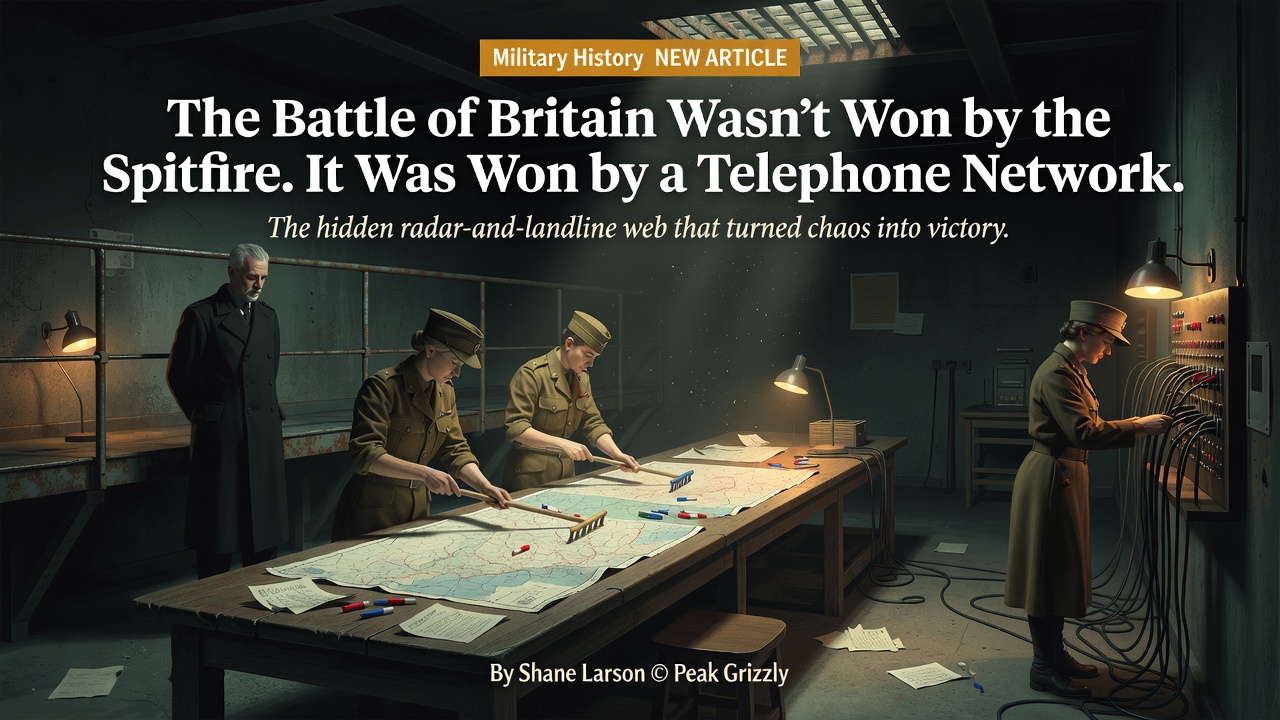
The organising happened at Bentley Priory, Fighter Command's headquarters, in a room most histories skip. Every radar station along the coast reported what it saw — and the stations overlapped, contradicted each other, and reported the same raid twice at different heights and strengths. Raw radar plots were not a picture of the battle; they were an argument about it.
The filter room's job was to reconcile those overlapping, contradictory, stale returns into a single coherent plot: one raid, one number, one track, one estimate of strength. That reconciled picture — not the radar returns themselves — went to the group and sector operations rooms, where controllers ordered squadrons onto interception courses. The whole chain ran over dedicated GPO landlines, so the information moved at the speed of a telephone call rather than the speed of a dispatch rider.
This is the part worth stating plainly: the aerials get the fame, but the filter room was the invention. Plenty of nations had radar sets by 1940. Exactly one had built the machinery for turning radar into decisions faster than the raid could fly.
Interception Instead of Patrols: the Arithmetic That Decided Everything
What did the system buy? The answer is arithmetic, and it decided the battle before a shot was fired.
A defending air force without early warning must fly standing patrols — fighters circling on the chance that something turns up. Standing patrols burn fuel, engine hours and pilots continuously, whether the enemy comes or not. A force defending that way exhausts itself in weeks.
A defending force with the Dowding System could keep its squadrons on the ground until a raid was detected, plotted and assigned, then put them where the bombers were going to be. Fighter Command spent its strength on interception, not on waiting. That is the difference between a fighter force that can fight a defensive battle for months and one that burns itself out in a month — and the Battle of Britain lasted months.
The German escorts, meanwhile, were fighting the same arithmetic in reverse. A Bf 109 over Kent carried fuel for a handful of minutes of combat before it had to turn for France. The defenders spent their endurance only when it counted; the attackers spent theirs on the commute.
The Island Holds
The Fortnight the Luftwaffe Almost Got It Right
For roughly two weeks in August 1940, the Luftwaffe attacked the radar stations. It did real damage — the station at Ventnor on the Isle of Wight was knocked off the air. Then German intelligence assessed the results, concluded the stations were difficult to destroy and not worth the effort, and the attacks stopped.
It was the single most consequential intelligence failure of the campaign. The Luftwaffe had put its hand on the one component whose loss would have blinded the whole system — and let go, because it did not understand there was a system. To the German assessment, the towers were local warning devices. That the returns fed a filter room, that the filter room fed a command network, that the network was why British fighters kept arriving in the right place at the right altitude — none of this was ever fully grasped in Berlin. The target list moved on: to the airfields and sector stations, where the fighting from 24 August to 6 September genuinely ground Fighter Command down, and then, on 7 September, to London — the fourth objective in eight weeks, each switch arriving just as the previous target was starting to crack.
Fighting a System You Cannot See
The intelligence failure compounded. Both sides over-claimed kills in the confusion of air fighting — by roughly double, on both sides, which is worth knowing the next time the newsreel figures are quoted at you. But the British were counting German wrecks on British soil, which kept their arithmetic honest enough. German intelligence had no wrecks to count and believed its own claims. By early September, Berlin's estimate had Fighter Command down to its last hundred fighters. The true figure was wrong by a factor of seven.
The counted record, assembled after the war, shows why. Fighter Command began July 1940 with around 650 serviceable single-seat fighters and ended the battle with around 730 — it lost roughly a thousand aircraft and finished stronger in machines than it started. British factories were delivering nearly five hundred fighters a month at the height of the fighting, and the Civilian Repair Organisation was returning up to two hundred rebuilt machines a month besides — an outfit so unglamorous that German intelligence never discovered it existed. The genuine shortage was pilots: 231 lost in the worst fortnight against a training output of about 260 a month. Real, rationed, dangerous — and never close to the collapse Berlin believed in. The decisive German choice of the campaign, the switch to London, was made on an estimate that was arithmetic fiction.
The Man Who Built It Was Sacked
Hugh Dowding was unpopular, uncollegiate and right. He had fought for the radar chain and the control network through the years when nobody could prove they would be needed, and the system that carried his name won the only major battle ever fought entirely in the air. He was removed from Fighter Command in November 1940, weeks after winning it, in the aftermath of a doctrinal quarrel that had run through the battle itself.
There is a colder footnote, and it is the honest test of the whole argument. When the bombers came back at night, the Dowding System did not work at all — it could not see in the dark, and no equivalent had been built for the dark. For eight months of the Blitz, the guns fired thousands of rounds for every bomber destroyed and the night fighters found almost nothing. Same country, same courage, same engineers. The only variable was whether the machinery had been finished before it was needed. By day it had been, four months early, and Britain won. By night it had not, and Britain endured. That is as close as history comes to running a controlled experiment, and it is the strongest evidence there is for what actually held the island in 1940.
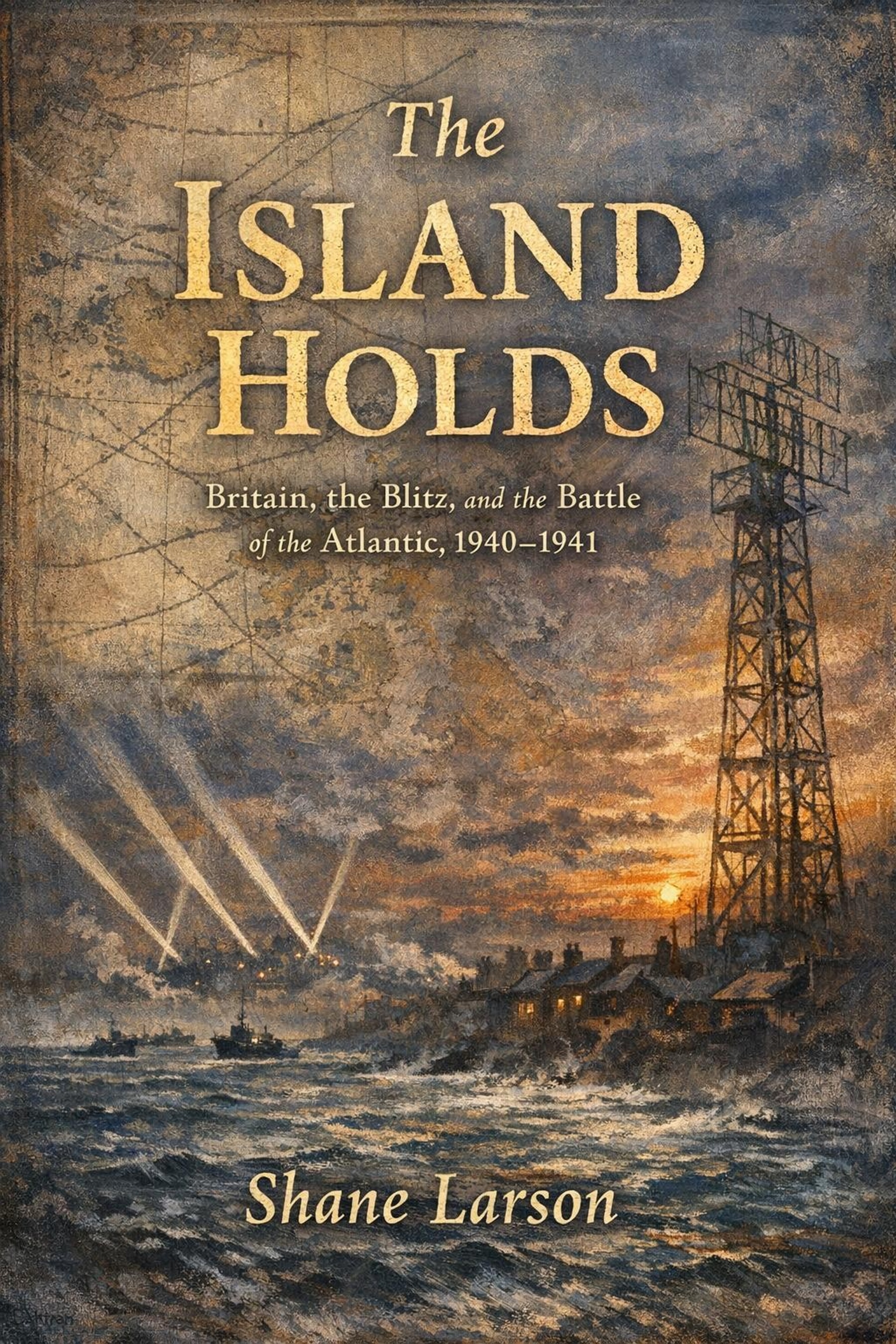
This article draws on my book The Island Holds: Britain, the Blitz, and the Battle of the Atlantic, 1940–1941, the third volume of The Second World War Chronicles. The book gives the Dowding System a full chapter and a technical appendix, does the loss-and-claims arithmetic in the open, and follows the harder story the newsreels never showed: the eight months of night bombing the defences could not stop, and the tonnage war in the Atlantic that came closer to losing the war than the air battle ever did.
The Island Holds
New posts and releases, straight to your inbox. No spam, unsubscribe anytime.