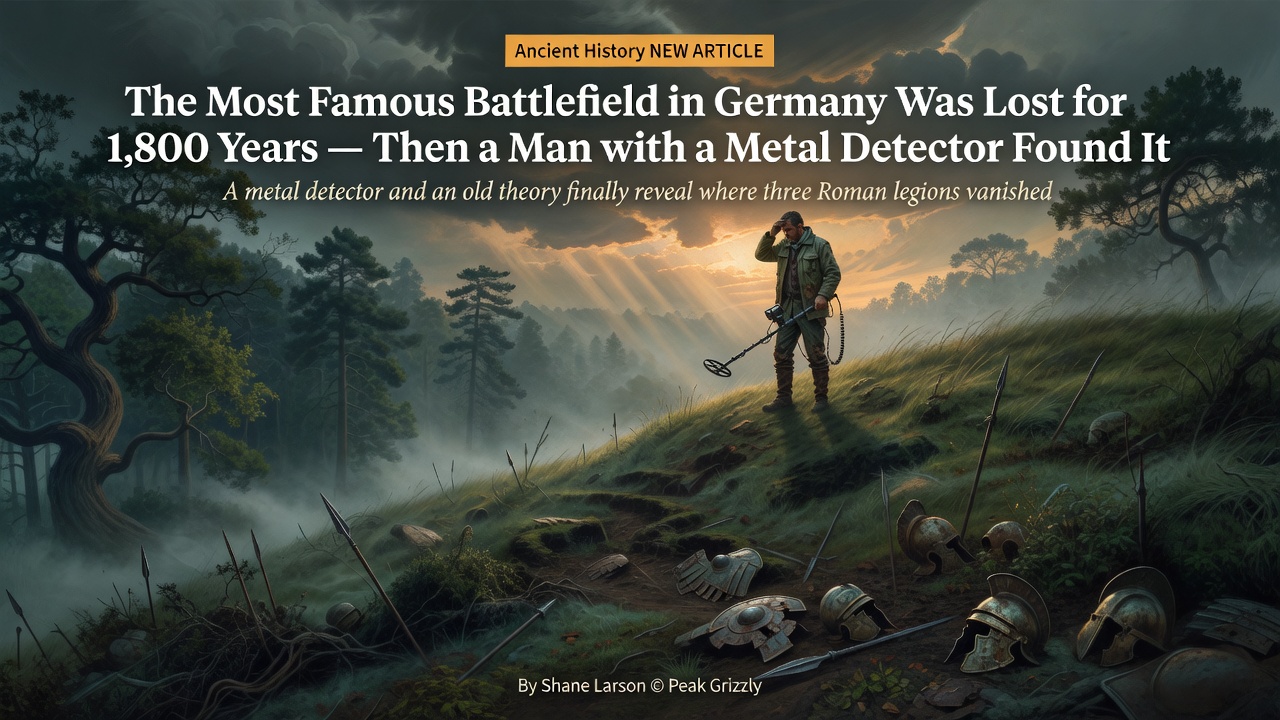
The Most Famous Battlefield in Germany Was Lost for 1,800 Years — Then a Man with a Metal Detector Found It
August 27, 2026 · 7 min read
In September of AD 9, three Roman legions were destroyed over several days of running fighting in northern Germany — the worst military disaster of Augustus's reign, and one of the worst in Roman history. Somewhere between fifteen and twenty thousand soldiers and camp followers died. The commander, Publius Quinctilius Varus, fell on his sword. Rome retired the three legion numbers permanently and pulled its frontier back to the Rhine, where it stayed for four hundred years.
And then the battlefield disappeared.
Not metaphorically. The actual location of one of the pivotal military events of European history was simply lost, and it stayed lost for eighteen hundred years. When it finally turned up again, in 1987, it was not where anyone had built the monuments — and the man who found it was not a professor. He was a serving British army officer on his time off, with a metal detector, a library card, and an unusual amount of patience.
How do you lose a battlefield?
Easily, it turns out, if nobody wants to remember it.
The Romans had no reason to memorialise a catastrophe. Six years after the disaster, the general Germanicus marched an army back to the site, found the bones of the dead still lying in the open, and buried them under a mound — which the local tribes tore down almost as soon as he left. No shrine, no marker, no map. The Romans who knew exactly where it happened wrote down almost nothing about the geography, and within a generation there was nobody left with a reason to visit.
The written record that survived is astonishingly thin. The historian Tacitus, writing about a century later, gave the place a name in a single sentence: the saltus Teutoburgiensis — the Teutoburg forest, or pass, or wooded upland; the Latin word is not even specific about which. No distances, no landmarks, no river named at the spot. Cassius Dio, writing a century after that, described the terrain — hills, ravines, dense trees, rain — in terms that could match a hundred places on the north German plain. That one phrase in Tacitus is the entire ancient locational evidence for the battle. Then the Cherusci, the tribe that led the ambush, faded out of history; the manuscript went into a monastery; and for a thousand years, nobody looked for the battlefield because nobody remembered there was one to find.
Seven hundred wrong answers
When Tacitus was rediscovered in the fifteenth century, the hunt began — and it says something about the evidence that it ran for four centuries without a winner. Scholars, antiquarians and local patriots proposed candidate sites across northern Germany; the tally of published locations eventually ran to something on the order of seven hundred. Towns competed for the distinction. Every ravine with a legend attached had its advocates.
In the nineteenth century, the search settled — by argument, not by discovery — on a wooded ridge in Westphalia that seemed to fit the sources well enough. The ridge was named the Teutoburger Wald, after Tacitus's phrase, and the identification felt so secure that in 1875 a colossal copper monument to the victorious German commander, Arminius, was raised on its summit. The name is still on the map, and the monument still stands. Note the order of operations, because it is the heart of this story: the forest is named after the battle, not the battle after the forest. The label was fixed to the landscape eighteen centuries after the event, on the strength of a scholarly argument — and, as it turned out, roughly fifty kilometres from where the evidence was actually lying in the ground.
One man got it right, and was not believed. Theodor Mommsen — the greatest Roman historian of his age, and a man who took coins seriously as evidence — looked at the reports of Roman coin finds that had been accumulating for centuries around a place called Kalkriese, near Osnabrück, north of the ridge that had just been given the famous name. The finds had a suspicious profile: a great many coins, all of them early, none later than Augustus. In 1885 Mommsen published his conclusion that the Varus battle had been fought there. The scholarly world shrugged. Coins could be explained by trade; there were no weapons, no bones, no proof. The theory went on the shelf with the other seven hundred.
Teutoburg Forest
An officer, a museum, and a hunch a century old
In 1987, Tony Clunn, a British army officer stationed in Osnabrück, wanted somewhere to pursue his hobby. He was a metal detectorist — a breed archaeologists have often had reason to distrust, because an unrecorded find is knowledge destroyed. Clunn did everything the other way around, and that is precisely why this story ends the way it does.
He read the literature first, including Mommsen's century-old, generally dismissed paper. Then, instead of striking out on his own, he went to the regional archaeologist at the Osnabrück museum, Wolfgang Schlüter, and asked where he should look. He got permission and a steer toward the Kalkriese area. He worked systematically, plotting his search areas like the officer he was. And he recorded the exact findspot of everything he recovered and reported all of it.
The first discoveries were Roman silver denarii — and then more of them, in numbers no farm loss or trade route would explain, with the same profile Mommsen had noticed a century earlier: nothing struck later than the reign of Augustus. The find that removed the ambiguity came next: lead sling bullets. Nobody trades sling ammunition. Slingshot means soldiers, and soldiers of exactly the right period, spread across quiet farmland where no battle was supposed to have happened.
Because every find had a recorded findspot, the coins and bullets were not curiosities in a shoebox — they were a distribution map, and the map said: something military happened here, over a wide area. Professional excavation began in 1989. It has not really stopped since.
What the ground said that Tacitus did not
What came out of the fields at Kalkriese did more than locate the battle. It changed the story.
The ancient accounts describe an ambush in a trackless forest — a spontaneous eruption of barbarian fury. The ground says otherwise. Along the base of the Kalkriese hill, where a corridor of firm sand narrows between the slope and what was then an enormous bog, excavators traced a turf-and-timber rampart hundreds of metres long, built before the fighting. A prepared fortification means the killing ground was chosen in advance, the labour was organised, and the attackers stood behind a wall waiting for a column they knew was coming. That is not frenzy. That is engineering — planned by somebody who understood exactly how a Roman army moved, and executed by a society the Romans insisted was incapable of planning anything.
The distribution of the finds — thousands of objects, hobnails from soldiers' boots scattered in lines across kilometres of landscape — suggests not a single defile of massacre but a long, running collapse, an army disintegrating across a broad front over days. Pits of human and animal bone, buried years after death, match the ancient report of Germanicus's soldiers gathering the exposed dead long afterward. An iron cavalry face-mask, once silvered, has become the site's emblem. And among the mule skeletons was a bronze bell that someone had carefully packed with straw and grass — a drover, on the last night, muffling his animal's bell in the hope of slipping out of the trap in the dark.
Is Kalkriese certainly the Varus battlefield? Careful people say very probably rather than certainly. A minority of scholars have argued the site could belong to the Roman campaigns of revenge a few years later, and the debate is genuinely useful — it has forced the evidence to be argued rather than assumed. But the coins, which stop at exactly the right moment, are hard to argue past. What can be said flatly is this: the ground has replaced the legend as the primary witness. For nineteen centuries, everything known about this battle came from five Roman writers, none of whom was there. Since 1987, the most reliable account has been written in slingshot, hobnails, coins and turf — because one amateur did the unglamorous things: read the old paper, asked the experts, kept records, and reported everything.
This article draws on my book Teutoburg Forest: Arminius, Varus, and the Three Legions Rome Never Got Back, which tells the full story — the Roman province Germany almost became, the insider who destroyed it, the three days of fighting reconstructed from the sources and the archaeology together, and the imperial decision afterward that fixed Europe's oldest frontier. It is part of the Rome's Enemies series, alongside Boudica.
Teutoburg Forest
New posts and releases, straight to your inbox. No spam, unsubscribe anytime.