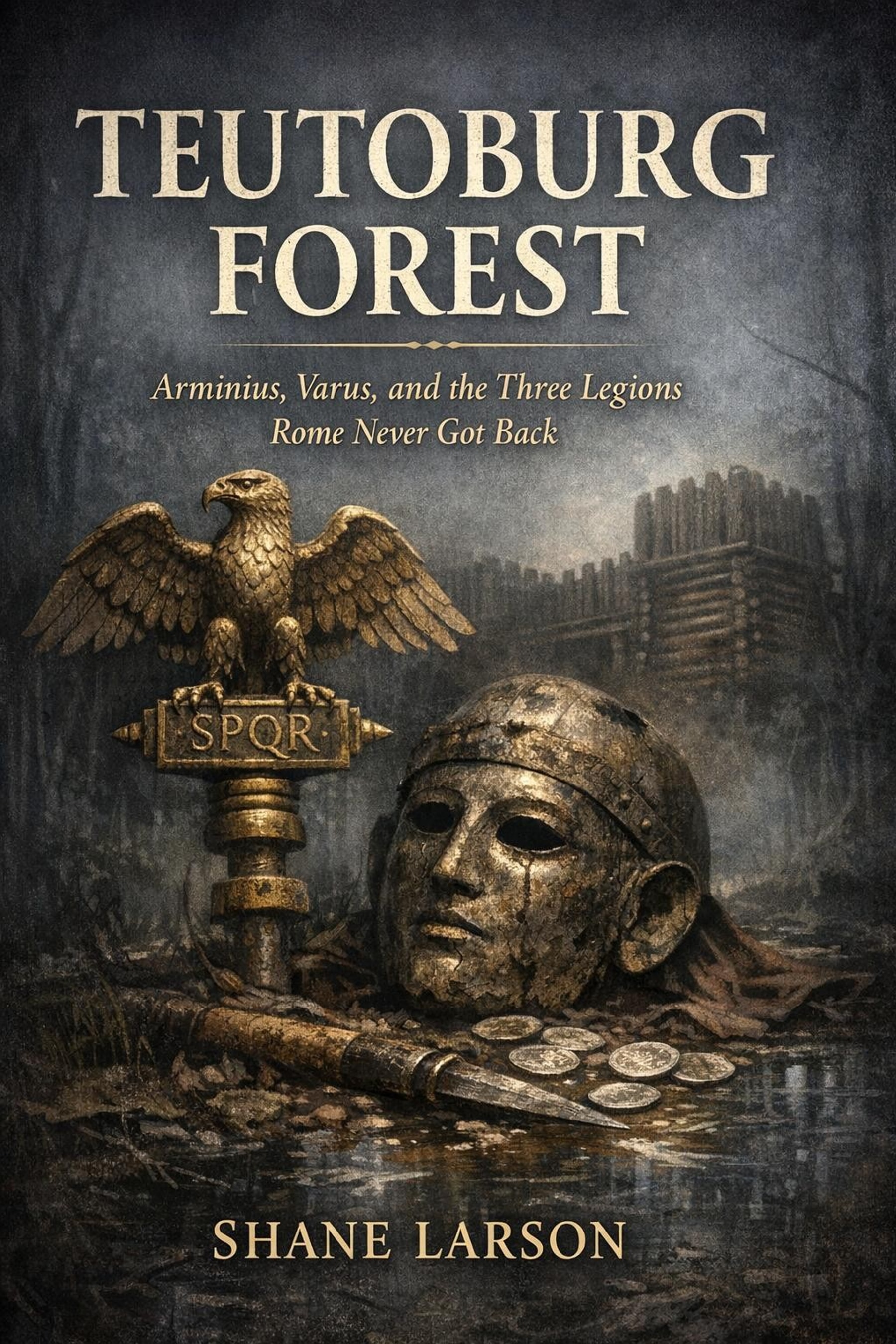
Teutoburg Forest
Arminius, Varus, and the Three Legions Rome Never Got Back
By Shane Larson
About This Book
In a museum case near Osnabrück, in northern Germany, sits a bronze mule bell stuffed with straw and grass. Two thousand years ago, on a wet night in September, somebody packed it by hand so it would not ring in the dark. The mule, its drover, and the army they belonged to were trying to walk out of a trap without making a sound. They did not make it.
The field that bell came out of has since produced thousands of Roman coins — none struck after the year the trap closed — along with lead sling bullets, soldiers' hobnails scattered in lines, an iron cavalry face-mask, and the bones of men and animals. It is the debris of one of the worst days the Roman Empire ever had: the destruction, in AD 9, of three entire legions under Publius Quinctilius Varus, caught on the march by a German tribal coalition led by a man who had been the governor's own trusted officer. Rome never used those three legion numbers again.
And here is the strangest part: for eighteen hundred years, nobody knew where that field was. The battle everyone calls the Battle of the Teutoburg Forest turned out not to have happened in the forest that carries the name.
A Province, an Insider, and a Decision
Teutoburg Forest: Arminius, Varus, and the Three Legions Rome Never Got Back tells the whole of it — the battle, the aftermath that fixed Europe's oldest frontier, and the long argument about what it meant.
It starts by correcting the usual frame. Rome was not raiding Germany in AD 9; it was annexing it, and had been for twenty years. There were forts strung along the river Lippe, tax registers being drawn up, a governor hearing court cases like a circuit judge — and, forty miles east of the Rhine, a purpose-built town at Waldgirmes with a street grid, a forum, and a gilded bronze statue of the emperor on horseback. Nobody erects gilded statues in territory they intend to leave. Germania was becoming a province, which is what makes what happened next structural rather than merely bloody.
The man who ended it, the Romans called Arminius: a nobleman of the Cherusci, a Roman citizen, an equestrian, and a decorated commander of auxiliary cavalry. He turned everything Rome taught him against it — how a column strings out on the march, where the baggage rides, how long a line takes to form — and chose ground where none of it could be done. Not one word about him survives from his own side. The book treats that silence as a subject in its own right, laying out what can be documented, naming the possible motives, and declining to invent the rest.
Then it makes its central argument. The ambush was not what redrew the map. Rome absorbed the loss, held the Rhine, and spent six years proving under Germanicus that its armies could still beat German coalitions in the open. What changed Europe was a decision taken in Rome in AD 16, when Tiberius weighed the cost of holding a province of forest and subsistence farms against what it could ever pay back — and chose the river. The frontier that resulted lasted four hundred years, and the boundary between the Romance and Germanic languages still runs roughly along it. The ambush was the occasion. The decision was the change.
Why I Wrote This
I had already written about this battle twice, compressed into a few pages each time, and it kept bothering me on the way past. What finally hooked me was not the ambush — it was the well at Waldgirmes. Settlers walking away from a Roman town took the time to cut a gilded statue of Augustus apart and throw the pieces down a shaft, and that gesture says more about what was lost in AD 9 than any casualty figure. The other pull was how much of the standard story turns out to be guesswork wearing a toga. The site was wrong for eighteen centuries. The "ambush" was a prepared position. Even the hero's famous name is a sixteenth-century invention. I wanted to write the version that tells you, sentence by sentence, which parts are evidence and which are reconstruction — because here, the honest version is also the better one.
Frequently Asked Questions
Has the real site of the Battle of the Teutoburg Forest been found?
Very probably — and the book is careful about that phrase. Since 1987, excavations at Kalkriese have produced a battlefield's worth of Roman military debris, coin evidence pointing at exactly the right years, and a rampart built before the fighting. Some scholars argue the finds could belong to the later Germanicus campaigns; the book lays out both cases and gives a labelled verdict — a strong probability, not a certainty.
Was Arminius's real name Hermann?
No. "Arminius" is the Latin name the Romans recorded; his own people wrote nothing down, so we do not know what he was called at home. "Hermann" is a sixteenth-century scholarly guess, made fourteen centuries after his death, that stuck. The book covers how that renaming happened and uses Arminius throughout.
Do I need any background in Roman history to read this?
None. The book assumes no prior knowledge and no Latin, and an appendix on the Roman army of AD 9 explains exactly what a legion could and could not do — which turns out to be the key to the whole battle.
Is this mainly a battle narrative, or a wider history?
Both, deliberately. The three days of fighting get the middle of the book at full detail, framed by the twenty-year annexation before it, the imperial decision after it, and the two-thousand-year argument since.
Is this book part of a series?
Yes — it belongs to the Rome's Enemies line, and it pairs naturally with Boudica: two revolts, two leaders who exist only in the words of their enemies, two very different Roman responses. Each book stands on its own.
If You Liked This, You Might Like
- Boudica — the closest companion to this book: another revolt led by a figure known only through hostile Roman sources, and a rebellion Rome answered by staying rather than leaving.
- Augustus — the disaster in Germany landed on this emperor's desk in the last years of his life; here is the whole reign the three legions were lost defending.
- The Julio-Claudians — Tiberius, Germanicus and the dynasty that inherited the German question and decided to close the account.
- The Height of Empire — what the frontier fixed in AD 16 looked like a century on, when the line this book ends with had become the spine of the Roman world.
- The Sassanids — the same series, the opposite frontier: while the river line this book ends with held for four centuries, Rome's eastern rival captured an emperor alive and fought the empire to mutual exhaustion.
The legions marched into the trees, the empire stopped at the river — and this is the whole story, told at the pace of the evidence. Part of the Rome's Enemies series from Peak Grizzly Publishing.
What You'll Learn
- Waldgirmes, the Roman town whose settlers cut a gilded bronze horseman apart and dropped the pieces down a well as they abandoned it — physical proof that a real province was lost.
- Varus reconsidered: a competent governor turned into a scapegoat, and why Rome needed the disaster to be one man's fault.
- The three days themselves, told at walking pace — why a legion in column on a wet forest track was a queue rather than an army, and how each collapse followed from the one before.
- The turf-and-timber wall at Kalkriese, built along a hillside before the fighting began. A prepared fortification means the ground was chosen and the labour organised in advance — engineering, not frenzy.
- Aliso, the fort that held out under siege and broke through the German lines by night — the one clear Roman success of the disaster, and the part almost every retelling omits.
- Germanicus's six years of vengeance: eight legions, a fleet of a thousand ships, two recovered eagles, an army burying the bones of the dead — victories that held nothing.
- The withdrawal examined as arithmetic, and the counterfactual asked seriously: what a Roman Germania would have cost, and how much one battle can honestly be said to have decided.
- The eighteen-hundred-year search for the battlefield, from seven hundred wrong guesses to the off-duty British officer whose metal detector ended the search in 1987 — and what the ground says that the Roman historians did not.
Included with Kindle Unlimited — read it free if you're a member.
New Ancient History releases and free chapters — no spam, unsubscribe anytime.