How Do You Decipher an Unknown Script? The Method That Cracked Linear B
August 27, 2026 · 7 min read
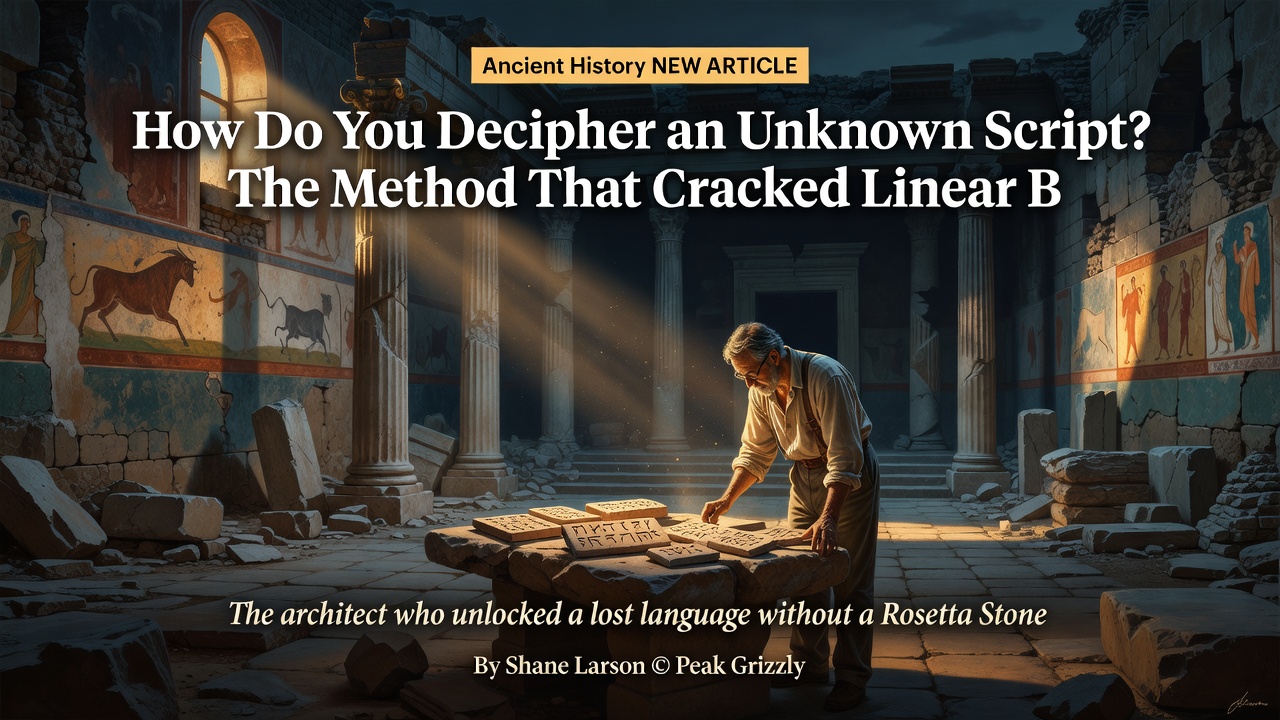
In the summer of 1952, a thirty-year-old architect went on BBC radio and announced that he could read a script that had defeated professional scholarship for fifty-two years. Michael Ventris had no doctorate, no academic post, and none of the things decipherers are supposed to need. Champollion had the Rosetta Stone, with its Greek translation. Linear B — the script Arthur Evans dug out of the burned palace at Knossos in 1900 — had no bilingual text, no known cousin language, and no living tradition of any kind. It was a locked room with no door, and Ventris opened it anyway.
How is that possible, even in principle? How do you read a script when there is nothing to read it against?
The answer is a method, and the method is worth knowing, because the world is full of scripts that have not been cracked — Linear A, the Phaistos Disc, the Indus signs, the Voynich manuscript — and fuller still of people announcing that they have cracked them. Once you understand how Linear B actually fell, you can judge every one of those claims for yourself.
Why guessing fails, every time
The obvious approach is to guess the language and work backward: assume the tablets are Etruscan, or Hittite, or Basque, assign sound values that produce words in your chosen language, and declare victory when a few of them seem to fit. Between 1900 and 1952 this was tried with nearly every language available, and it failed identically every time. A syllabic script with a corpus of thousands of words is a rich enough system that a motivated researcher can always torture a few plausible-looking matches out of it. Several of the guessers were eminent; their problem was that a method which can find your answer in any data has not found anything. Ventris himself spent a dozen years publicly convinced the language was related to Etruscan. The reason he succeeded anyway is that his working method never depended on that belief being true — and when his own results contradicted it, he dropped it.
The real method runs in the opposite direction. You do not start by asking what the words mean. You start by asking how the signs behave.
Step one: count before you read
The first thing an unknown script tells you, before you can read a word of it, is what kind of writing system it is — and it tells you through arithmetic. Count the distinct signs. An alphabet, which needs a sign per sound, runs somewhere in the twenties or thirties. A logographic system like Chinese, which needs a sign per word, runs into the thousands. A syllabary — a sign for each syllable, ka, ke, ki, ko, ku — lands in between, roughly fifty to a hundred.
Linear B has about ninety recurring signs. That single number rules out an alphabet and rules out a purely logographic system. The script had to be a syllabary, meaning every sign carries a consonant-plus-vowel package — the structural fact the whole decipherment stands on. The tablets also carry a second system, pictorial ideograms for commodities, which told investigators what the documents were about — livestock, cloth, chariots, people — without surrendering a single word of the language. Inventory lists, clearly. In what tongue, nobody could say.
Step two: find the structure
The decisive work here was done by Alice Kober, a classicist at Brooklyn College who spent the 1940s building a hand-made database of the script on index slips cut from scrap paper during wartime rationing — a file that grew to roughly 180,000 slips. Certain words, she noticed, appeared in the tablets in three slightly different forms: the beginning held steady while the final signs changed in consistent, repeating patterns. Her triplets were the proof that the hidden language inflected — its words changed their endings to do grammatical work, the way Latin and Greek words do.
Then she pushed one step further, and this is the beautiful part. In a syllabary, a sign bundles a consonant with a vowel. So when an inflected word swaps one ending for another, the sign at the join does something predictable: it keeps the stem's final consonant but takes the new ending's vowel. Tracking those alternations, Kober could prove that two signs shared a consonant, or shared a vowel, without knowing what any consonant or vowel was. She had extracted relationships between pure unknowns. She died of cancer in 1950, at forty-three, two years short of seeing where that led.
Linear B
Step three: build the grid
Where it led was the grid. Ventris took the co-occurrence logic Kober had established, applied it across the whole sign inventory, and arranged the results in a table: every sign in a column shares a consonant, every sign in a row shares a vowel — with not one sound value assigned anywhere. It is a map of the language's skeleton, drawn entirely from internal pattern. He circulated the work openly as he went — twenty Work Notes mailed at his own expense to scholars on three continents. By early 1952 the grid held dozens of signs in fixed relationships, like a crossword with the letters still blank.
The grid has a remarkable property: it is all-or-nothing. Pin down even a few signs correctly, and it propagates the values through every row and column at once. Pin them down wrongly, and the propagation collapses into gibberish immediately. The grid cannot be fooled a little.
Step four: the crowbar of proper names
So where do the first sound values come from? From the one category of word that survives translation: names. Places keep their names across languages — and the tablets from Knossos ought to contain Cretan place names. Ventris noticed a handful of sign groups that appeared at Knossos but not at Pylos on the mainland — good candidates for local place names — and tried an experiment. Suppose one of them was Amnisos, the harbor town near Knossos. That guess forces values onto its signs; the grid propagates them through whole rows and columns; and the propagated values either produce recognizable words elsewhere or they do not. They did: out came ko-no-so — Knossos — and tu-ri-so — Tulissos — place names he had not assumed, generated by the machinery. It is how Champollion had used the royal names in cartouches to crack the hieroglyphs. Names are the crowbar; the grid is what turns one pried-open board into the whole door.
Then came the shock. The ordinary words emerging around the place names — words for totals, for boys and girls in the personnel lists — were not Etruscan. They behaved like Greek: an archaic Greek, six centuries older than Greek was supposed to exist in writing, and the one answer Evans's whole school of thought had ruled out. Ventris tested it, watched it keep working, abandoned his own decade-old theory, and announced the result.
Step five: predict something you have not seen
What separates a decipherment from a delusion is the last step: the solution has to work on evidence the solver never touched. In 1952 Carl Blegen's excavation at Pylos brought up a fresh tablet, unseen during the decipherment. Reading it with Ventris's values produced Greek words for tripod cauldrons and for jars described by their number of handles — and beside each entry stood the ideograms: little pictures of tripods, and of jars with exactly that many handles drawn on them. The sound values, worked out with no reference to this tablet, had predicted its pictures. That is confirmation no ingenuity can fake, and it is the moment the field surrendered.
The test you can carry
Compress the story and you get a checklist that works on any claimed decipherment you will ever meet:
- Did structure come before meaning? A real method counts, maps, and grids before it translates. A claim that opens with "assume the language is X" has already failed.
- Is the corpus big enough to check? Linear B offered thousands of documents from multiple sites. The Phaistos Disc is one object; the average Indus inscription is a few signs long. On corpora that small, no proposed solution can be tested against enough independent text to fail — which means it also cannot succeed.
- Do the values propagate? Genuine sound values force readings everywhere they appear, not just in the showcase examples.
- Can anyone else drive it? Ventris published his method in real time; others applied it and got his results. A decipherment that produces readings only in its author's hands is not a decipherment.
- Has it predicted anything? The tripod-tablet standard. Until a claimed solution reads evidence its solver never saw, it is a hypothesis at best.
Hold the Voynich manuscript's annual "solutions" against that list and you will see why none has stood. Hold Linear B against it and you will see why, seventy years on, no serious person doubts it.
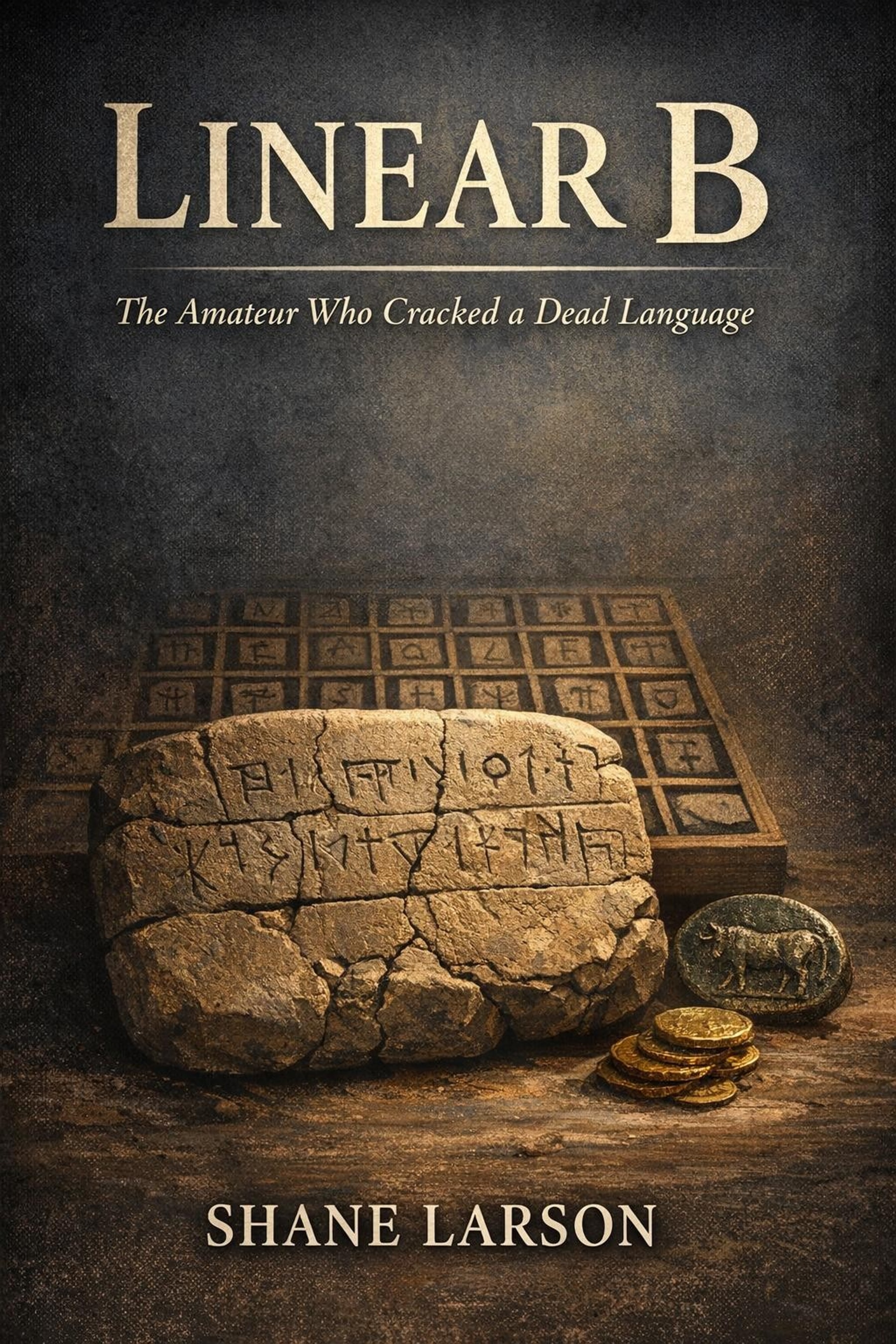
I ended up spending a book on this story — Linear B: The Amateur Who Cracked a Dead Language, which follows Evans, Kober, and Ventris from the tablets' discovery to the broadcast, the proof, and the palace world they turned out to describe. But the method travels free of the book, and it is worth keeping: structure before meaning, names as the crowbar, prediction as the proof. That is how a locked room with no door gets opened — and why most of the rooms are still locked.
Linear B
New posts and releases, straight to your inbox. No spam, unsubscribe anytime.