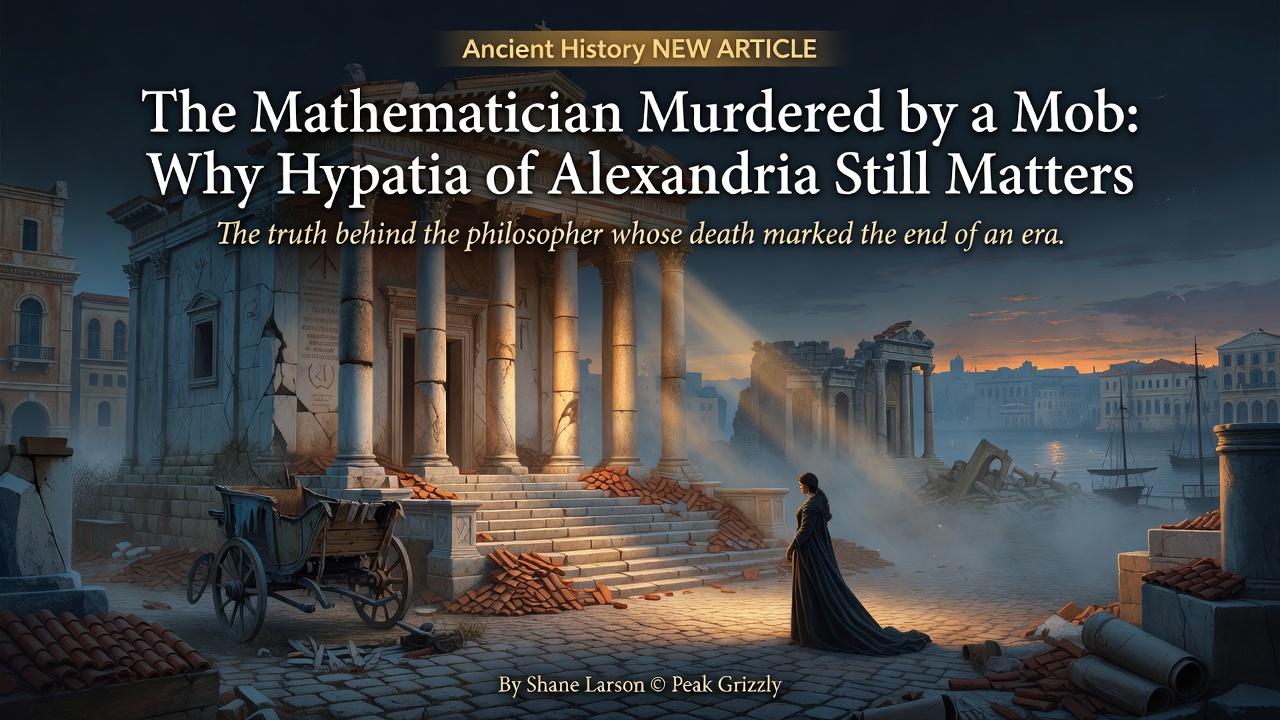
The Mathematician Murdered by a Mob: Why Hypatia of Alexandria Still Matters
June 26, 2026 · 10 min read
In March of 415, a woman in her early sixties was riding home through the streets of Alexandria when a Christian mob pulled her from her chariot, dragged her into a former Roman temple that had been converted into a Christian church, stripped her, and beat her to death with broken roof tiles. They tore her body apart. They carried what was left to a place outside the city called Cinaron and burned it on a pyre.
The woman's name was Hypatia. She was the head of the Neoplatonic school in Alexandria — a mathematician whose commentaries on Apollonius of Perga and Diophantus of Alexandria were studied across the Mediterranean, an astronomer who refined the design of the astrolabe, and the most respected public intellectual in what had been, for seven centuries, the greatest learning city in the ancient world. She was also the trusted advisor of the Roman governor of Egypt, a Christian himself named Orestes, who was locked in a political struggle with the rising patriarch of Alexandria, a man named Cyril.
Hypatia's murder was not random. The mob that killed her had been organized by Cyril's allies. The killing was deliberate, public, and politically motivated. Cyril went on to become the dominant theological voice in eastern Christianity and was eventually canonized as a saint by both the Roman Catholic and Coptic Orthodox churches. No one was ever criminally punished for the murder.
If you have heard of Hypatia at all, you have probably heard her story as a romance. The Enlightenment invented the romance: Hypatia as the last philosopher of the classical world, killed by religious fanaticism, her death marking the end of ancient learning and the beginning of the Dark Ages. There is enough truth in this version to keep it useful, but there is also enough untruth to make it a poor guide to what actually happened. The historical Hypatia is more interesting than the romance, and the actual fifth century is more complicated than the polemic on either side has wanted it to be.
What She Actually Did
Start with what she actually taught. Hypatia was a Neoplatonist philosopher in the Alexandrian tradition, which means she worked within a specific philosophical lineage that ran from Plotinus (third century CE) through Porphyry and Iamblichus and into her own time. The Alexandrian Neoplatonist school differed from its sister school in Athens: it was more focused on mathematics and logic, less focused on ritual practice, more open to Christian students who were willing to engage with philosophical content without committing to pagan religious observance.
Her teaching covered the full curriculum of late-antique higher education: Euclid's Elements, Apollonius's Conics (the geometry of conic sections), Diophantus's Arithmetica (number theory and what would later be called algebra), Ptolemy's Almagest (mathematical astronomy), the Plato dialogues in the Neoplatonist order of reading, and the commentaries of Plotinus and his successors. Her father Theon had edited the standard ancient text of Euclid; that edition was the version that came down through Byzantine and Islamic transmission to medieval Europe and was the basis for every Renaissance and early modern geometry course. The mathematical inheritance that Newton received was partly the work of Theon's circle, and Hypatia almost certainly contributed to it.
She did practical work as well. Her favorite student, Synesius of Cyrene, mentions in his letters that Hypatia helped him build a working astrolabe — an astronomical instrument with a long history in the Alexandrian tradition. She constructed a hydrometer for him at his request (a device for measuring the specific gravity of liquids; he wanted one to investigate the local hydrology around Cyrene). The Alexandrian school had always combined theoretical mathematics with practical instrument-building, and Hypatia kept that tradition going.
She also had a public profile that almost no other late-antique female intellectual achieved. Her lectures were attended by crowds. She was consulted as an advisor by the Roman prefect of Egypt. She maintained correspondences and friendships with students who had gone on to high office across the eastern Mediterranean — including, remarkably, with at least one student (Synesius again) who became a Christian bishop. The boundaries of religious identity in this period were more porous than later mythology has wanted them to be, and Hypatia is one of the clearest cases of that porosity.
What Killed Her
Hypatia's death was not the result of theological disagreement. She was not, as far as the evidence shows, a polemical figure against Christianity. She taught Christian students. She did not engage in religious controversy in her teaching. Her killers did not kill her over what she believed; they killed her over where she sat in a political conflict.
The conflict was between Cyril, who had become patriarch of Alexandria in a contested election in 412, and Orestes, the Roman prefect appointed by the emperor in Constantinople. The two men disagreed about the boundaries of patriarchal and civil authority in the city. Cyril was expanding his political power aggressively. He had closed the churches of a Christian schismatic group called the Novatianists in violation of imperial law. He had led a mob that expelled the Jewish community from Alexandria in 414, a major political event that the imperial government barely punished. He had elevated a desert monk named Ammonius — who had thrown a stone at the prefect — as a Christian martyr.
Orestes was trying to maintain the civil authority of the Roman state in a city where the patriarch was effectively the more powerful figure. Hypatia was his most prominent civilian advisor and friend. By early 415, with the political tension at a peak, a narrative began to circulate (encouraged by Cyril's supporters, on the available evidence) that Hypatia was a sorceress who had bewitched the prefect into hostility toward the patriarch. The narrative was effective. The mob that killed her had been prepared by the message that she was the obstacle preventing reconciliation. Removing her was the way to break the prefect.
The killing itself, reconstructed from the convergent accounts of three ancient sources — the Christian historian Socrates Scholasticus (who is hostile to Cyril and appalled by the killing), the Coptic bishop John of Nikiu (who is hostile to Hypatia and approves of the killing), and the pagan philosopher Damascius (who is hostile to Cyril and praises Hypatia) — involved a planned attack by a mob, identified in some sources as led by a low-ranking ecclesiastical functionary named Peter the Reader. They intercepted her chariot, dragged her to the Caesareum (the patriarchal church complex), and killed her. The savagery of the killing was noted by even the hostile sources. The body was burned at a place called Cinaron.
The imperial response was minimal. An edict in 416 restricted the parabalani — Cyril's quasi-military lay enforcement organization — to 500 members and required their names to be registered. No senior official was punished. Cyril remained patriarch for another twenty-nine years and went on to engineer the condemnation of Nestorius at the Council of Ephesus in 431, establishing his theological reputation that would lead to his eventual sainthood. The killers of Hypatia disappear from the historical record.
What She Wasn't
The popular Hypatia of the Enlightenment, the Victorians, the twentieth-century feminist tradition, and the 2009 film Agora has often been embellished beyond what the evidence supports.
She was not literally the last philosopher of the classical world. Neoplatonist philosophy continued at Athens for more than another century — Plutarch of Athens, Syrianus, Proclus (who died in 485, seventy years after Hypatia), Damascius (who led the Athenian school until its closure by Justinian in 529). Mathematics and astronomy continued in Alexandria itself well into the sixth century, under Olympiodorus and John Philoponus. The "Hypatia as the last philosopher" framing is symbolic, not literal.
She did not anticipate Copernican heliocentrism, as the 2009 film Agora suggests. The heliocentric model had been proposed by Aristarchus of Samos in the third century BCE, was rejected by his contemporaries, and was not seriously revived until Copernicus in the sixteenth century. There is no evidence in any ancient source that Hypatia held or advocated a heliocentric view. She taught Ptolemaic astronomy — the geocentric model that her father had written the standard commentary on. The film flatters her by making her a proto-scientist; the evidence does not support the embellishment.
She was probably not a particularly innovative mathematician. Her work, as far as we can reconstruct it, was in the commentary tradition — explaining, organizing, refining, transmitting the inherited canon. The originality of late-antique mathematics ran through this commentary tradition, not through the production of new fundamental results. The mathematics of her age was preservation and pedagogy, not the discovery of new theorems. Her contribution was real; it was just not the kind of contribution that modern readers tend to imagine when they read about a "great mathematician."
Why She Still Matters
The actual Hypatia is, I think, more interesting than the embellished one — though it requires a little more patience to see her.
She matters as a case study in the fragility of institutional intellectual life. The Mouseion that her father was the last visible member of had been the greatest research institution of the ancient world; by Hypatia's time it was a memory. The Great Library — or its surviving daughter, the Serapeum library — was destroyed within her lifetime. The civic infrastructure that supported public scholarship in a city like Alexandria depended on patronage, institutional protection, and the consent of the dominant political forces of the day. When those conditions failed, the institutions did not survive on their own merits. They needed support. Hypatia operated in the last decades when that support still existed in any form. The fact that Greek mathematics survived at all — that we inherited Euclid, Apollonius, Ptolemy at all — is a contingent historical achievement, not a guarantee.
She matters as a case study in the relationship between religion and political power. The Roman Empire that produced her was developing a settlement in which religion was becoming inseparable from political authority. When the patriarch and the prefect of Alexandria came into conflict, there was no neutral framework to adjudicate. The conflict was resolved by street violence. Hypatia died because the structures that should have protected a private citizen from a politically motivated mob were inadequate. The structures had been designed for a world in which religious and political power were separable. They were not separable in fifth-century Alexandria.
She matters as a case study in the exposure of the public intellectual woman in a culture that does not have stable space for that role. Hypatia was not the only woman of her era to teach philosophy or mathematics. She was the most prominent. Her prominence made her useful as a target. The killing of a woman carried specific cultural resonance that the killing of a male philosopher might not have carried.
And she matters as a case study in how historical memory works. Hypatia was almost forgotten for a thousand years and then came back into circulation in the eighteenth century when she became useful to Enlightenment anti-clericalism. She has been remade in every generation since: Voltaire's Hypatia, Gibbon's Hypatia, Kingsley's Hypatia (in the 1853 novel that introduced her to Victorian readers), the twentieth-century feminist Hypatia, the Agora Hypatia. Each remaking has told us more about the remaker than about her. The historical Hypatia is partly recoverable from the sources we have. The cultural Hypatia is whatever each generation needs her to be.
The honest position is that the two are different things. The book that grew out of these reflections — Hypatia of Alexandria: The Last Philosopher — tries to give the historical Hypatia as carefully as the evidence allows. The cultural Hypatia is not wrong, exactly. She has been useful as a symbol for real things. But the symbol is not the woman, and the woman is interesting enough on her own that she does not need the symbol's enhancements.
She was a teacher of mathematics and philosophy. She had a school. She had students. She had a long friendship with the Roman governor. She had an open door to anyone who could follow the argument. She was killed when the political weather of her city turned against her. She has been argued over for sixteen hundred years. The argument continues.
The book is for anyone who wants to know the version that the sources actually support.
New posts and releases, straight to your inbox. No spam, unsubscribe anytime.