The Largest Civilization of the Bronze Age Was Forgotten So Completely, Its Bricks Became Railway Gravel
July 21, 2026 · 5 min read
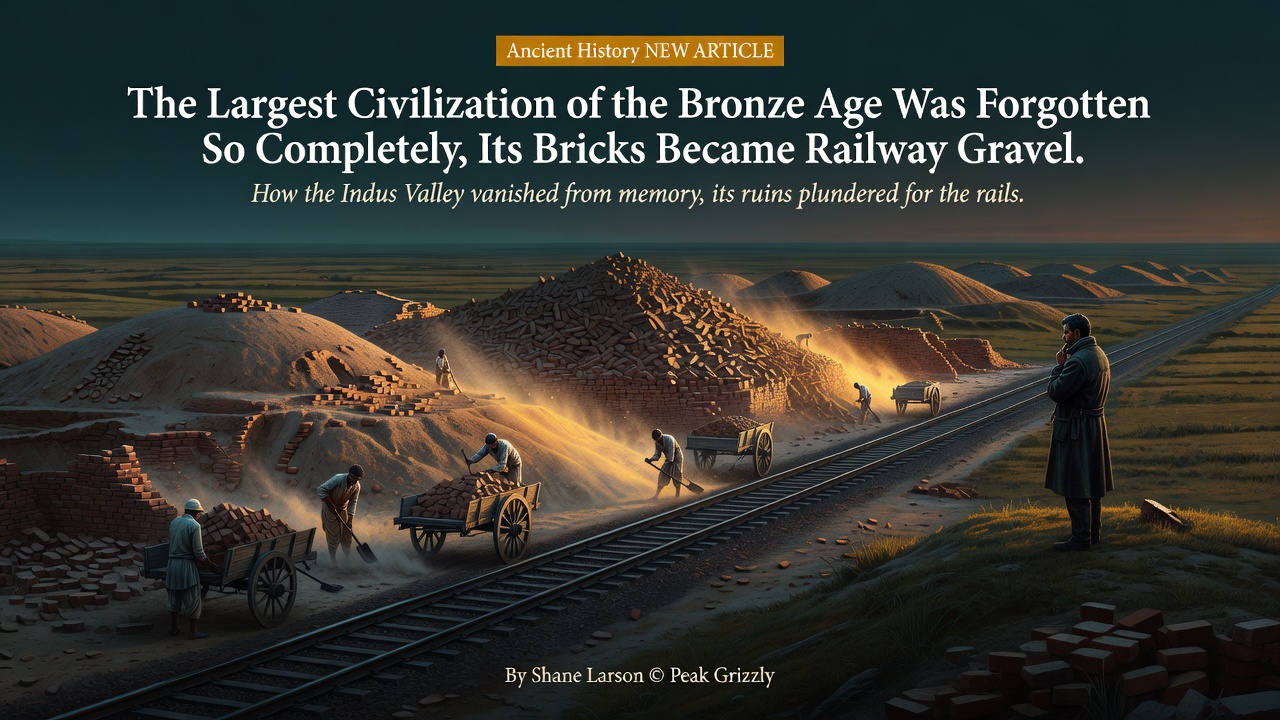
In the 1850s, engineers building the Lahore-to-Multan railway across the Punjab had a problem: track ballast. The line needed crushed material by the ton, and the alluvial plain offered little stone. What it offered instead were some enormous old brick mounds near a village called Harappa — millions of hard-fired bricks, conveniently pre-made, free for the quarrying. The engineers took them. Roughly ninety miles of the line ended up bedded on that brick.
The bricks were four thousand years old. They came from one of the largest cities of the greatest civilization of the Bronze Age — a civilization nobody on Earth remembered.
That's not rhetorical flourish. Egypt was never forgotten: the pyramids stood in plain sight, the pharaohs lived on in the Bible and the classics. Babylon survived in scripture and legend. But the Indus Valley Civilization — which at its height around 2500 BC covered a million square kilometers, more than Egypt and Mesopotamia combined — left no legend, no place-name, no whisper in any surviving tradition. When archaeologists finally understood what those mounds were, in 1924, they did not revise history. They added an entire third cradle of civilization to it, from zero.
I've just finished a book about the Indus, and what pulled me through it is that this civilization isn't just the largest of its age. It's the purest mystery in the ancient world — for reasons that get more interesting the closer you look.
A Civilization That Refuses to Introduce Itself
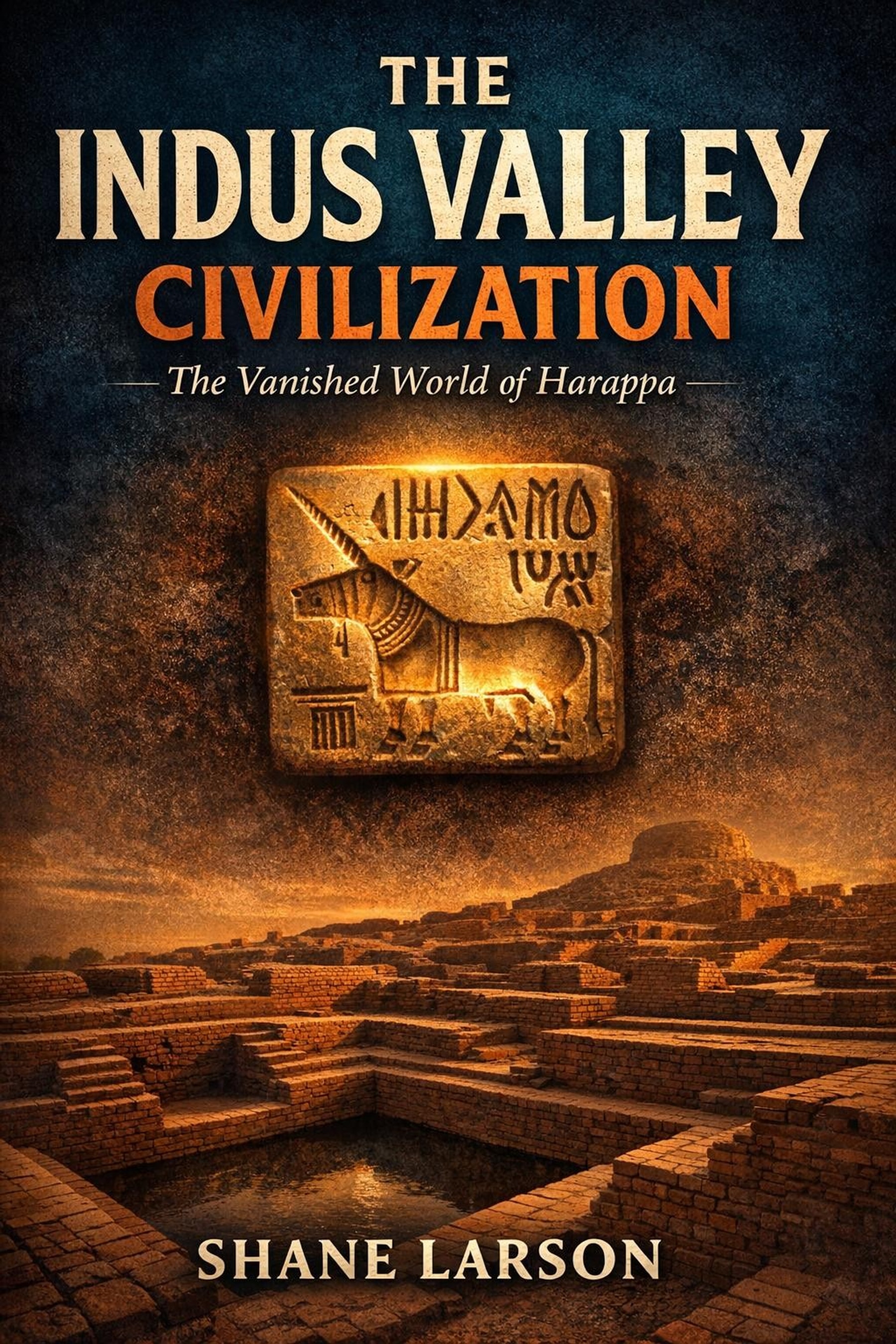
Every other early civilization tells you about itself. Egypt gives you king lists, boasts, love poems, tax receipts. Sumer gives you epics and lamentations. The Indus gives you... seals. Thousands of small carved stones, mostly showing animals — including a one-horned beast scholars call the unicorn — beneath short strings of signs. About 400 to 700 distinct signs, in inscriptions that average five characters. No books. No monuments with royal names. No bilingual text like the Rosetta Stone.
A century of decipherment attempts — some brilliant, many crankish — has broken against those five-character inscriptions. There is no confirmed reading of a single Indus word. We do not know what language these people spoke, what they called their cities, or what they called themselves. One serious scholarly argument holds the signs may not encode language at all.
Which means everything we know about the largest civilization of its era has been read from bricks, beads, drains, and bones. And what that evidence shows is stranger than anything the missing texts could plausibly say.
Cities With Plumbing, No Palaces, and No Wars
Start with what made the excavators' jaws drop: the cities were planned. Mohenjo-daro's streets run on a grid, oriented to the prevailing winds, when Egyptian and Mesopotamian capitals were organic tangles. Bricks conform to a standard 1:2:4 ratio across the entire million square kilometers. Stone weights follow one system from the Arabian Sea to the Himalayan foothills.
The Indus Valley Civilization
Then the detail that has no ancient parallel anywhere: the sanitation. Ordinary houses — not palaces, ordinary houses — had private wells, dedicated bathing platforms with sealed brick floors, and drains connecting to covered municipal sewers running beneath the streets, complete with inspection openings and settling pits, evidently maintained for centuries. Rome's famous sewers mostly served monuments; most Romans lived with chamber pots. European cities matched Indus-level domestic sanitation in the nineteenth century AD. In Egypt the civic surplus went into tombs; in Sumer, into temples. In the Indus it went into water for everybody — and if it's true that what a civilization builds reveals what it worships, that fact deserves more attention than it gets.
Now the double mystery. First: archaeologists have found no palaces. No royal tombs. No victory monuments, no statues of rulers twenty times life size, no named kings — in a civilization that self-evidently coordinated standards across a subcontinent for seven hundred years. Somebody organized this. That somebody is archaeologically invisible, and after a century of digging, the honest answer to "who ruled the Indus?" remains: we don't know. Second: there is astonishingly little evidence of war. Almost no weapons designed primarily for battle, no destruction layers, no siege debris; city walls that read more as flood defenses and customs barriers than fortifications. Was the Indus genuinely peaceful? Maybe — though absence of evidence has limits, and my book stress-tests the utopian reading as hard as it deserves. But even the skeptical version leaves something remarkable: a Bronze Age superpower with no visible cult of either kings or violence.
The Vanishing
And then it ended — in the strangest way in the ancient record. No invasion. No burning. Starting around 1900 BC, the cities simply thinned. Drains stopped being maintained. The seals and the script faded from use. The great coordinated system dissolved back into regional villages, and within a few centuries the civilization-scale world was gone — so thoroughly that its descendants kept no story of it.
The colonial-era textbooks had a villain ready: Aryan invaders on chariots, with skeletons at Mohenjo-daro cast as massacre victims. That story ruled for fifty years and turned out to be wrong on every count — the skeletons came from different eras and mostly show no violence, the cities show no conquest layer, and radiocarbon dating eventually proved the urban system had unraveled centuries before any newcomers arrived, with ancient DNA confirming migration into a post-urban landscape rather than conquest of a living one. The real suspects are quieter: a weakening monsoon, documented in lake and cave records; the slow death of the Ghaggar-Hakra river system; agriculture shifting east; trade partners in Mesopotamia hitting their own crises. Not a cause — a cascade. The same shape as every collapse I've written about, with the villain deleted.
What's left is a civilization that has to speak entirely through objects: a four-inch bronze girl with an armful of bangles and an attitude; carnelian beads that took a craftsman weeks each, found in the royal tombs of Ur; dice and toy carts; children's footprints baked into drying brick; and ninety miles of railway riding on the rubble. My new book, The Indus Valley Civilization: The Vanished World of Harappa, tells the whole story as the detective case it is — the rediscovery, the cities, the script problem, the missing kings, the missing wars, the Mesopotamian connection, the collapse trial, and the invasion myth's rise and fall — wonder and skepticism given equal seats at the table.
The Indus Valley Civilization
New posts and releases, straight to your inbox. No spam, unsubscribe anytime.