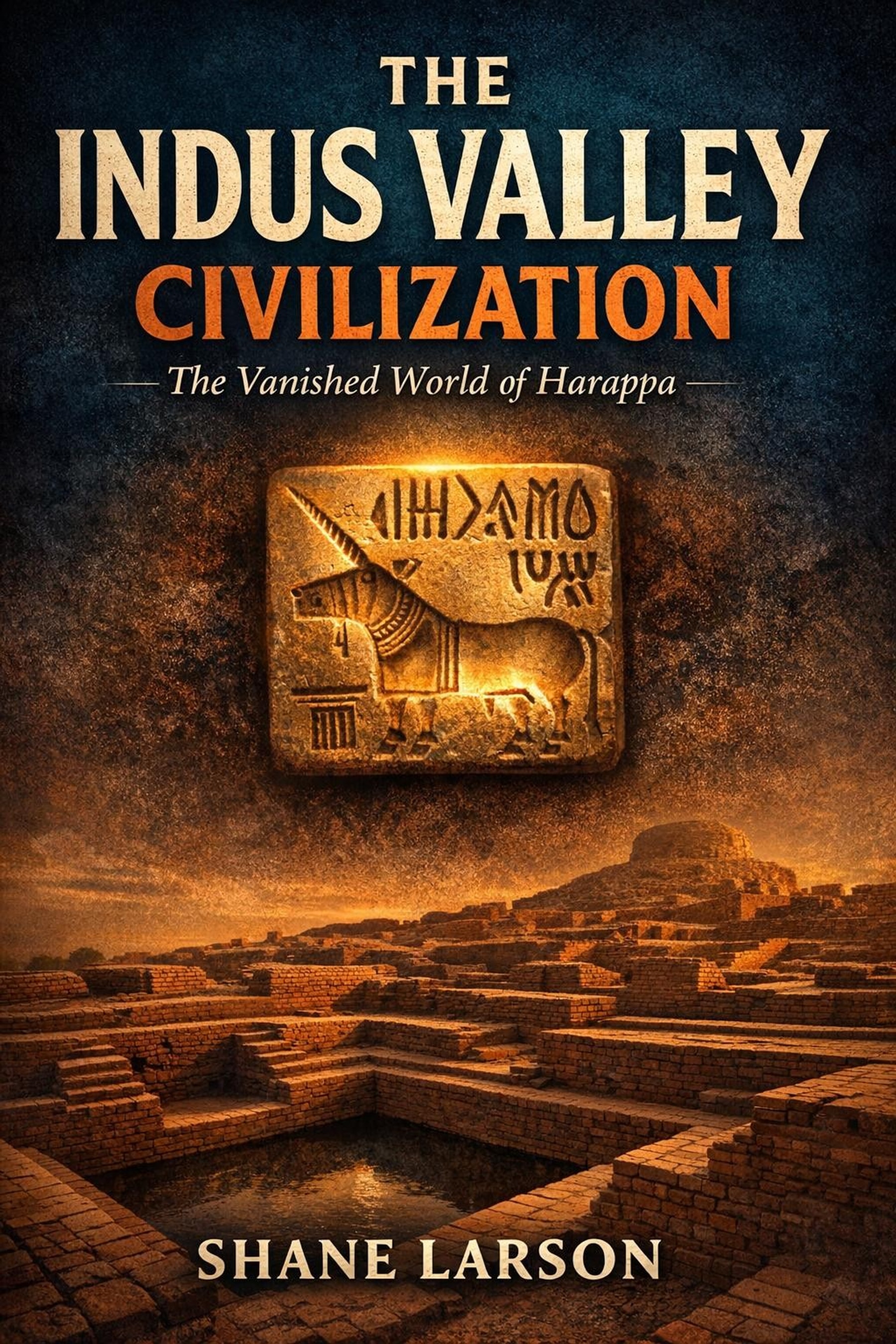
The Indus Valley Civilization
The Vanished World of Harappa
By Shane Larson
About This Book
In the 1850s, British engineers pushing the East Indian Railway across the Punjab needed ballast — hard, kiln-fired brick to bed the rails on. They found a ready supply in the low mounds that dotted the plain near a village called Harappa. Local contractors had been mining those mounds for building material for generations. The bricks were beautifully made, perfectly uniform, and, as it turned out, roughly four thousand years old. Miles of track were laid on the rubble of a city nobody could name.
That is the strange heart of this story. Egypt was never lost. Mesopotamia lived on in the Bible and in Greek memory. But the third great civilization of the ancient world — larger, at its height, than the other two combined — vanished so completely that it left no legend, no king list, no surviving name for itself. The people of the Indus did not decline into a smaller version of themselves. They were deleted from human memory, and their cities were quietly recycled into railway gravel before anyone understood what they were looking at.
It took until 1924 for the pieces to come together, and when they did, the map of the ancient world had to be redrawn. This was not a footnote or a provincial culture on the edge of somewhere important. This was a metropolitan society spread across a million square kilometers of what is now Pakistan and northwest India, contemporary with the pyramids, trading with Sumer, and in some respects more advanced than either — and it had been sitting under the soil, unread, the whole time.
The Argument
The book approaches the Indus the way a good investigator approaches a cold case: start with the physical evidence, refuse to fill the silence with wishful thinking, and be honest about where the trail goes cold. What the bricks, beads, seals, and skeletons actually tell us is remarkable enough without embroidery — and the embroidery, it turns out, has done real damage to public understanding of these people.
Because the Indus left no readable texts, they have become a screen onto which every generation projects its hopes. In the twentieth century they were cast as peaceful utopians, a society without war, without kings, without inequality — a kind of Bronze Age Eden. More recently they have been drafted into bitter modern arguments about who the "original" inhabitants of the subcontinent really were. This book walks the line carefully: it takes the genuine mysteries seriously while showing exactly where the confident claims outrun the ground truth. The absence of evidence is not evidence of utopia. It is just absence, and it deserves to be treated as such.
What emerges is a portrait of one of the most distinctive societies humanity has ever built — obsessively orderly, apparently un-warlike, commercially far-reaching, and organized by a form of authority we still cannot identify. And then, without an invading army or a single dramatic catastrophe, it came apart. The rivers shifted, the monsoon faltered, the trade links frayed, the great cities emptied, and within a few centuries the whole world of Harappa slid out of memory. Understanding how that happens — how a civilization can die quietly — is as unsettling as any story of fire and conquest.
What's Inside
- Rediscovery from zero: How a lost civilization was reconstructed from bricks in a railway bed, a few stray seals, and one archaeologist's refusal to believe he was looking at something ordinary.
- Plumbing that shames the nineteenth century: Private bathrooms, brick-lined wells, and covered municipal drains built into the street grid four thousand years before European cities managed the same trick.
- The grid itself: Why cities laid out on deliberate right-angled blocks — when Egyptian and Mesopotamian capitals were tangled warrens — points to planning authority we can see everywhere and name nowhere.
- A script that has beaten everyone: Hundreds of signs, thousands of inscriptions, a century of attempts by linguists and code-breakers, and still not a single confirmed reading. The chapter explains why it resists — and what it can tell us even unread.
- The kingdom with no visible king: No palaces, no royal tombs, no monuments to god-rulers. What the eerie standardization of weights, bricks, and layouts implies about power that left no throne behind.
- Meluhha: The Indus merchants who show up by name in Mesopotamian records, with their own quarter of foreign traders, their seals turning up in Sumerian cities.
- The quiet collapse: The dying river, the weakening monsoon, and the slow cascade that emptied the cities — a very different kind of ending from the Bronze Age's spectacular fires.
- The invasion that never happened: How the "Aryan invasion" story dominated textbooks for half a century, and how archaeology and ancient DNA have taken it apart.
Why I Wrote This
I kept running into the Indus as a footnote. It would get a paragraph in a survey of world history — "advanced drainage, undeciphered script" — and then the book would hurry back to Egypt and Sumer, where there are pharaohs and epics to talk about. That bothered me. The largest of the three founding civilizations was consistently getting the least attention, purely because it didn't leave us a story we could read.
But the silence is the point. I wanted to write about what it actually feels like to reconstruct a whole society from what people threw away, buried, and built with — without a single sentence of their own to guide you. And I wanted to be honest about the temptation, which I felt myself, to make them more perfect and more knowable than the evidence allows. The Indus deserve to be met on their own terms, not turned into whatever we happen to need them to be.
Frequently Asked Questions
Do I need to know anything about ancient India to read this?
No. The book assumes you're coming in cold and builds the world from the ground up — geography, chronology, and how the sites were found. If your mental map of the subcontinent's deep past is blank, that's the ideal starting point.
Does it try to decipher the Indus script?
It does not claim to, because no one honestly can. What it does is explain how the script works as far as we can tell, walk through the serious decipherment attempts and why they've failed, and separate the credible scholarship from the periodic "I've cracked it" headlines.
Is this book pushing a political argument about Indian origins?
No. The migration-and-DNA question is handled as archaeology and genetics, not as a modern loyalty test. The book lays out what the evidence currently supports and is clear about the difference between what we know and what people want to be true.
How does it handle the "peaceful utopia" idea?
Skeptically, and with reasons. The relative absence of fortifications and weapons is real and worth explaining — but the book shows why "we haven't found evidence of war" is not the same as "there was no war," and why the utopian reading says more about us than about them.
If You Liked This, You Might Like
- The Minoans — Another sophisticated society that left behind an undeciphered script and a maddening silence; the closest cousin to the Indus in the whole catalog.
- Cahokia — A vast, planned city that rose, thrived, and was abandoned into total obscurity, on the other side of the world — the same haunting question of how a civilization gets forgotten.
- The Mauryan Empire — The subcontinent's first great empire, two thousand years later; read together, they bracket the deep history of South Asia before and after the long silence.
- The Collapse Pattern — If the slow unraveling of the Indus fascinates you, this is the framework for how complex societies come apart across all of history.
The greatest civilization no one remembers is finally legible again — not fully, never fully, but enough to stand it back up in the light and see it for what it was.
Included with Kindle Unlimited — read it free if you're a member.
New Ancient History releases and free chapters — no spam, unsubscribe anytime.