Kit Carson
The Legend That Turned
By Shane Larson · The Wild West Series (Book 30)
About This Book
In October 1826 a saddler in Franklin, Missouri, placed a notice in the local paper. His apprentice had run off — a boy of about sixteen, small for his age but thick-set, light-haired, bound to learn the trade and gone since the first of the month. The saddler offered a reward of one cent.
That advertisement is the first documentary trace of Christopher Carson's existence. Nobody bothered to look for him.
Twenty-three years later, a search party came up on an abandoned camp on the Canadian River. They had been tracking a raiding band that had taken a woman named Ann White off the Santa Fe Trail, and they arrived too late. Among the belongings scattered across the ground was a cheap paper-covered novel in which a fictional Kit Carson rescued white women from Indians, single-handedly and without fail.
The real one was standing there. He could not read a word of it. He was illiterate his entire life, and there were something like seventy of those books.
The Man and the Printed Man
This is a biography of Kit Carson that takes both of him seriously.
The first one was real and formidable. A runaway apprentice who reached Santa Fe at sixteen and never really came back; a Rocky Mountain trapper through the last good years of the beaver trade; a man who married an Arapaho woman named Waanibe and raised their daughter, later married a Cheyenne woman, and later still married into a prominent New Mexican family in Taos; fluent in Spanish and several Native languages; and the guide whose route-finding and negotiation made John C. Frémont's expeditions succeed. He was, by the accounts of a great many people who dealt with him across forty years, modest and honest and unusually kind, in a country and a trade where nobody was any of those things by default.
The second one was manufactured. Frémont's expedition reports — printed by Congress, written up with his wife's considerable literary hand — made Carson a national figure, and the dime novelists took delivery. Beadle and Adams, Ned Buntline, writers who had never been west of Pittsburgh, working at a dollar a book for readers who paid a dime. The printed Carson killed improbable numbers of people, rescued improbable numbers of women, and spoke in complete sentences he then quoted from the Bible. The real one was recognized in the street by people who were consistently disappointed to find him small.
And then there is 1863, which is why anyone is still arguing.
Canyon de Chelly
As a colonel of New Mexico volunteers, under a general named James Carleton who had designed the policy and would not be talked out of it, Carson prosecuted the campaign against the Navajo. It was not primarily a campaign of battle. It was a campaign of destruction: cornfields burned standing, herds killed or driven off, stored grain turned out on the ground, and then a high-desert winter allowed to finish the work. People came in because there was nothing left to stay for.
What followed was the Long Walk — a series of forced marches across 1864, hundreds of miles to a reservation at Bosque Redondo where the water was alkaline, the crops failed four years running, and roughly a quarter of the people taken there died before the place was abandoned as a failure.
Carson asked repeatedly to be relieved of that command. Carleton refused. He carried it out anyway, and he carried it out well — he had been chosen precisely because he was the man in the territory most capable of it. He later testified before a congressional committee against the reservation's continuation.
He is also a man who spent the preceding decade as an Indian agent arguing on behalf of the Ute and the Jicarilla Apache, filing reports about inadequate rations and the whiskey trade, and buying supplies on his own credit when the government's did not arrive.
None of that resolves. This book does not pretend otherwise.
What's Inside
- The legend tracked alongside the life. As each real event happens, you see what the dime novelists made of it. That structure is the book's distinctive move: the argument about Carson's reputation is one you assemble as you go rather than one sprung on you at the end.
- The mountain years as work, not romance — the distances, the winters, the traps in freezing water, the rendezvous where a year's catch was gambled away in a fortnight, and an economy that ended when European hatters switched to silk.
- Three marriages, given their weight. Waanibe and their daughter Adaline; a brief Cheyenne marriage the popular accounts delete entirely; and Josefa Jaramillo in Taos. The erasures are examined, because what gets left out of a legend is evidence about the legend.
- California, 1846, including the killings at the Sacramento River and the shooting of three unarmed Californios at San Rafael — reported from sources that conflict, with each source characterized, Carson's own words where they exist, and a plain statement of what he never addressed anywhere in his life.
- The chain of command, laid out precisely: what originated with Carleton, what Carson requested, what he objected to, what he executed, what he delegated, and what happened after he was gone.
- Navajo accounts of the campaign and Bosque Redondo, given real space in the body of the book rather than as a coda, and treated as historical testimony.
- The rise and fall of a name — the county, the national forest, the army post, the monuments, and then the reassessment: how Navajo oral history reached a wider audience, what the historians argued from the 1970s on, and what has come off which buildings and when.
- Three appendices: the documented events beside their dime-novel versions; the Navajo campaign as a documentary record so you can check the narrative against it; and a chronology of 1809–1868 that shows how much of American westward expansion runs through one life.
Why I Wrote This
There are two Kit Carson books available and I did not want to write either of them.
One is the epic, in which he is the great frontiersman and the Navajo campaign is a regrettable chapter near the end. The other is the correction, in which the campaign is the whole man and everything before it is prologue to an atrocity. Both are written by serious people. Both leave things out, because they have to — the evidence does not fit either shape without trimming.
What kept me on it was the illiteracy. Here is the most written-about man in nineteenth-century America, the subject of seventy-odd novels and a national reputation, and he could not read one sentence of any of it. Everything anyone thought they knew about him was assembled by other people while he was alive to be embarrassed by it. And when the argument turned against him a century later, the thing being argued about was still, partly, that printed man.
So the book states what he did, as precisely as the record allows, and stops there. That is a harder book to write than either of the other two, and I think it is the one this subject actually needs.
Frequently Asked Questions
Does the book take a side?
No, and it says so openly rather than pretending to neutrality while leaning. The conclusion lays out the case made for Carson and the case made against him at equal length and full strength, and then says plainly that they do not cancel, do not resolve, and that a verdict would cost you the only thing the book can hand over intact — the evidence and the true shape of the problem.
Is this a defense of him?
No. The Navajo campaign, the Long Walk, and the California killings are all in the book, stated without softening and without the excuses that usually attach to them. The chain of command is reported as a fact about how the policy was made, not as a reason he is off the hook.
Is it a takedown?
Also no. The record contains a man who lived his entire life inside Native and Mexican communities, married two Native women, spent a decade arguing for the people in his agency, and testified against the reservation. Leaving that out would be as dishonest as leaving out the orchards.
How does it handle Navajo accounts?
They are in the body of the book, with real space, treated as historical testimony about what happened to the people it happened to. They are described and paraphrased rather than quoted at length from published collections — both because those collections are under copyright and because testimony of that kind deserves handling rather than harvesting. The collections are named so you can go and read them.
Do I need to have read the other Wild West books?
No. It stands alone. It does pair unusually well with the book on the dime-novel industry, since Carson is that industry's single best case study.
How long is it?
Around 73,000 words: an introduction, thirteen chapters in four parts, a conclusion, and three appendices. The paperback runs 239 pages.
If You Liked This, You Might Like
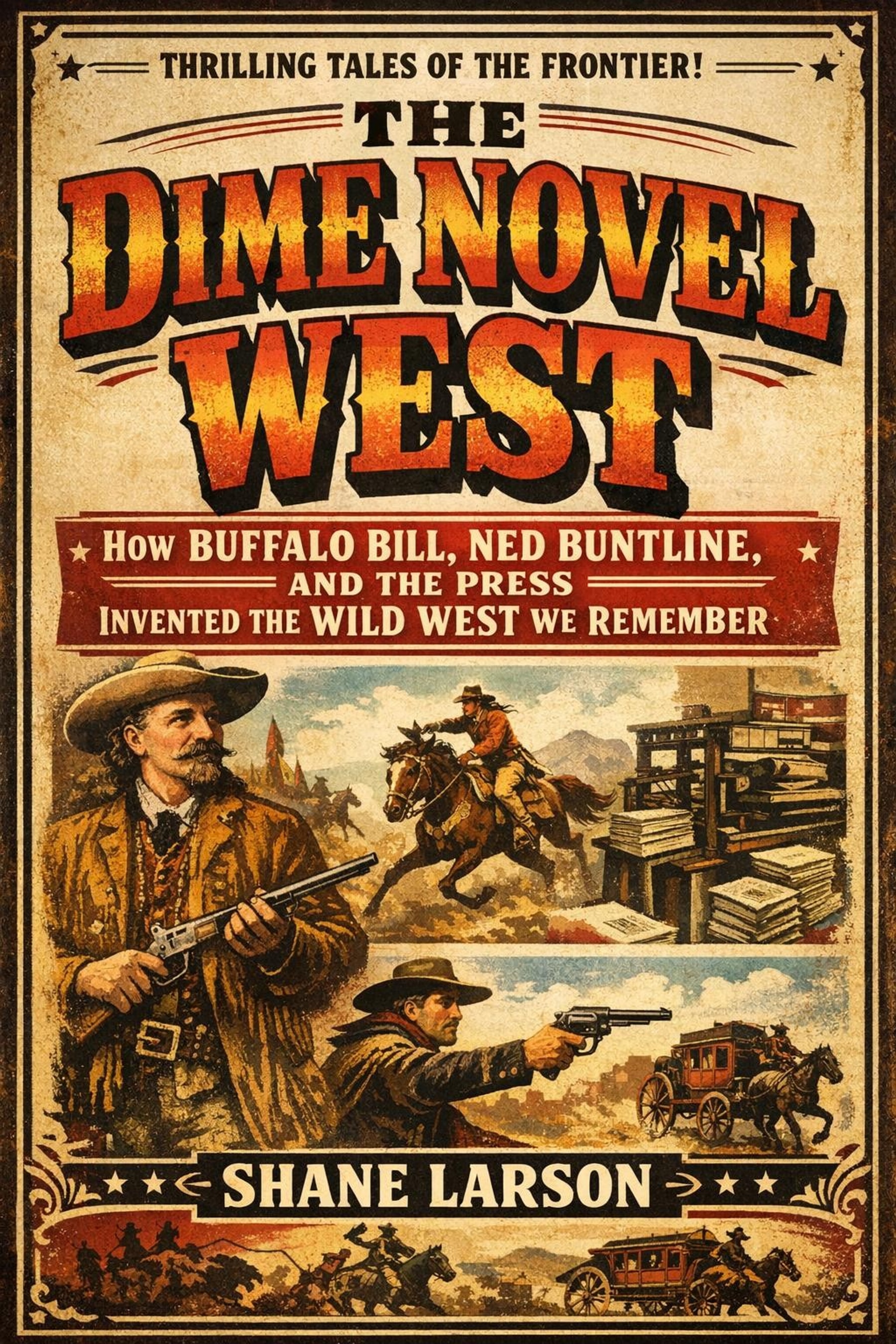
- The Dime Novel West — The machine that built the printed Carson, examined on its own terms. These two books explain each other, and this is the closest pairing in the catalog.
- Buffalo Bill Cody — The other side of the same problem. Cody could read his own press and helped write it; Carson could do neither. Two men manufactured by the same industry, one of them participating.
- Crazy Horse — A contested record from the opposite direction: a man who sat for no photograph and left almost nothing, where Carson left too much of the wrong kind.
- Sitting Bull — The plains wars a generation on, and another reputation the country has never finished arguing about.
A one-cent reward, seventy novels he could not read, and a name that spent a century going up on buildings and has spent this one coming down. The record is stranger than either version of it.
What You'll Learn
- The legend tracked alongside the life — as each real event happens, you see what the dime novelists made of it
- The mountain years as work, not romance: the distances, the winters, and the fur economy that ended when hatters switched to silk
- Three marriages given their weight — Waanibe and their daughter Adaline, a brief Cheyenne marriage the popular accounts delete, and Josefa Jaramillo in Taos
- California in 1846, including the Sacramento River killings and the shooting of three unarmed Californios at San Rafael, reported from sources that conflict
- The chain of command laid out precisely: what originated with Carleton, what Carson requested, what he objected to, and what he executed
- Navajo accounts of the campaign and Bosque Redondo, given real space in the body of the book and treated as historical testimony
- The rise and fall of a name — the county, the forest, the monuments, and the reassessment that took them down
- Three appendices: the documented events beside their dime-novel versions, the Navajo campaign as a documentary record, and a chronology of 1809–1868
Included with Kindle Unlimited — read it free if you're a member.
New Wild West / American Frontier History releases and free chapters — no spam, unsubscribe anytime.
More in The Wild West Series
View series →