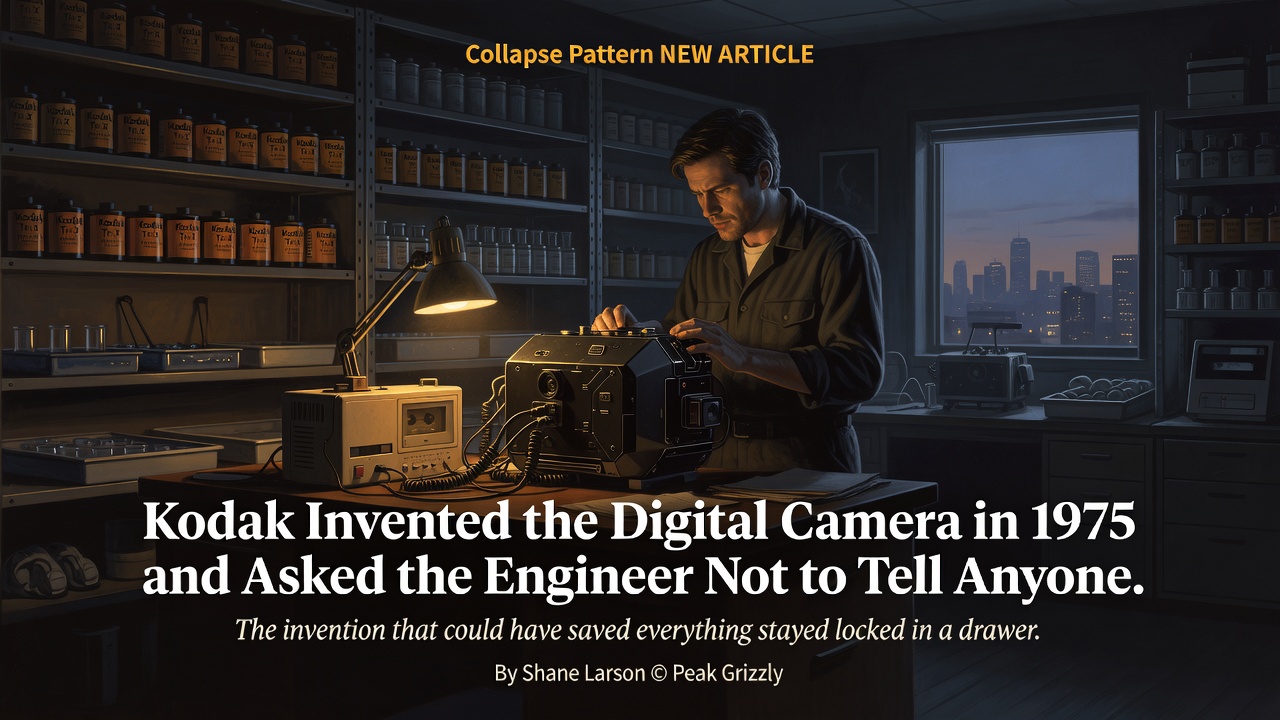
Kodak Invented the Digital Camera in 1975 and Asked the Engineer Not to Tell Anyone
August 5, 2026 · 6 min read
In December 1975, a 24-year-old Kodak engineer named Steve Sasson carried something into his supervisor's office that looked like a toaster crossed with a circuit board. Eight pounds. A black-and-white image at roughly 0.01 megapixels, written to cassette tape over 23 seconds, viewable only on a purpose-built screen.
It was the first digital camera.
Sasson demonstrated it to Kodak executives through 1976 and 1977. He walked them through the development curve and estimated that digital images would match 35mm film quality within fifteen to twenty years. He was almost exactly right.
By his own account, the response was that the technology was "cute," and a request that he not talk about it.
The usual reading of this story is that Kodak's leadership was blind. They were not. That is the entire problem. They understood precisely what they were looking at, and understanding it was what made them suppress it.
The Thing Everyone Gets Backwards
Film was Kodak's business, and film was an extraordinary business. Cameras were sold near cost; the money was in what came after. Every photograph taken meant film sold, chemicals sold, paper sold, processing sold — a consumable revenue stream that recurred forever, at margins most industries never see.
Digital photography has none of that. You sell a camera once. There is no film, no developing, no print, no recurring anything.
So the honest internal case for digital in 1976 was: let us invest heavily in a technology that will take twenty years to mature, in order to replace our highest-margin product with a dramatically lower-margin one, starting now.
No executive gets that approved. Not because they are stupid, but because every incentive in a functioning company points the other way. Quarterly results, compensation, the analysts, the retirement of the person who signs off — all of it is anchored to the business that currently works. A manager who cannibalises a profitable line to chase an unprofitable one is not visionary in the moment. They are underperforming, visibly, against peers.
Kodak did eventually build digital cameras and for a while sold a lot of them. But it moved slowly, hedged constantly, and kept trying to preserve the film revenue underneath. It filed for bankruptcy in 2012, holding a substantial portfolio of digital imaging patents.
The Same Shape, Repeatedly
Blockbuster is the case everyone thinks they know, and the popular version is wrong in an instructive way. Blockbuster was not oblivious to Netflix; it launched its own by-mail service and later an offering that was, on the merits, competitive. What it could not do was give up late fees, which at points ran to a substantial share of profit. Late fees were the thing customers hated most and the thing the P&L needed most. Netflix's actual innovation was not mail. It was building a business that did not require punishing its customers.
Nokia had smartphones, touchscreens and app concepts in development years before the iPhone. What it had more of was Symbian — an operating system that worked, shipped in enormous volume, and had an entire organisation built around it. Committing to a new platform meant declaring the existing one dead, along with the careers attached to it. The company's own engineers reportedly understood the problem for years before anything moved.
Sears was the Amazon of its century: a catalogue that put a national inventory in front of rural households, with logistics no competitor could match. It had the customer relationships, the distribution, and the brand to own e-commerce. It spent the relevant decades defending physical retail, then financialising the real estate underneath it.
The Corporate Collapse Pattern
None of these were failures of perception. In every case the threat was identified internally, early, by named people, in documents. The failure was that recognising the threat and acting on it are separated by an organisational barrier that gets stronger the more successful the company is.
The Other Failure Mode
Not every collapse is disruption. There is a second kind, where the company does not miss a technology shift — it misrepresents its own condition.
Enron built a structure whose complexity was the point: off-balance-sheet vehicles that moved debt somewhere it would not be counted, blessed by auditors who were also selling consulting. Theranos promised a diagnostic capability that did not exist and ran demonstrations on other manufacturers' machines. WeWork was an office leasing company with conventional lease liabilities, valued as a technology platform on metrics it invented. Lehman used repo transactions to shift assets off the balance sheet at quarter end. Silicon Valley Bank held long-duration assets against short-duration deposits and did not hedge the rate risk, which is the oldest exposure in banking.
The connective tissue with the first group is thinner than it looks but real: in both, the organisation had a story about itself that the numbers were increasingly failing to support, and it responded by defending the story.
Why the Board Doesn't Stop It
In theory, this is what the board is for. Shareholders elect directors, directors oversee management, and when the company heads for a cliff, the board takes the wheel.
In practice it almost never happens — not at Kodak, Blockbuster, Nokia, Enron, Theranos, WeWork, Sears, Lehman, or SVB. That consistency is not bad luck.
Directors are typically recruited through the CEO's network, and often by the CEO. They meet a handful of times a year. Nearly everything they know about the company comes from the management they are meant to be evaluating, in materials management prepares. The information asymmetry is total.
The social dynamics compound it. A board is a small group of senior people who see each other periodically and value the relationship. Being the director who keeps pressing an uncomfortable question is a way to stop being invited. And the specific move required — challenging a strategy that is currently generating record profits, on the grounds that it will fail in eight years — is not a courageous act in the room. It reads as not understanding the business.
By the time the numbers make the case unarguable, the window to act cheaply has closed. Boards fire CEOs constantly. They almost always do it after the collapse is visible, which is the one point at which it changes nothing.
The Warning Signs
Across all of these, a few things recur early enough to be useful.
Revenue concentrated in a product the market is beginning to leave. Financial reporting that grows more complex each year. Metrics invented in-house that replace standard ones. Executive compensation tied to measures management controls directly. Senior technical people leaving without being replaced at level. A stated strategy that requires competitors to behave irrationally. And the reliable tell: internal dissent that is handled as a personnel matter rather than an analytical one.
The last is the closest thing to a universal signal. In nearly every case, someone inside the company had it right, early, and in writing. Kodak had Sasson. Enron had Sherron Watkins. The question was never whether the information existed. It was whether the organisation had any mechanism for acting on information that threatened its current revenue.
Mostly, they don't. That is what makes the pattern a pattern.
The Corporate Collapse Pattern: How Great Companies Destroy Themselves takes each case in full — Kodak, Blockbuster, Nokia, Enron, Theranos, WeWork, Sears, Lehman and SVB — plus the companies that faced the same moment and survived it.
The Corporate Collapse Pattern
New posts and releases, straight to your inbox. No spam, unsubscribe anytime.