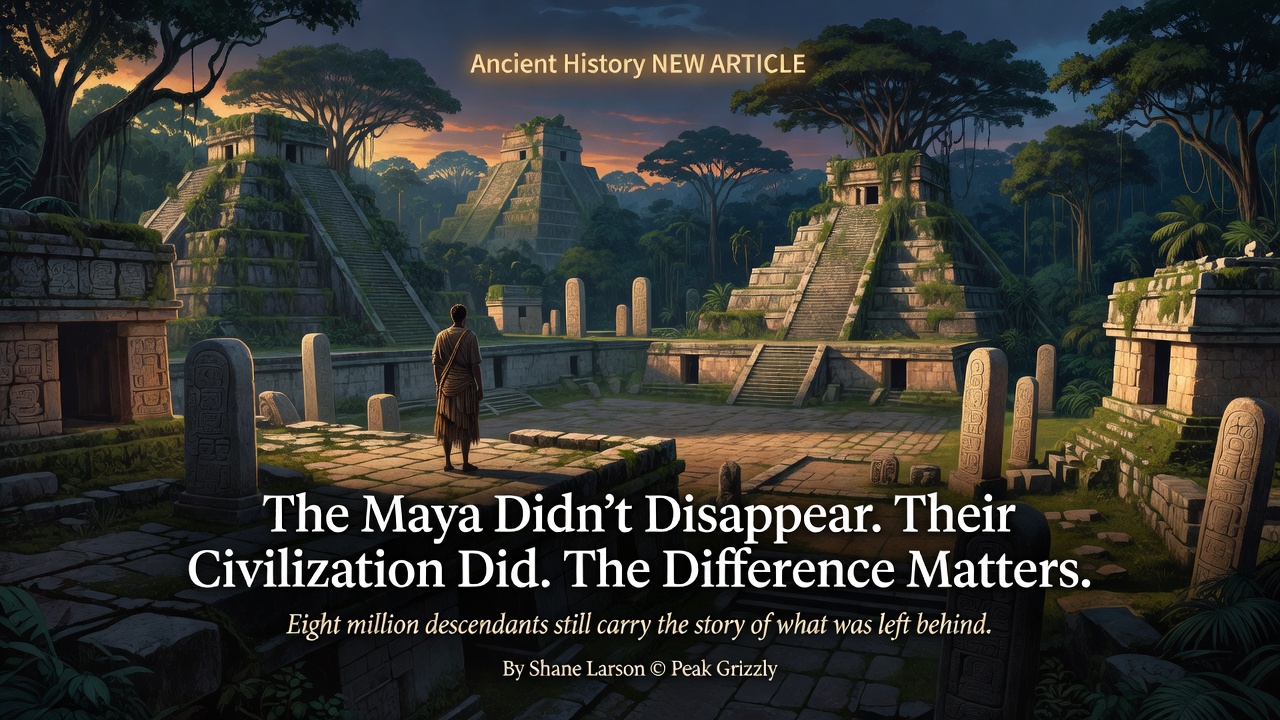
The Maya Didn't Disappear. Their Civilization Did. The Difference Matters.
May 25, 2026 · 8 min read
There is a sentence that keeps showing up in popular writing about the Classic Maya collapse, in slightly different forms, for at least a hundred years. It is some version of: "The Maya mysteriously vanished from their cities around the year 900, and no one knows why."
Almost everything in that sentence is wrong.
The Maya did not vanish. Roughly eight million people of Maya descent live today across southern Mexico, Guatemala, Belize, and Honduras. They speak around thirty Mayan languages. They run businesses and serve in legislatures and farm milpa fields on land their ancestors farmed. They are one of the largest indigenous populations in the Americas. They are very much here.
The cities they abandoned, also, did not collapse mysteriously. The collapse of the southern lowland Maya cities in the ninth and tenth centuries is one of the best-documented civilizational transitions in archaeology. We have sediment cores from the lake beds. We have decoded hieroglyphic inscriptions naming the kings and dating the wars. We have pollen records showing what the forests were doing. We have, as of 2018, a LiDAR survey that has revealed the buried cities themselves in a level of detail that did not exist a decade ago. The collapse is not Atlantis. The answers exist.
What I want to argue in this post — and at much greater length in my new book, The Maya Collapse — is that the framing of "vanished civilization" is doing real damage to how we understand what actually happened. It collapses two very different things into each other: the end of a particular political and institutional order, and the disappearance of a people. The first one is true. The second one is not. Untangling them changes the entire shape of the story.
What ended around 900 CE was an institution, not a people
To understand what ended, you have to know what was running at peak.
By around 750 CE, the Classic Maya world was at its height. The great lowland cities — Tikal, Calakmul, Palenque, Copán, Caracol, Yaxchilan, Quiriguá — were home to populations in the tens of thousands. Causeways stitched them into regional networks. Limestone pyramids climbed above the jungle canopy. Royal courts ran them, headed by a divine king known as a k'uhul ajaw, who claimed descent from the gods and intercession with the supernatural — most importantly, the bringing of rain.
These courts produced a vast inscriptional record. Every major monument was carved with a Long Count date locating it to the exact day. The texts named the kings, recorded their accessions, their marriages, their wars, their captives, and their ritual obligations. The decipherment of these inscriptions over the last fifty years — by Yuri Knorozov, Tatiana Proskouriakoff, David Stuart, and many others — has given us the political history of the Classic Maya in a granularity that almost no other ancient civilization can match. We know which king of Tikal lost to which king of Calakmul in 562 CE. We know when the alliance shifted. We know the names of the captives.
In the late eighth and early ninth centuries, that machinery started to stop.
City by city, the inscriptional record runs out. Copán's last dated monument is from 822 CE. Yaxchilan's is from a few decades earlier. Tikal's stretches a little later, to around 869. Caracol's last fully dated stela is 859. Inside about a century, the entire system of royal inscription across the southern lowlands ceases. The cities are not necessarily empty — archaeologists find squatters in some palaces, fires in some plazas, scattered later occupation — but the institutions are gone. The kings stop being named. The courts stop producing the cultural artifacts that defined them. The very practice of inscribed monumental kingship ends.
This is what archaeologists mean by the "Classic Maya collapse." It is not the death of the Maya people. It is the failure of a specific political and ideological system — divine kingship, supported by tribute, justified by ritual, embedded in dense urban centers — across a particular region in a particular window of time.
The causes are knowable, and there is more than one
The reason the collapse keeps getting framed as a mystery is that no single cause explains it. Every monocausal theory has been tried. Every monocausal theory has come up short.
Drought is the cleanest evidence we have. Lake-sediment cores from Lake Chichancanab and Punta Laguna show a severe, multi-decade reduction in rainfall across the southern lowlands in the ninth century, exactly when the inscriptional record is collapsing. Some of those years were genuinely catastrophic. The agricultural systems of the southern lowlands — already operating at the edge of what intensive milpa, terracing, and raised-field cultivation could sustain — would have failed in serious ways.
But drought alone does not explain everything. Northern cities like Chichen Itza and the Puuc-region sites went through the same broad climatic period and not only survived but, in some cases, briefly flourished. Some southern cities collapsed before the worst of the drought. Drought is a trigger, not a complete cause.
The same logic applies to every other candidate. The endemic warfare between Tikal and Calakmul, which had been a structural feature of Classic Maya politics for centuries, escalated through the eighth century in ways that drained manpower and disrupted regional trade. But warfare on its own had not collapsed the system before. Deforestation and soil erosion — visible in pollen and sediment records — would have made the agricultural base more brittle, but the Maya had been managing intensive land use for centuries. Even the failure of divine kingship as an ideology, once the rains stopped, only explains the political crisis if you assume the ecological and military pressures were already there.
The Maya Collapse
The honest answer, and the one most working Maya archaeologists now hold, is that the collapse was multicausal. It was drought arriving on top of deforestation, on top of escalating warfare, on top of stretched agricultural systems, on top of a political ideology whose legitimacy depended on outcomes the kings could no longer deliver. Every pressure made every other pressure worse. The system did not fall to a single blow. It failed on every axis simultaneously.
This is, incidentally, what most actual collapses look like. The Late Bronze Age in the eastern Mediterranean. The long unwinding of the Roman west. The abandonment of Cahokia in the Mississippi valley. Complex societies tend not to be defeated by single problems. They are defeated by combinations of problems that, in isolation, each of their institutions could have handled.
Why the "vanished civilization" framing hides the most important part
Once you understand what actually ended around 900 CE, the survivors stop being a footnote and start being the point of the story.
In the centuries after the southern collapse, the Maya world reorganized. Populations moved north into Yucatán, into the Puuc region, into the Petén lakes area, into the Guatemalan highlands. The cities that came after — Chichen Itza, Uxmal, Mayapan, the highland kingdoms of the K'iche', Kaqchikel, and Mam — were not the same kind of polity as the Classic divine-king courts. They were smaller, less hierarchical, less monomaniacal about monumental inscription. The Postclassic Maya were a different kind of society. They were also, unambiguously, still Maya.
When the Spanish arrived in the early sixteenth century, they did not encounter empty jungle. They encountered Maya kingdoms — and they spent the next two hundred years trying to subdue them. The Itza holdout at Nojpetén was not conquered until 1697. The colonial period brought a second catastrophe — disease, encomienda labor, the burning of the Maya codices by Bishop Diego de Landa — but it did not extinguish the people. Maya communities persisted through Spanish rule, through Mexican and Guatemalan independence, through twentieth-century civil wars, and are persisting now.
When you tell the story as "vanished civilization," you write all of this out. You turn one of the great surviving indigenous populations of the Americas into a mystery prop. You also miss the most interesting lesson the collapse actually has to teach, which is that complex societies do not always fall — sometimes the people simply walk away from them. The institutional Maya world was abandoned. The Maya themselves chose, mostly, not to keep the system going. Eight million people are alive today, in part, because their ancestors did not stick with a way of life that had stopped working.
That is a very different story from the one in the old textbooks. It is also, by any honest reading of the evidence, the true one.
What the LiDAR revolution changed
One last thing worth knowing, because it has only landed in the last few years.
In 2018, the PACUNAM consortium published the results of a LiDAR survey of about 2,100 square kilometers of the Petén rainforest in northern Guatemala. LiDAR uses airborne laser pulses to map ground topography through forest canopy. What the survey found, underneath the jungle, was something like sixty thousand previously unrecorded Maya structures. Causeways. Defensive walls. Terraced agriculture climbing hills that had looked, from the ground, like undisturbed forest. Whole satellite communities around major sites.
The implications are still being worked out, but they are large. The peak population of the Classic Maya world was much higher than the previous estimates. The density of land use was much higher. The level of regional integration was much higher. The southern lowlands in 750 CE were not a few great cities surrounded by light occupation. They were a dense, working, intensively managed landscape supporting millions of people.
That is the world the ninth-century drought arrived in. That is the population that had to be fed when the rains failed. The collapse is not less explicable in light of LiDAR. It is more so. The scale of what was being attempted, and the scale of what had to give when it stopped working, are now much clearer.
It also makes the survivorship story even more remarkable. A civilization of that scale unwound itself, with millions of people having to find somewhere else to live and some other way to organize their lives, and at the end of the unwinding the Maya were still there.
If this resonated
The Maya Collapse: Why the Most Sophisticated Civilization in the Americas Walked Away From Its Cities is my full-length narrative treatment of all of this. It walks through the rise of Classic Maya urbanism, the engineering and political achievements at peak, the long Tikal-Calakmul rivalry, the ninth-century cascade of pressures, the lights-going-out map of the final inscriptions, the Postclassic reorganization, the Spanish encounter, the long rediscovery, and the contemporary descendants. It treats the science honestly and gives the survivors their proper place in the story.
If the framing in this post is one you want to see worked out at the level of evidence, the book is where to go.
The Maya Collapse
New posts and releases, straight to your inbox. No spam, unsubscribe anytime.