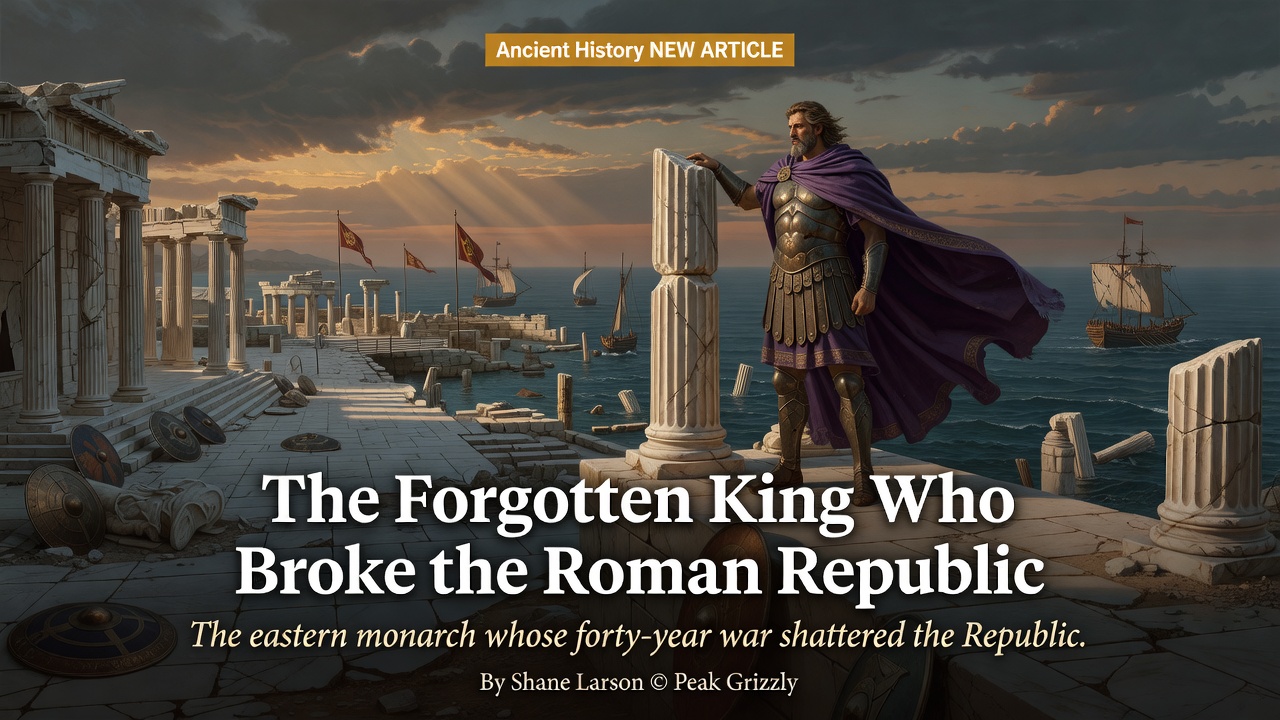
The Forgotten King Who Broke the Roman Republic
May 12, 2026 · 10 min read
The Roman Republic broke in the early 80s BCE. Most readers know the rough outline: a general named Sulla, in dispute with his political rival Marius over command of an eastern war, marched his army on Rome itself — the first time in Roman history a Roman commander had ever invaded the city with his troops. The precedent he set would be followed by Caesar a generation later. The civil wars that produced the dictatorship of Sulla, the rise of Pompey and Crassus and Caesar, the Triumvirates, the assassination of Caesar, and eventually the principate of Augustus are all downstream of that single moment when Sulla decided that controlling the city of Rome by force was a politically thinkable thing for a Roman commander to do.
The conventional story attributes this to internal Roman dynamics. Class conflict between the optimates and the populares. The legacy of the Gracchi reforms. The structural weakness of a republic running an empire it had not been designed for. The personal ambitions of the great commanders. These factors are all real, and they all matter.
But the conventional story leaves out the immediate trigger. Sulla marched on Rome because of an eastern war. The eastern war was against a king most readers have never heard of, named Mithradates VI Eupator. Sulla wanted the command. Marius's faction was trying to take it from him. Sulla refused to let the Roman political system deny him what he had militarily earned, and he used military force to keep the command. The chain of events that broke the Republic started there.
Almost nobody in the modern English-speaking world knows the king at the center of this. He is one of the most consequential figures of the late Roman Republic, and his name does not circulate the way Hannibal's or Spartacus's or Cleopatra's do. He should be more famous than he is. This piece is an attempt to fix some of the forgetting — and to argue that you cannot understand the fall of the Republic without him.
Who He Was
Mithradates VI Eupator was the king of Pontus, a Hellenistic kingdom on the southern coast of the Black Sea, in what is now northeastern Turkey. He inherited the kingdom in 120 BCE, when his father died of poison at a banquet. He was twelve years old. His mother, who became regent, probably wanted to kill him in favor of her younger son. He fled into the mountains of Pontus and spent the next several years on the run.
The ancient sources describe what he did during those years in colorful terms. He hunted dangerous game. He learned multiple languages (Pliny the Elder eventually credited him with twenty-two, a number plausible if not certain). He slept under the open sky. And — most famously — he took small doses of every known poison, gradually increasing the doses, to build up immunity against assassination attempts. This regimen is the origin of the modern English word mithridatism (resistance to poison built through controlled exposure) and gave its name to the mithridate, a universal antidote that European apothecaries compounded continuously from the medieval period until the British Pharmacopoeia removed it in 1788.
He came back to Sinope around 113 BCE and took his throne in a coup. He was twenty-two. His mother died (probably executed, possibly by suicide), his younger brother died, the senior court figures who had supported the regency were purged, and he began the work of consolidating his kingdom.
Over the next two decades, he built it into something far larger than what his father had left him. He absorbed Lesser Armenia and the eastern frontier territories. He brought Colchis into his system, giving him control of the eastern Black Sea coast. He took over the Bosporan Kingdom in the Crimea, giving him a second base on the northern coast. He defeated the Scythian peoples north of the Black Sea, recruited them as auxiliaries, and built a heterogeneous army that combined Hellenistic-style heavy infantry, Iranian heavy cavalry (including the armored cataphracts that would surprise Roman commanders in their first encounters), and steppe mounted archers. He built a navy of several hundred warships. He cultivated diplomatic relationships with every major royal court in the Hellenistic world. He married his daughters into the major Iranian and Hellenistic dynasties — including the future Tigranes the Great of Armenia, who would become his son-in-law and his refuge in the Third War.
By the late 90s BCE, Pontus was the leading non-Roman power in Anatolia. The Roman senate had begun to notice, and the diplomatic relationship — nominally still an alliance, technically still in force — was deteriorating.
What He Did
In 88 BCE, Mithradates struck.
The trigger was a Roman commissioner named Manius Aquillius, who had been sent to Anatolia to enforce Roman interests and had encouraged the Bithynian king to invade Pontic territory as a deliberate provocation. Mithradates protested. Aquillius refused to call back the invasion. Mithradates defeated the Bithynian army, invaded Bithynia, then invaded the Roman province of Asia. The Greek cities of the province — many of which had been impoverished and embittered by the Roman tax-farming system — welcomed him as a liberator.
Then he did the thing that defined the rest of his reputation. He sent coded letters to every major city in the province, ordering the simultaneous killing of every Roman and Italian resident on a specified day. The instructions were detailed. The day came. The cities did as they had been told. The ancient sources give numbers between 80,000 and 150,000 dead. Modern historians put the figure lower but no one estimates fewer than tens of thousands. The Asiatic Vespers, as the massacre has come to be called, was the largest coordinated anti-Roman action of the Republican period.
The Roman response was a war that would last twenty-five years. Three separate wars, in fact, conventionally numbered the First (89-85 BCE), Second (83-81 BCE), and Third (73-63 BCE) Mithradatic Wars. Three of Rome's greatest generals were sent against him in succession — Sulla, Lucullus, and Pompey. Each one defeated him in major engagements. Each defeat proved temporary. Sulla won the war in Greece and signed a generous treaty because he needed to go home and fight a civil war (the civil war Mithradates had inadvertently enabled). Lucullus invaded Pontus, drove Mithradates to Armenia, won crushing victories at Tigranocerta and Artaxata — and then watched his own army mutiny on him just as he was about to finish the job. Mithradates returned. Pompey finally took the command in 66 BCE, defeated Mithradates in a night attack, drove him out of Pontus, and reorganized the entire Roman east.
Mithradates
Mithradates fled across the Caucasus mountains to the Bosporan Kingdom in the Crimea. He was almost seventy years old. He had no Roman force pursuing him there — the terrain was impossible for legions. He was, theoretically, safe.
But he was also done. His son Pharnaces, watching his father plan an audacious overland invasion of Italy through the Balkans, conspired with the local elite of the Bosporan Kingdom to depose him. The army turned. The garrisons defected. Mithradates retreated to the citadel at Panticapaeum (modern Kerch) with his last loyalists. He gave his daughters poison and they died. He took poison himself and it did not work. He turned to his Gallic bodyguard Bituitus and asked to be killed by the sword. Bituitus complied. The body was sent to Pompey, who was wintering at Amisus on the Pontic coast. Pompey gave it royal honors and buried it in the Mithradatic family tombs at Sinope.
This was March of 63 BCE.
Why It Matters
The Mithradatic Wars are not a side-show in the late Roman Republic. They are one of the main mechanisms by which the Republic broke.
Sulla marched on Rome in 88 BCE because he wanted the command against Mithradates. The Marian-Cinnan regime that ruled Rome while Sulla was in Greece had every incentive to undermine him; the civil war that followed was a direct consequence. Lucullus's eastern command between 73 and 67 BCE consumed Roman political capital for a decade and ended in a humiliation that destroyed his own career and gave his opponents — particularly the equestrian publicani, whose tax-farming abuses Lucullus had restricted — a free hand. Pompey's eastern settlement between 66 and 62 BCE gave him the wealth, the prestige, and the client networks to attempt to dominate Roman politics on his return. The First Triumvirate of 60 BCE, the rivalry between Caesar and Pompey, the civil war of 49-45 BCE, the assassination of Caesar in 44 BCE — every step in this chain has a Mithradatic precondition.
Without Mithradates, there is no Sulla's march on Rome. Without that march, the late Republican pattern of military strongmen seizing the city does not get established. Without that pattern, the chain of civil wars that produced the empire does not follow the path it followed. The shape of Roman history — and through Roman history, the shape of European political thought, the shape of the Western legal and constitutional tradition, the shape of all the political systems that descend from the Roman model — is significantly different.
This is a big claim. But it is the claim of every serious modern study of the late Republic that takes the eastern dimension seriously. The internal Roman dynamics are real, but they were channeled and accelerated and made tractable by the strategic pressure of the Mithradatic Wars. The standard narrative that puts Caesar and Pompey at the center and Mithradates at the periphery has the framing backwards. The man in the east created the political weather. The men in the west operated within it.
The Forgetting
Why does almost nobody know this?
Several reasons. The Roman literary tradition that shaped Western memory privileged Roman commanders and treated their enemies as foils. The Greek and Iranian traditions that might have preserved an alternative perspective got absorbed into the Roman provincial system and gradually lost their independent voice. The Hellenistic dynastic culture that Mithradates represented was extinguished within a generation of his death. The medieval Christian tradition that mediated classical learning to the modern West had little use for Hellenistic kings of obscure Asian states. The 19th-century classical curriculum that shaped Anglophone education focused on the canonical Greek and Latin literary texts, which treated Mithradates as a colorful detail in the larger Roman story. He survived in academic contexts but slipped out of the popular consciousness.
There is also a more specific issue. Mithradates was complicated. He was not a noble freedom fighter. He organized the killing of tens of thousands of unarmed civilians as a strategic instrument. He executed several of his own sons. He ruled with paranoid violence. He does not fit the modern romantic mode of "Rome's heroic enemies" that has kept names like Hannibal and Vercingetorix and Spartacus in circulation. He was a Hellenistic-Iranian king operating in a Bronze-Age-derived dynastic system, capable of strategies and brutalities that the modern reader has to work to put in their proper context. The figures who survive in popular memory tend to be the ones whose stories can be told in straightforward heroic or tragic frames. Mithradates does not have a straightforward frame.
But he was, by any honest accounting, one of the great political and military figures of his age. He fought Rome for forty years. He survived three Roman generals. He triggered the political collapse that produced the empire. He was the centerpiece of Pompey's triumph in 61 BCE and was still being argued about, by Cicero and Plutarch and Appian, decades after his death. The eastern Mediterranean of the late Republic was substantially organized around him for forty years. He deserves to be remembered.
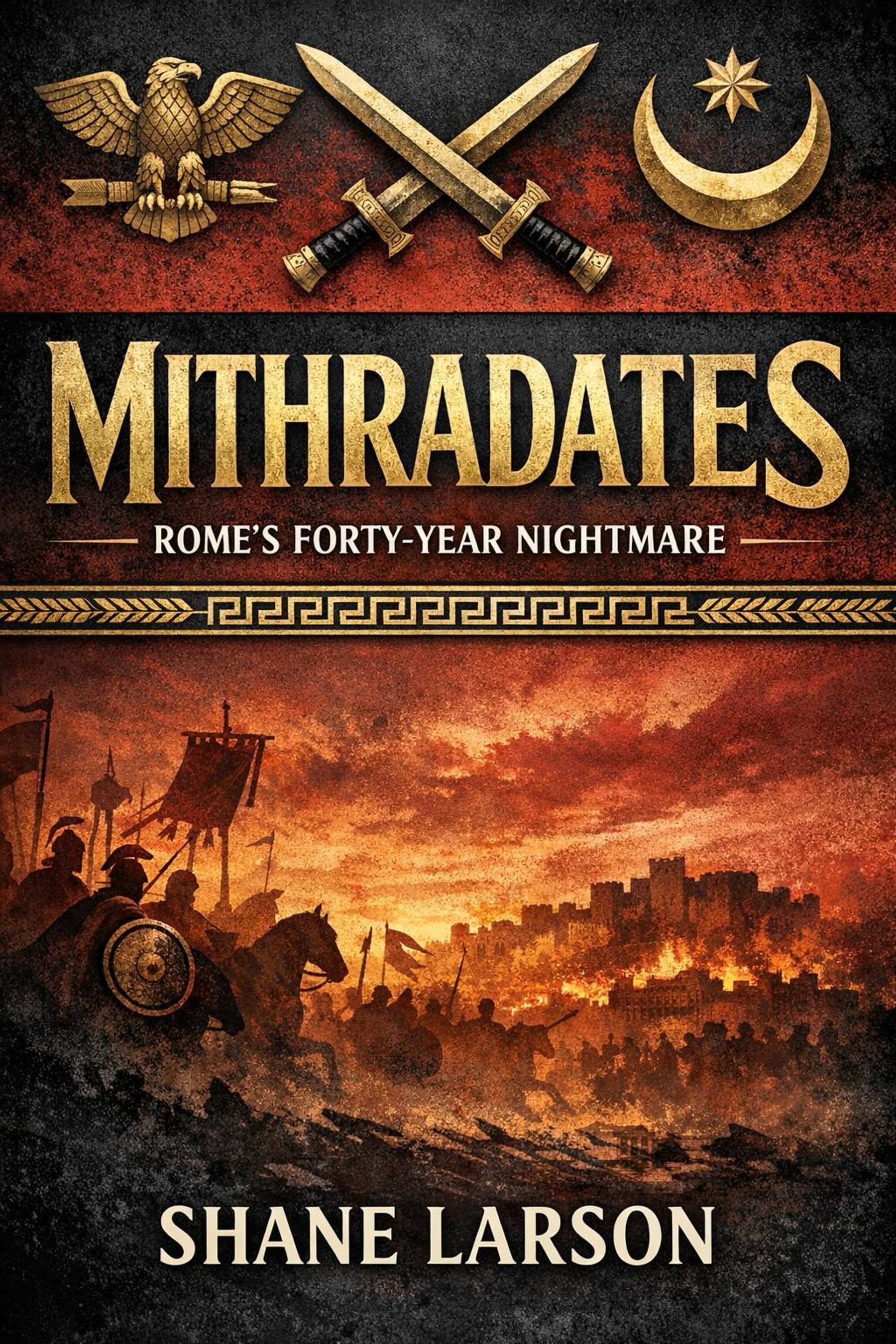
If this resonated, the book it grew out of — Mithradates: Rome's Forty-Year Nightmare — goes much deeper. Into the poison childhood. Into the consolidation of the Black Sea empire. Into the Vespers itself and the three wars and the death in the Crimea. Into the long afterlife in European medicine and literature — the mithridate antidote that European apothecaries compounded for fifteen hundred years, Racine's tragedy of 1673, Mozart's first major opera of 1770, the modern academic recovery from Theodor Mommsen through Adrienne Mayor's 2010 biography.
The book is the version of the late Republic that puts him back where he belongs. The Republic the Romans broke is not entirely a Roman story. Half of it happened in the east, against a king most readers have never heard of. This is the book about that king.
Mithradates
New posts and releases, straight to your inbox. No spam, unsubscribe anytime.