Nobody Alive in 476 Thought the Roman Empire Had Just Ended
August 5, 2026 · 6 min read
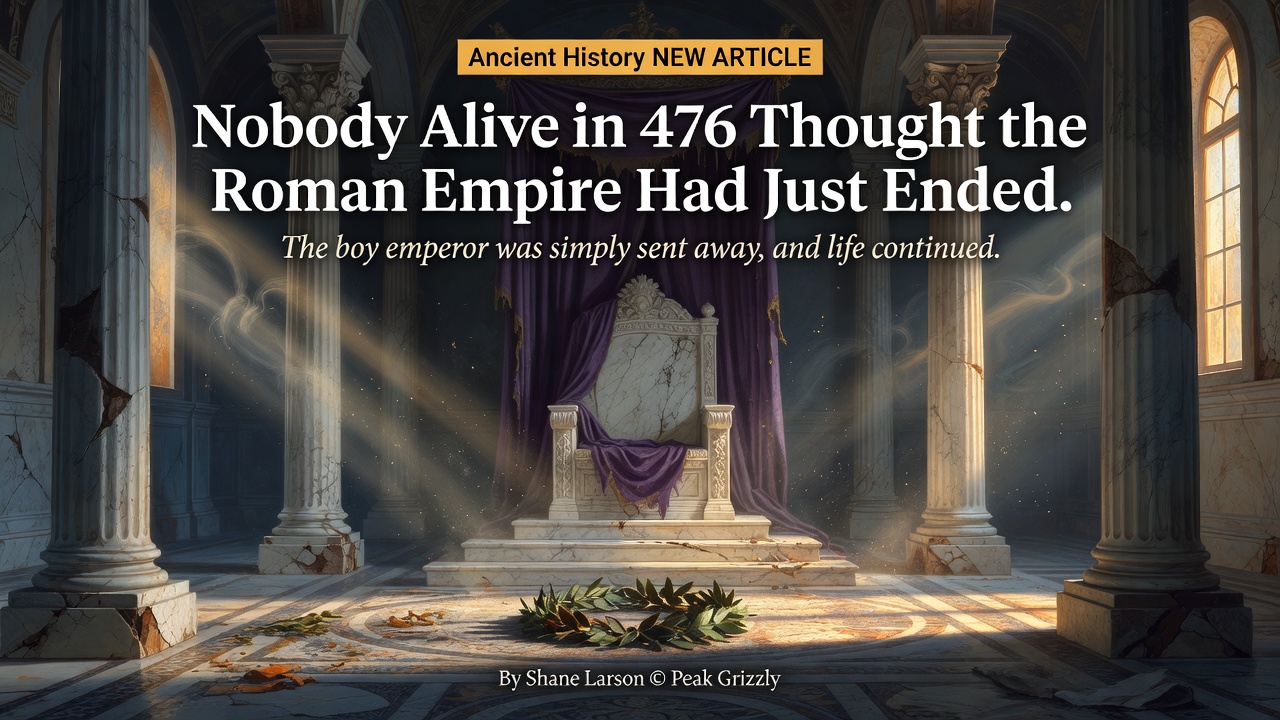
On 4 September 476, a general named Odoacer deposed the western Roman emperor. The date is taught as the end of antiquity and the beginning of the Middle Ages.
Here is what actually happened.
The emperor was a boy of about fourteen named Romulus Augustulus — a name that reads as a joke history played, combining the legendary founder of Rome with a diminutive meaning "little Augustus." He had been placed on the throne the previous year by his father Orestes, a Roman official who had once served at Attila's court and who controlled the barbarian troops that by then constituted the western army. Orestes had risen through the ranks after the collapse of Attila's empire in 453, returning to Italy with connections to both Roman administration and the federate soldiers who now made up most of the western forces.
Constantinople never recognised him. In the East's view the legitimate western emperor was Julius Nepos, whom Orestes had driven out and who was still alive in Dalmatia. So the "last Roman emperor" was, in the eyes of the surviving half of the empire, not an emperor at all. Eastern emperors had already grown accustomed to treating the West as a subordinate region whose rulers required their approval, and they had withheld it from several short-lived predecessors.
Orestes lasted about a year. His troops — Heruli, Scirians, and others — demanded a third of Italy's land to settle on, which is what similar groups had already obtained in Gaul, Spain, and Africa. He refused. They revolted, chose Odoacer, and killed him. The demand itself followed a familiar pattern: earlier settlements in Gaul had used similar fractions of tax revenue or land, often formalised through treaties that left Roman landowners in place while redirecting portions of the fiscal yield.
Odoacer then removed the boy, and did not kill him. Romulus was sent to a villa in Campania with a pension. The sources record that the youth lived out his days in relative comfort at the Lucullan villa near Naples, a detail preserved in both eastern and western chronicles.
That mildness is the most informative detail in the whole episode. You do not pension off a threat. The western emperor had become sufficiently irrelevant that disposing of him required no violence — he was a symbol that had outlived its function, and everyone involved understood that. Previous depositions had often ended in executions or exile to distant frontiers; here the outcome was closer to early retirement.
Nothing Announced Itself
Odoacer did not claim the imperial title. He sent the western imperial regalia to Constantinople with a message that the West no longer needed a separate emperor, and ruled Italy as king while acknowledging the eastern emperor's nominal authority. The gesture was pragmatic rather than ideological; it removed the costly fiction of a parallel court while preserving the legal fiction that Italy remained part of a single Roman realm.
Meanwhile, in Italy, most things continued.
The Senate kept meeting. Consuls kept being appointed. Roman law remained in force and Roman courts kept operating. Taxes were collected by the same apparatus. Landowners held their estates. The Church, by now the most durable institution in the West, carried on entirely uninterrupted. Papal correspondence from the period shows bishops continuing to petition the same urban prefects and provincial officials who had served under the last emperors. No contemporary source treats 476 as the end of the Roman Empire. The chroniclers who mention it at all record it as one more coup in a century that had produced a great many, in a place where emperors had been installed and removed by generals for decades. The elevation of the date came later, from historians looking backward for a place to put a boundary.
Which raises the obvious question of whether anything fell.
The Two Positions, Both With a Case
Historians have argued this for fifty years, and the argument is worth understanding because both sides are holding something real.
The Fall of Rome
The transformation view says the western empire did not collapse so much as change form. Roman institutions, law, language, and religion continued under new management. The barbarian kingdoms that replaced imperial administration were largely Romanised — they used Roman law for their Roman subjects, employed Roman bureaucrats, and generally wanted to inherit the system rather than destroy it. Theodoric's Ostrogothic Italy governed with a Roman civil service and a Roman senator as chief minister; the same pattern appears in the Burgundian kingdom, where Roman legal codes were adapted rather than replaced, and in Visigothic Spain, where Gothic rulers maintained Roman tax rolls and municipal offices for decades. On this reading, "fall" is the wrong metaphor for a continuous, if disrupted, evolution into the early medieval world.
The decline view answers that this is too comfortable, and points at the material record. And the material record is stark.
Pottery is the classic evidence. Under the empire, high-quality, standardised, mass-produced pottery reaches ordinary households across the West — including in Britain, at the far edge. Fine wares such as African Red Slip from North Africa and Gaulish samian ware appear in rural sites as well as towns, evidence of integrated markets and specialised kilns. In the fifth and sixth centuries that distribution collapses. The quality falls, the sophistication falls, and in Britain the wheel-thrown pottery industry essentially disappears for centuries. That is not a change in taste. It is the failure of a specialised, integrated economy that had supported skilled producers and long-distance distribution. The same pattern shows in building in stone, in coinage, in literacy rates, in the size of cattle. Urban excavation layers from the period reveal fewer new public buildings, reduced maintenance of aqueducts and roads, and a measurable drop in average animal bone size, indicating poorer nutrition. Living standards for ordinary people fell substantially, and stayed fallen for a long time.
The honest synthesis is that both are describing different things accurately. Institutions and culture were substantially continuous; the economy and material conditions genuinely collapsed. Whether you call that a fall or a transformation mostly reveals whether you are looking at elites or at everybody.
Why the Date Persists Anyway
A boundary that arbitrary survives because narrative requires one.
Long, ambiguous processes are difficult to teach, difficult to structure a syllabus around, and unsatisfying to read. So a moment gets promoted: a specific day, a named last emperor, a barbarian general — a scene with characters in it.
The problem is that the scene actively misleads. It suggests a fall, and a fall implies a sudden external blow. What the evidence describes instead is roughly two centuries of erosion: a shrinking tax base, an army increasingly staffed by people with no attachment to the state paying them, provinces slipping out of central control one at a time, and a political system that spent a century removing its own emperors. The third-century crisis had already exposed the fiscal and military weaknesses; Diocletian and Constantine restored surface stability through heavier taxation and a more rigid bureaucracy, but the underlying vulnerabilities remained.
By 476 the western empire had already lost Britain, most of Gaul, Spain, and North Africa — and Africa mattered enormously, because it was the grain supply that fed Rome and supported the annona system. What Odoacer deposed was the emperor of Italy and a title. The remaining western provinces operated under local rulers who still used Roman titles and procedures where convenient, but without any central coordination from Ravenna or Rome.
The Roman Empire did not end on a Tuesday in September. It thinned out over generations until the last removal of an emperor was a personnel decision, and the person it happened to received a villa and an allowance.
The Fall of Rome: Decline and Transformation covers the whole arc — the height, the third-century crisis, Diocletian and Constantine, the permanent division, the barbarian settlements, the shrinking West, what was lost and what survived, and why the eastern half kept going.
The Fall of Rome
New posts and releases, straight to your inbox. No spam, unsubscribe anytime.