Nobody Rebuilt the Palaces: The Fact That Explains the Bronze Age Collapse
July 28, 2026 · 9 min read
Around 1200 BC, over the span of roughly fifty years, nearly every major city in the eastern Mediterranean was destroyed, abandoned, or violently diminished. The palace-citadels of Mycenaean Greece burned. The Hittite capital of Hattusa, seat of a superpower that had fought Egypt to a standstill, was evacuated and then torched. The merchant city of Ugarit on the Syrian coast, one of the richest ports on earth, died so completely that its very name dropped out of human memory for three thousand years. Historians call it the Bronze Age Collapse, and it is the largest civilizational failure in the ancient record before the fall of Rome.
The destruction is what gets the attention, and understandably so. A black layer of ash and collapsed mudbrick runs through excavation sites in eight modern countries at roughly the same depth and roughly the same date. It is one of the most dramatic horizons in all of archaeology.
But the destruction is not the strange part. Ancient cities burned constantly. They burned in wars, in raids, in accidents, in earthquakes, and the standard sequel to a burned ancient city was a rebuilt ancient city, usually within a generation. Troy was destroyed and rebuilt so many times that its mound contains nine major cities stacked like a layer cake. Babylon was sacked and restored repeatedly across two thousand years. Destruction, in the Bronze Age world, was weather. You cleared the rubble and you built again, because the things that had made the city worth having — the harbor, the farmland, the trade route, the sanctuary — were still there.
The strange part, the genuinely anomalous part, is what happened after 1200 BC: nothing.
Ruins in inhabited country
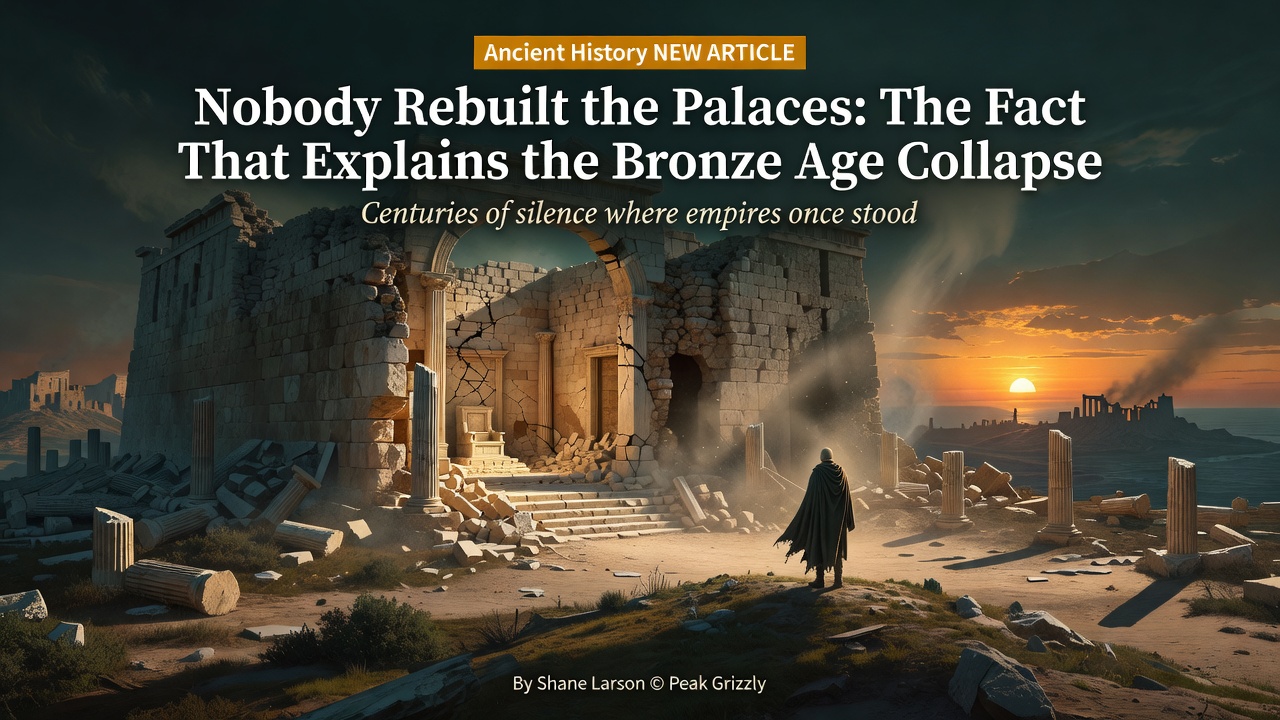
At Pylos, in the southwestern Peloponnese, a Mycenaean palace burned somewhere around 1180 BC. The fire was hot enough to bake the palace's clay administrative tablets into permanence, accidentally preserving the last written Greek anyone would produce for about four hundred years. And then the site sat there. Not for a decade — for centuries. No new palace. No restored archive room. The region was not empty; survey archaeology shows people living in the area, at reduced but real numbers, throughout the period that followed. They simply did not rebuild.
The same pattern repeats across the map. At Mycenae and Tiryns, the great Cyclopean walls — fortifications so massive that later Greeks assumed giants had built them — stood essentially intact. Walls are the expensive part. The hard work was already done, waiting. Some diminished occupation lingered among the ruins for a while, and then even that faded, and the citadels stood empty in open country while ordinary life went on in villages nearby. Close enough to quarry the stones. Close enough that, centuries later, the ruins were still visible enough to accumulate legends.
At Hattusa, the evidence suggests the capital was substantially evacuated before it burned — archives removed, valuables gone, an orderly departure followed by fire in a half-empty city. The Hittite state did not relocate and carry on, the way states usually do when they lose a capital. It ceased to exist as a political fact, so thoroughly that its rediscovery had to wait for modern archaeology.
Ugarit is the extreme case. The city burned around 1190 BC, a thin squatter reoccupation flickered and went out, and then the greatest port of its age became an anonymous hill. When people settled that coastline again in later centuries, they built somewhere else.
So the question that actually matters about the Bronze Age Collapse is not "who burned the palaces?" — a question that, for most sites, the evidence cannot answer anyway; arrowheads carry no flags. The question is: why did nobody rebuild? People survived in every one of these regions. The land still produced. The harbors were still harbors. Rebuilding was the invariable ancient response to destruction, until this one time it wasn't. Four hundred years of it wasn't, in the Greek case.
Answer that question and you are most of the way to understanding the whole event.
What a palace was actually for
To see why the rebuilding never came, you have to be precise about what these buildings were. "Palace" suggests a royal residence, a big house for a king. That is not what a Mycenaean palace was. A Mycenaean palace was an economic machine — the hub of what scholars call a redistribution economy. The palace assessed the countryside, collected its wool and flax and grain and labor, warehoused the proceeds, fed and equipped specialized craftsmen, and pushed the finished goods — textiles, perfumed oil, chariots, bronze — into long-distance trade networks that brought back what the kingdom could not produce. Above all, what no Aegean kingdom could produce: the copper and tin that made bronze, neither of which Greece had in usable quantities.
The palace's clay tablets, where they survive, are almost comically unliterary. Ration lists. Flax quotas. Inventories of chariot wheels. Personnel rosters. The palace was, functionally, an administrative apparatus with architecture around it — a node in an international system that stretched from Sardinia to Mesopotamia, moving metal, grain, and luxury goods in quantities that would not be seen again for centuries. One shipwreck from the system's high noon, found off the Turkish cape of Uluburun, carried ten tons of Cypriot copper and a ton of tin in a single hull, along with Baltic amber, African ebony, and goods from ten distinct cultures.
That system is what justified the palace. The assessments, the quotas, the scribes, the storerooms — the whole extractive weight of the institution pressed down on the countryside, and what held it in place was the return flow: the bronze, the prestige goods, the imported materials, the security, the connection to a wider world that made the palace the indispensable middleman. A palace was a bet on the network. It ran a leveraged, specialized, efficient operation, and like most leveraged operations, it looked brilliant right up until the margin call.
When the World Burned
The network dies first
The Bronze Age Collapse, on the account the evidence best supports, was not fundamentally a military event. It was a systems failure. Beginning in the late thirteenth century BC, a run of correlated shocks hit the eastern Mediterranean within a few decades: a severe, prolonged drying of the climate — now documented in cave formations, lake cores, and pollen sequences — with harvest failures behind it; disruption of the shipping lanes; movements of displaced and desperate populations; earthquakes at some sites; and opportunistic raiding by the loose maritime groups Egyptian scribes lumped together as the Sea Peoples. No single one of these was fatal. The system had survived droughts, wars, and earthquakes before. What it could not survive was all of them at once, because it had been optimized over three centuries for efficiency rather than resilience: single-source metals, imported grain, one palace per kingdom, one archive per palace, no redundancy anywhere.
Connected systems fail the way the connections run. Grain routes failed, which starved states that could not feed themselves — the Hittite Empire, remarkably, imported much of its grain by sea, and its late correspondence shows a superpower negotiating for food shipments as a matter of explicit life and death. Starvation moved populations. Moving populations broke ports and shipping. Broken shipping deepened the starvation and cut the metal trade. Each failure propagated the next, and within about two generations the network that had bound the region together for three centuries simply stopped existing.
Now put the palace back in the picture. A palace with the network behind it was the most powerful institution in its world. A palace without the network was a protection racket with nothing to protect and nothing to deliver — an apparatus for collecting flax quotas to feed a trade that no longer existed, staffed by scribes recording obligations no one would ever again redeem. The building might survive. The institution was already dead.
The verdict of the survivors
Which is why nobody rebuilt, and why the non-rebuilding is not a minor postscript but the single most diagnostic fact in the record.
Rebuilding is a decision, made by survivors, about whether an institution earned its keep. Every previous destruction in the region's long history had been followed by reconstruction because the answer had always been yes: the network that made a palace or a port worth having was still out there, waiting, the moment the rubble was cleared. This time the network itself was the casualty. A rebuilt palace at Pylos in 1150 BC would have administered quotas for nobody, stockpiled surplus against nothing, and demanded the old extraction while delivering none of the old returns. The people living in the villages around the ruins — people who had carried, for generations, the memory of what the palace took from the countryside — looked at the standing walls and declined.
Destruction is an event. Not rebuilding is a verdict — delivered slowly, over generations, by the survivors, and the verdict was: not worth what it cost.
That reading also explains what happened next, which is otherwise a puzzle. Because the centuries after the collapse, for all their genuine poverty and silence, were quietly among the most inventive in human history. The alphabet — a script simple enough to learn without a palace bureaucracy to employ you — spread along the Levantine coast precisely because the institutions that had monopolized writing were gone. Phoenician trading houses, answering to no imperial overlord, pushed their ships farther than any palace fleet had gone. Iron replaced bronze not because early iron was better — it mostly wasn't — but because its ore was everywhere and needed no thousand-mile supply chain, which meant serviceable metal in ordinary hands for the first time. And in Greece, small communities rebuilt social life from the village up, without divine kings or archive rooms, and had to improvise new ways of making collective decisions. The road from those improvisations leads, eventually, to the polis.
None of that grows in the shadow of a functioning palace. All of it grew in the space the palaces left behind. The survivors were not just refusing to restore the old system; slowly, unknowingly, they were building the things that would make it permanently obsolete.
A conclusion the ruins insist on
There is a version of this argument that curdles into a modern parable — fragile networks, efficient systems, a warning to our own interconnected world. I have come to think that reading is a mistake, and I say so as someone who finds the parallels as tempting as anyone. The people of Pylos and Ugarit and Hattusa were not rehearsing our future. They were living their own present, the only one they had, and their catastrophe deserves to be understood on its own terms rather than mined for lessons.
But on its own terms, the conclusion stands. If you want to know why the Bronze Age world ended, do not start with the fires. Fires are common and mostly anonymous. Start with the silence after them — the centuries of standing ruins in inhabited country — and ask what has to be true for that silence to make sense. The answer is that the palaces were never really the thing. The network was the thing. The palaces were just what the network looked like from the ground, and when it died, they went from being the center of the world to being large piles of well-cut stone, and the survivors treated them accordingly.
The ruins are not evidence of what the catastrophe destroyed. They are evidence of what the survivors decided not to bring back.
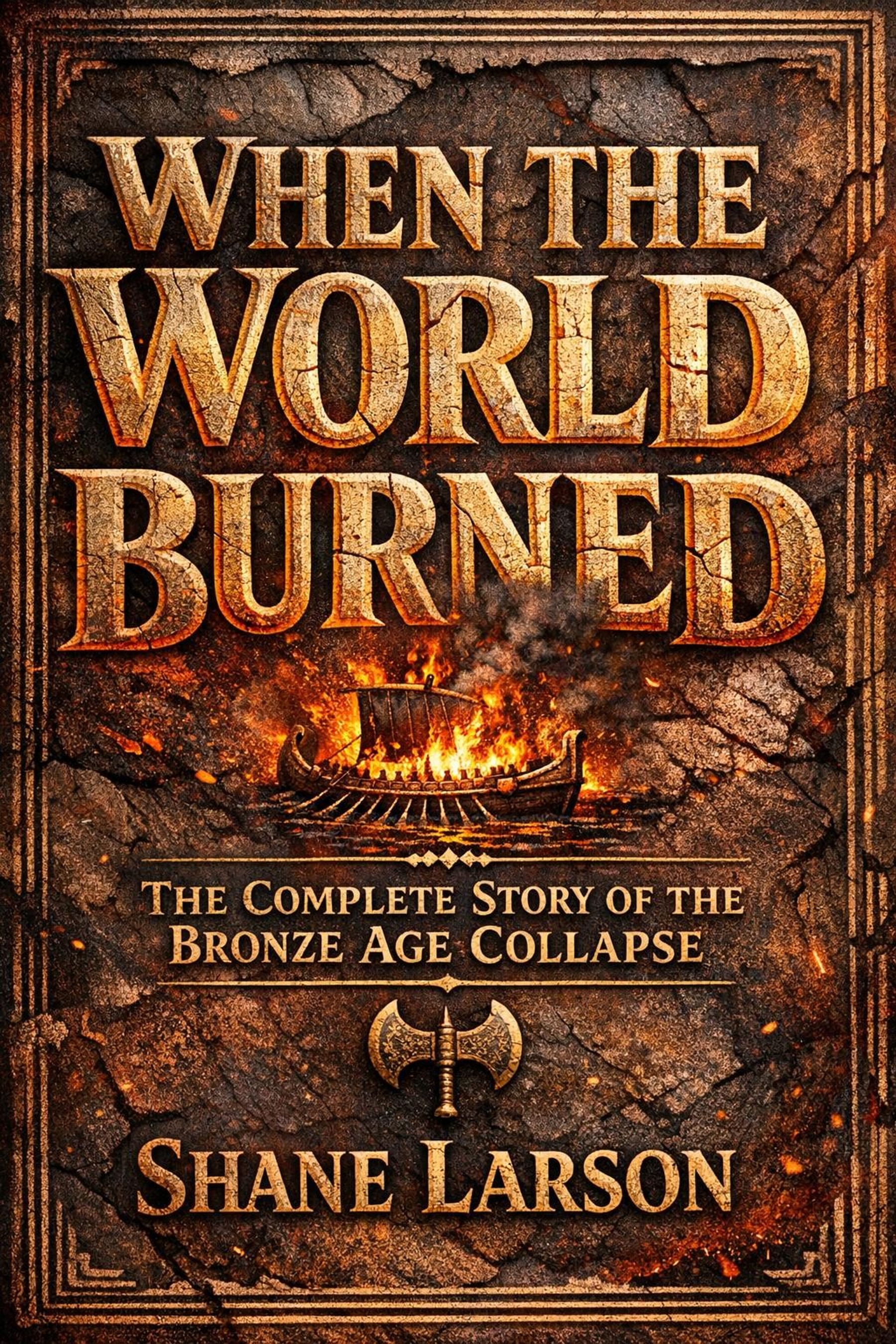
This essay is drawn from an argument that runs through my new book, "When the World Burned: The Complete Story of the Bronze Age Collapse" — a single-volume narrative of the entire event: the connected world at its height, the destruction site by site, the causes weighed with the confidence levels stated, and the four centuries of aftermath in which the alphabet, Phoenicia, Israel, iron, and a new Greece grew out of the wreckage. If this piece left you wanting the whole story, that is the book it came from.
When the World Burned
New posts and releases, straight to your inbox. No spam, unsubscribe anytime.