The First Civilization of the Americas Has No Name
July 22, 2026 · 6 min read
Here is a fact that ought to be far more famous than it is: the first civilization of the Americas is one we cannot name.
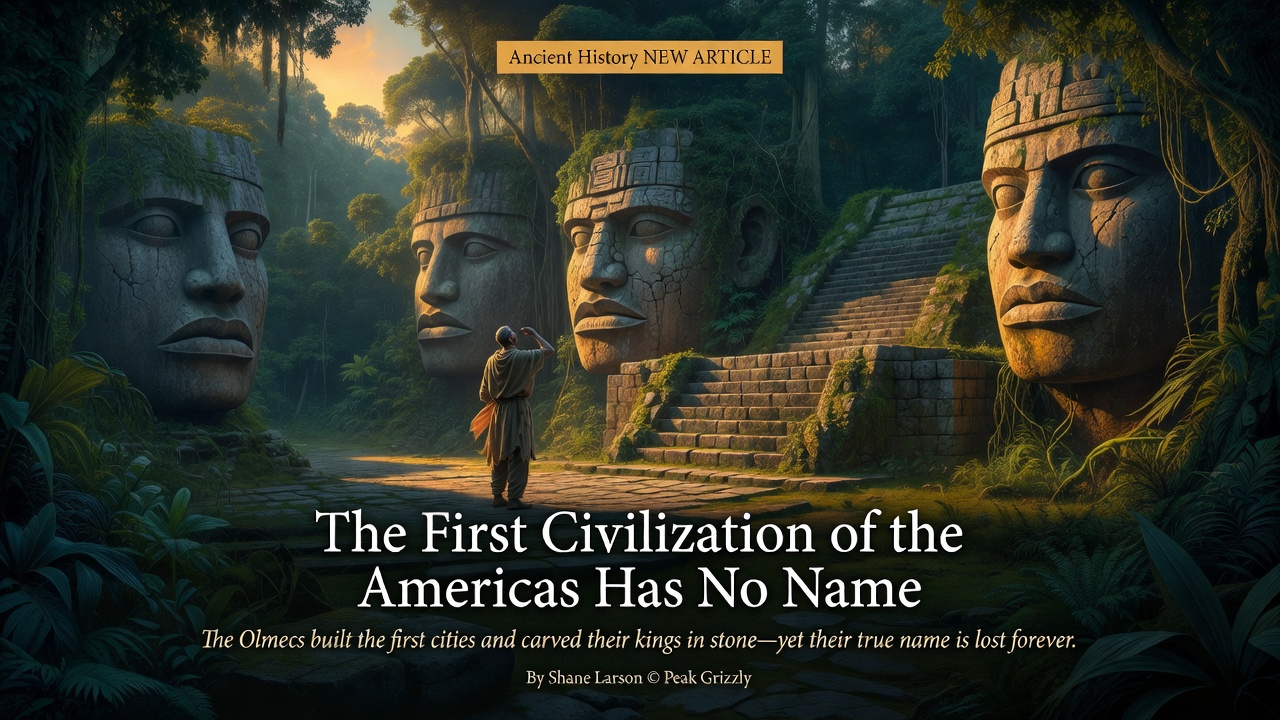
We know a great deal about them. We know where they lived, what they ate, how they built, what they seem to have believed. We have their cities, their pyramids, their jade, their tombs, and seventeen monumental portraits of their kings carved from multi-ton boulders of volcanic stone. What we do not have is the one thing that seems most basic — their name for themselves. The word we use, "Olmec," is not theirs. It is Aztec, meaning roughly "rubber people," and the Aztecs coined it two thousand years after the Olmec civilization had already collapsed, applying it loosely to whoever happened to live in the rubber-growing lowlands where the ruins were. It is as though the whole of ancient Egypt were known to history only by a nickname invented by medieval Europeans. The founders of Mesoamerican civilization are, in the most literal sense, anonymous.
And they were the founders. That is the part worth sitting with.
Before Everyone Else
Most people meet the ancient Americas through the Aztecs and the Maya — the Aztecs because the Spanish conquered them and left written accounts, the Maya because of their jungle ruins and their famously mysterious collapse. But both of those civilizations were latecomers to a story that had begun a very long time before. Three thousand years before Cortés, while the Bronze Age was ending on the other side of the world, the Olmecs were building the first cities the Western Hemisphere had ever seen, in the hot, swampy, river-laced lowlands of the Mexican Gulf coast.
They built a city called San Lorenzo on a plateau they enlarged by hand, moving staggering quantities of earth to raise a ceremonial center above the floodplain. They built another, La Venta, around one of the earliest great pyramids in Mesoamerica, and there they buried offerings of almost incomprehensible extravagance — pits filled with hundreds of tons of imported serpentine, arranged into the faces of gods and then covered over so that no human being would ever see them again. They processed rubber from jungle latex three thousand years before Charles Goodyear stumbled onto vulcanization. They played a ballgame with that rubber that would become, and remain, the defining sport and ritual of Mesoamerica for the next three thousand years, right down to the courts the conquistadors watched. They carved jade, revered the jaguar, worshipped a maize god, and may have written the first words ever set down in the Americas.
Nearly every institution we associate with the later Maya and Aztecs — the pyramid-and-plaza city, the sacred calendar, the ballgame, the jaguar and feathered-serpent gods, the maize cosmology, the divine king immortalized in stone — appears first, or arguably first, among the Olmecs. When later Mesoamericans built their temples and played their games and read their calendars, they were elaborating a template the Olmecs had drawn. This is why the Olmecs are sometimes called the "mother culture" of Mesoamerica, and why any honest history of the Maya or the Aztecs is, secretly, a book with a missing first chapter. The Olmecs are that chapter.
Forty Tons, Sixty Miles, No Wheels
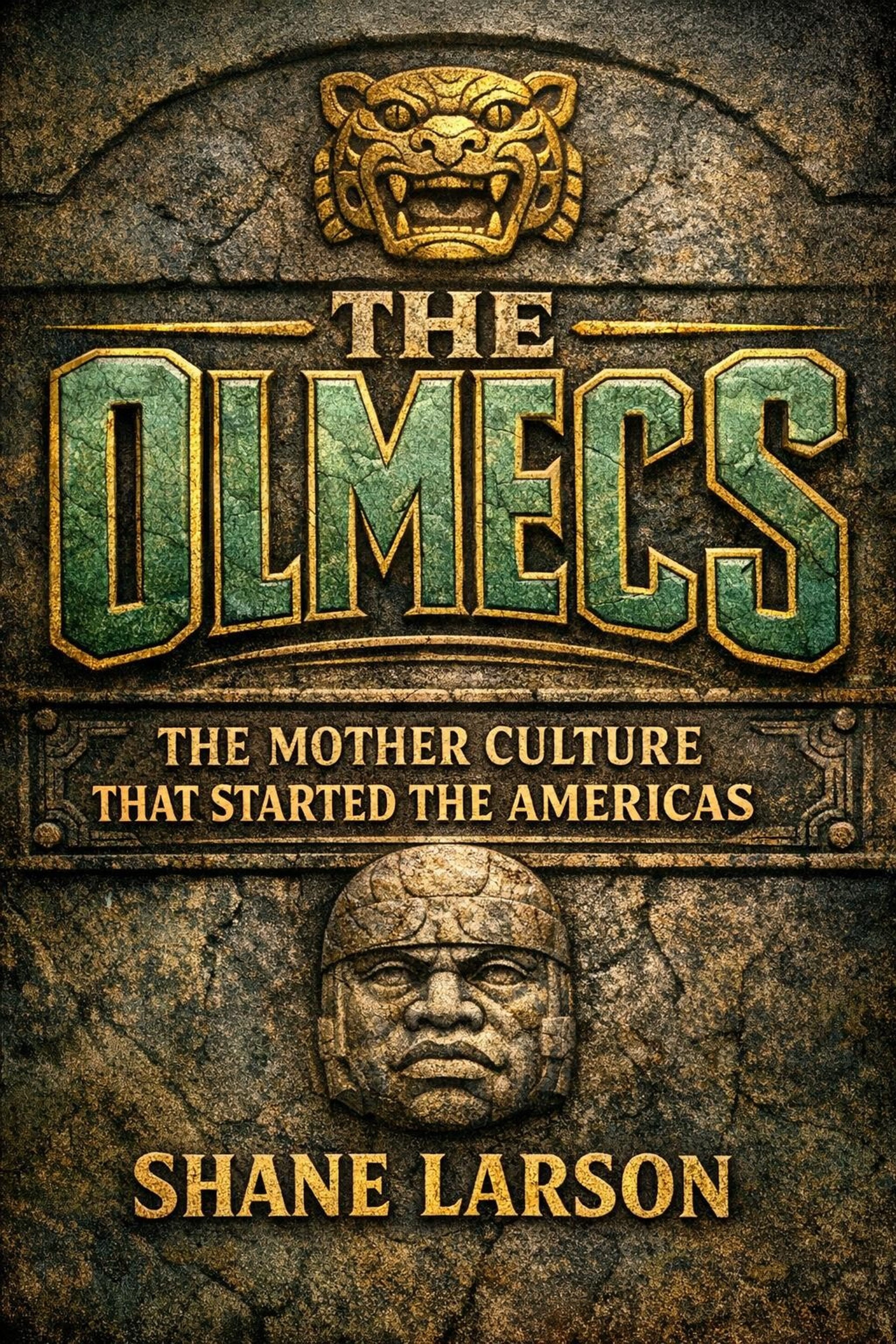
If you have seen the Olmecs at all, you have probably seen the heads. Seventeen colossal stone heads have been found, the largest standing well over nine feet and weighing more than forty tons, each carved from a single boulder of basalt, each depicting an individual human face — heavy-lidded, full-lipped, wearing a distinctive close-fitting helmet. They are among the great works of art of the ancient world, and they present one of its great engineering puzzles, because the stone they are carved from does not exist anywhere near where the heads stand. The basalt was quarried in the Tuxtla Mountains, sixty or more miles away, and moved across lowland and swamp and river to the cities where it was carved.
The Olmecs
Now consider how. The Olmecs had no wheeled vehicles for hauling. They had no draft animals — no horses, no oxen, none of the big domesticable beasts the Old World used to pull and carry, because the Americas simply had none available. They had no metal tools; they shaped even basalt and jade with stone, sand, and water. So a forty-ton block of stone was moved sixty miles, and then carved into a portrait, using nothing but human muscle, rope, wood, rafts, and organization.
That last word is the key, and it is where the real wonder lies. Because the feat looks impossible to modern eyes, it has attracted a great deal of nonsense — claims that the heads were carved by ancient African voyagers, or lost tribes, or transoceanic visitors, or, inevitably, ancient aliens. I take these claims seriously enough in the book to dismantle them properly, with the geology (the stone is local Mexican basalt), the genetics (Indigenous American populations show no pre-Columbian foreign founding signal), the archaeology (the Olmecs demonstrably developed in place, out of local farming villages, with no sign of intrusive founders), and the art history (Olmec style flows continuously into later Mesoamerican art). But the deeper problem with the fantasies is not just that they are wrong. It is what they steal. Every version of "someone else must have done it" takes a monumental achievement of Native American civilization and hands the credit to imaginary outsiders, on the unexamined assumption that the ancestors of today's Indigenous Mexicans couldn't have managed it themselves. They could, and they did. The real explanation — thousands of coordinated human beings, commanded by a society organized enough to feed and direct them toward a single monumental goal — is not a lesser story. It is the whole point. Moving those heads is not evidence of aliens. It is evidence of a state.
A Civilization Built on Honest Questions
What I love about the Olmecs, and what made me want to write about them, is that they force a particular kind of intellectual honesty. Because they left no readable texts, almost everything we say about them is inference — reconstructed from what they left in the ground, and from the risky practice of reading their images in the light of the better-documented cultures that came after. This means the subject is full of genuine, unresolved mysteries, and the temptation is either to paper over them with false confidence or to fill them with fantasy. I wanted to do neither. I wanted to treat the open questions as the story.
And the questions are wonderful. Did the Olmecs really invent the first writing in the Americas? There is a slab called the Cascajal Block, covered in sixty-two signs unlike any known script, that might be the earliest writing in the hemisphere — or might not, and the honest answer is that we don't yet know, and I explain exactly why. Were the Olmecs truly the single mother culture, or one sister culture among several developing in parallel? That is the central fight in the field, and both sides have real evidence and real weaknesses; the truth seems to be somewhere in between, influence without empire. Why did their great centers fall, their own colossal heads and royal thrones deliberately smashed and buried? We can list the suspects — invasion, revolt, environmental stress, or the Olmecs themselves ritually "killing" the monuments of dead kings — but we cannot yet crown one. Like the collapses of the Maya and of Cahokia, this one refuses a clean answer.
That refusal is not a weakness of the story. It is the story. The Olmecs are a lesson in how civilization begins — independently, from scratch, one of only a handful of times in human history — and a lesson in how completely a founding people can be forgotten, absorbed and half-remembered by their own heirs until even their name is lost. They left us faces we can look in the eye and not one word we can read. If that combination haunts you the way it haunts me, the book goes much deeper into the world behind those silent, watching stone faces.
The Olmecs
New posts and releases, straight to your inbox. No spam, unsubscribe anytime.