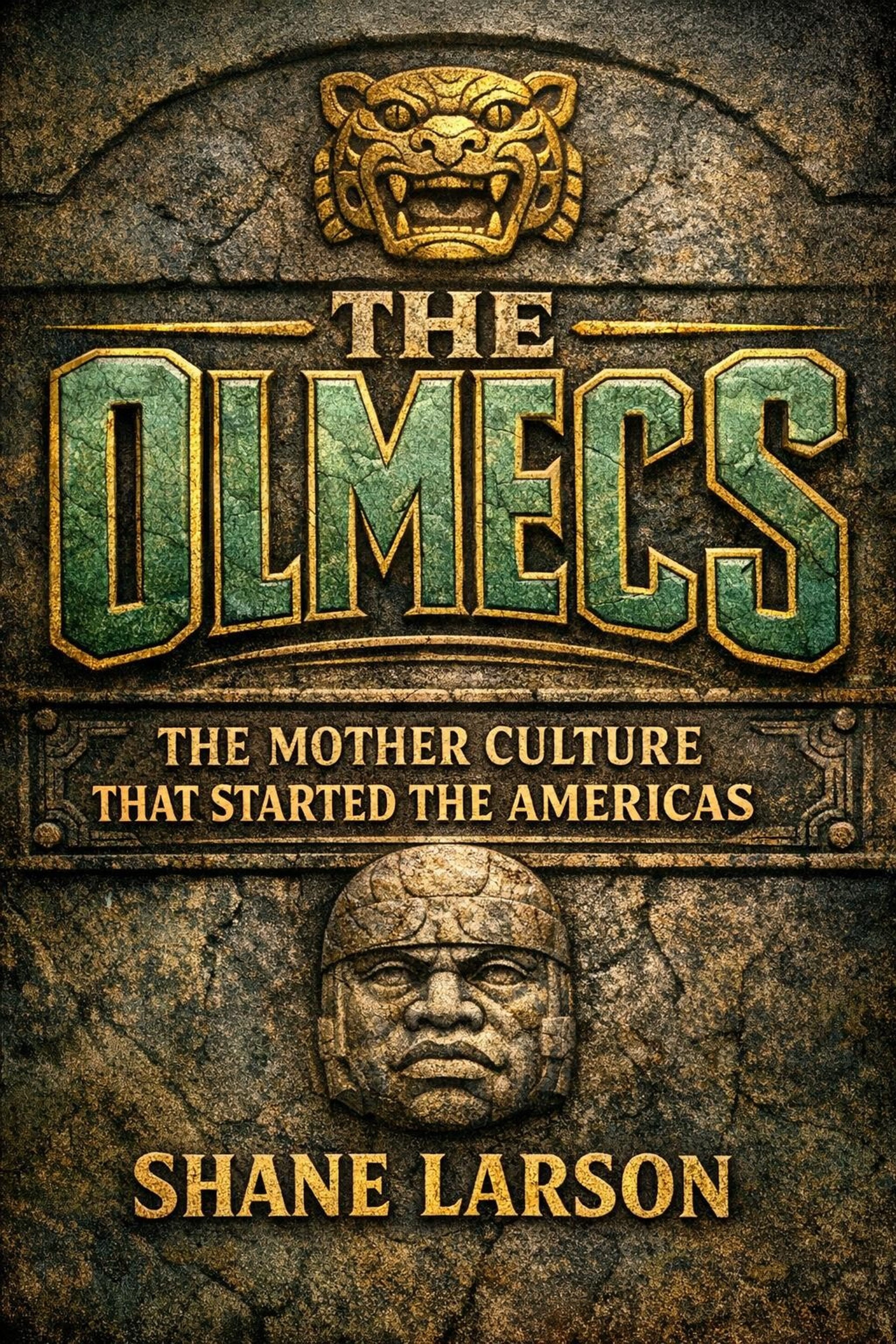
The Olmecs
The Mother Culture That Started the Americas
By Shane Larson
About This Book
Around three thousand years ago, on an island of high ground amid the swamps of the Mexican Gulf coast, a crew of laborers dug an enormous pit, filled it with hundreds of tons of blue-green serpentine stone hauled from far away, arranged the top layer into the stylized face of a supernatural being — and then buried the whole thing under a thick blanket of clay, so that no living person would ever see it again. It was an offering to the gods and the earth, and its audience was never meant to be human.
That single act tells you almost everything about the people we call the Olmecs. They commanded staggering amounts of labor. They moved precious stone across impossible distances without wheels or draft animals. They believed in gods powerful enough to deserve treasure hidden forever underground. And they did it all so early — a thousand years before the Maya built anything at all — that when later peoples looked back, they could barely remember these founders existed. We still can't. We don't even know what they called themselves. "Olmec" is a nickname the Aztecs coined two thousand years after the fact.
This is the story of the first civilization of the Americas: the people who started everything, and were forgotten by everyone.
The Missing First Chapter of the Ancient Americas
Most of us learn the ancient Americas backward, from the end. We know the Aztecs, because the Spanish destroyed them and wrote it down. We know the Maya, because of their spectacular ruins and their mysterious collapse. But behind both of them, three millennia before Cortés, stands a civilization that invented the template they inherited — and almost nobody has heard of it.
The Olmecs built the first cities of the New World in the hot river lowlands of Veracruz and Tabasco, beginning around 1400 BCE. They carved colossal stone heads, some weighing more than forty tons, from basalt quarried sixty miles away and dragged across swamp and river by sheer organized human muscle. They processed rubber from jungle latex three thousand years before Goodyear, and invented the ballgame that would define Mesoamerican life for the next three thousand years. They laid out pyramids and plazas, prized jade above all things, worshipped jaguar-gods and a maize deity, and may have written the first words in the Western Hemisphere. Nearly every hallmark of the later Maya and Aztec worlds shows up first among the Olmecs. When you look at a Maya pyramid or read about the Aztec ballcourt, you are looking at the elaboration of ideas first worked out on the Olmec coast.
And then, around 400 BCE, it ended. Their great centers were abandoned. Their own monuments — the colossal heads, the royal thrones — were deliberately defaced, smashed, and buried, whether by invaders, rebels, or the Olmecs themselves in some act of ritual closure we still can't read. The culture dissolved into the broader stream of Mesoamerican life, leaving faces we can look in the eye and not one word we can understand.
What's Inside
- Why civilization began in the flooded, humid lowlands rather than the grand highlands everyone pictures
- San Lorenzo, the first city in the Americas — a plateau reshaped by hand and made of stone carried sixty miles
- The colossal heads: the honest engineering of how forty-ton faces were moved without wheels, animals, or metal
- A firm, evidence-based dismantling of the ancient-aliens and lost-voyager myths — and why they persist
- The first rubber and the sacred ballgame, and the buried offerings of the sacred city of La Venta
- Were-jaguars, cleft heads, and maize gods: reading a religion with no texts, and the danger of reading it backward
- The Cascajal Block and the genuinely open question of the first American writing
- The great debate — mother culture or sister cultures? — presented with both sides at their strongest
Why I Wrote This
I've spent years writing about the civilizations of the ancient Americas — the Maya and their collapse, the Aztec capital, the Inca roads, the lost city of Cahokia. And every one of those stories kept pointing backward to a beginning I hadn't told: the Olmecs, the people who came first, who invented the template everyone else inherited. It felt like writing about the branches of a tree and never once describing the roots.
What pulled me in was the strangeness of it. Here is one of only a handful of times in all of human history that civilization was invented from scratch, with no model to copy — and the people who did it are almost entirely anonymous, their name lost, their language unreadable, their achievement later so doubted that outsiders invented fantasies of foreign visitors rather than credit the real builders. I wanted to give them their story back: to tell it with the evidence, to treat the genuine mysteries as the interesting part, and to clear away the pseudo-archaeology that has buried the real people under a heap of nonsense. The true story is better than the myth.
Frequently Asked Questions
Who were the Olmecs, and when did they live?
They were the first civilization of Mesoamerica, centered on the Gulf coast of Mexico, flourishing roughly between 1400 and 400 BCE — more than a thousand years before the Classic Maya. They built the earliest cities, monumental art, and many of the religious and cultural institutions that later Mesoamerican peoples inherited.
Is it true we don't know their real name?
Yes. "Olmec" means "rubber people" in the Aztec language, applied long afterward to whoever lived in the rubber-producing lowlands. The Olmecs left no readable texts, and no later source preserves what they called themselves. It's one of the most haunting facts about them.
How did they really move the colossal heads?
Through enormous organized human labor — quarrying basalt in the distant Tuxtla Mountains and hauling it on sledges and rollers overland and on rafts along rivers and lagoons, without wheels, draft animals, or metal tools. The book reconstructs the logistics honestly; the real answer is far more impressive than the fantasies about it.
Does the book take on the "ancient aliens" and lost-civilization theories?
Directly. One chapter lays out the diffusionist and ancient-astronaut claims fairly and then dismantles them with geology, genetics, archaeology, and art history — and explains why they persist and what they take away from the real people who built all this.
Do I need to have read your other books on the Americas?
Not at all. This is the beginning of the story, so it works as the natural starting point. If you've read about the Maya or the Aztecs, this is the deep background; if you haven't, it's a perfect place to begin.
If You Liked This, You Might Like
- The Maya Collapse — The civilization that inherited and elaborated the Olmec template, and the mystery of its own undoing.
- Tenochtitlan — The Aztec capital at the end of the Mesoamerican story whose beginning the Olmecs wrote.
- Cahokia — Another vanished city of the ancient Americas, and proof that the New World built wonders the textbooks skip.
- The Minoans — A brilliant early civilization that vanished and left mysteries instead of words — the Old World cousin of this story.
They were there first. They built the template for a hemisphere, and were forgotten so completely that even their name is gone. This is the civilization behind the civilizations — the people without a name who started the Americas.
Part of the ancient Americas shelf alongside The Maya Collapse*,* Tenochtitlan*,* The Inca Highway*, and* Cahokia*.*
Included with Kindle Unlimited — read it free if you're a member.
New Ancient History releases and free chapters — no spam, unsubscribe anytime.