The Palace Was a Warehouse: What the Oldest Greek Ever Written Reveals About Homer's Golden Age
July 24, 2026 · 7 min read
In the spring of 1953, the archaeologist Carl Blegen sat down with a freshly cleaned clay tablet from the Palace of Nestor at Pylos and a cheat sheet — an experimental grid for a script nobody had been able to read for fifty years. The grid was the work of Michael Ventris, a young English architect with no university degree in the subject, who had announced months earlier that the Bronze Age script called Linear B was an early form of Greek. Most of the field thought this was somewhere between premature and impossible. The tablet in front of Blegen, cataloged as Ta 641, carried little pictograms of three-legged cauldrons. Blegen applied Ventris's values to the signs beside them and out came ti-ri-po-de — tripods. Jars drawn with four handles sat next to a word that read as "four-eared." Jars with three handles: "three-eared." Blegen wrote to Ventris with the reserve of a man trying not to shout: all this could hardly be coincidence.
It was one of the great decipherment moments in history, the Aegean's own Rosetta Stone scene. Greek — the language of Homer, Plato, and the New Testament — could suddenly be read six centuries deeper into the past, all the way back into the palaces of the age the myths claimed to describe. The tablets came from the exact places legend said the great kings ruled: Mycenae, rich in gold, seat of Agamemnon; sandy Pylos, home of wise old Nestor; Knossos on Crete, palace of Minos. If any documents on Earth were going to contain the heroic age — the kings, the oaths, the war at Troy — it was these.
Then scholars read them. And the oldest Greek ever written turned out to be paperwork.
The Oldest Greek Ever Written Is a Ration List
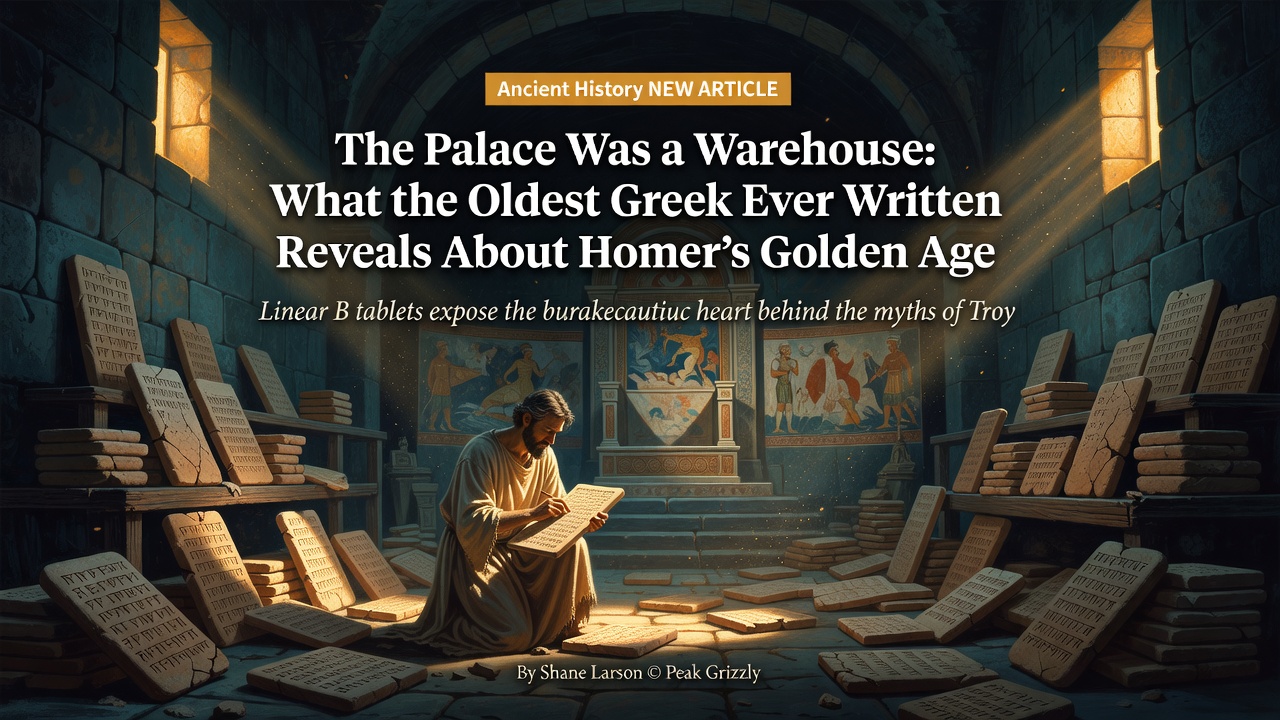
There is no poetry on the tablets. There are no letters, no laws, no prayers, no chronicles, no treaties. Across the thousands of Linear B documents recovered from the palaces, there is not one complete sentence anyone would call literature. What there is, in staggering quantity, is accounting.
The Knossos archive tracks sheep — on the order of eighty to a hundred thousand of them, flock by flock, with wool quotas for each and notations for shortfalls. Pylos logs its textile industry down to the individual level: groups of women workers, listed with their children, receiving measured rations of figs and grain. There are inventories of chariot wheels in various states of repair, including entries scribes flagged, with the world's most ancient bureaucratic honesty, as unfit for use. There are allocations of bronze to smiths, village by village, with notes on who received metal and who was left out of the distribution. There are lists of oarsmen assigned to ships, landholding records tangled in obligations, and offerings dispatched to the gods — and the gods are the startling part, because the names are familiar. Poseidon looms large at Pylos, centuries before Homer made him the flooder of the hero's homeward path. Zeus is there. Hera is there. There is even a "Lady of the Labyrinth" at Knossos, collecting her jar of honey.
Put the whole archive together and a civilization comes into focus — just not the one the poems promised. The Mycenaean palace was not a feasting hall where kings traded boasts. It was the administrative core of a command economy: a fortified compound that took in wool, grain, olives, and labor, transformed them through attached workshops into textiles, perfumed oil, and weapons, and pushed the products out into networks of exchange that reached Egypt and the Levant. The man at the top was called the wanax — a word that survives, fossilized, in Homer's vocabulary for "lord" — and beneath him ran a hierarchy of officials, overseers, and scribes who wrote everything down because the system could not function otherwise.
Here is the detail I find most telling: writing itself, in this world, belonged entirely to the warehouse. Literacy appears to have been a professional skill confined to administrators, used for one purpose — tracking stuff. Nobody wrote down a story. Nobody, as far as we can tell, thought writing was for stories. When the palaces burned around 1200 BC, the script died with the filing system it existed to serve, because outside the filing system it had no life at all.
That burning, incidentally, is the only reason we can read any of this. Clay tablets were temporary documents, meant to be scraped and reused, kept soft. The fires that destroyed the palaces baked them into ceramic. Every Linear B tablet we possess survived because of the catastrophe that killed the civilization that wrote it. The apocalypse was the archivist.
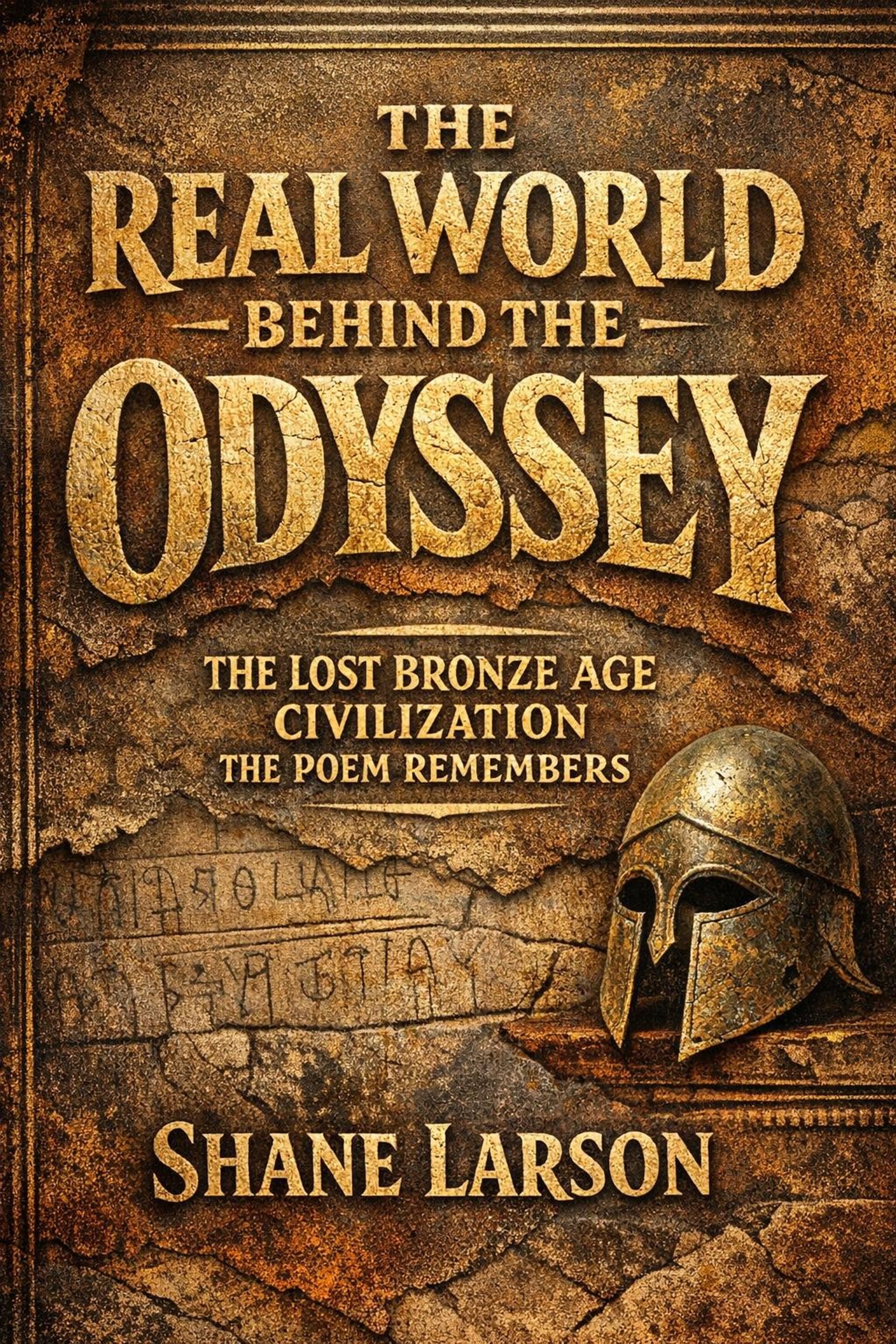
The Real World Behind the Odyssey
Memory Turned Clerks into Kings
So the golden age, on the ground, was a filing cabinet. Which raises the real question — the one that turns a tidy archaeological irony into something much stranger. The Odyssey and the Iliad describe those same palaces as glittering halls of feasting heroes, in poems composed around the 700s BC, some four to five hundred years after the last scribe at Pylos put down his stylus. Greece in between had lost writing completely. No documents crossed the gap. Nothing crossed the gap except spoken verse, carried by generations of singers who could not read, performing for audiences who had never seen a functioning palace — only the overgrown, cyclopean ruins on the hilltops, so massive that the later Greeks decided giants must have built them.
Four centuries of oral transmission did two opposite things to the memory of the Bronze Age, and the tension between them is the engine that produced Homer.
It distorted — systematically, in ways scholars of oral tradition can now describe with real precision. Oral memory compresses: generations of scattered coastal raiding along the Anatolian coast, of exactly the kind Hittite diplomatic records complain about, collapse into one titanic ten-year war. It inflates: the wanax with his wool quotas and his bronze ledgers becomes a king of unimaginable wealth, because a ruined greatness grows in the telling and no living counterexample survives to check it. It enchants: a sea that the archaeology shows was a busy commercial highway — one wreck off the Turkish coast at Uluburun carried ten tons of copper and goods from at least seven civilizations — becomes a haunted wilderness of monsters, because the trade networks that made that sea familiar had been dead for centuries and open water had become terrifying again.
But oral memory also preserved — and this is the part that should stop you cold. Homer describes a helmet plated with rows of boar's tusks. Boar's-tusk helmets were real Mycenaean equipment; we have the tusk plates from excavated graves and the helmets in Bronze Age art — and they had been obsolete for hundreds of years before the poet who described one was born. The poem gives Ajax a body-length tower shield generations out of use by the poet's day. The heroes fight with bronze in a poem composed deep in the Iron Age. Names recognizable from the epics — including forms of Achilles and Hektor — show up on the tablets as ordinary Mycenaean men's names. None of the singers can have seen any of this. The verse itself was the time capsule: formulaic phrases, locked into the meter and repeated performance after performance, carried genuine Bronze Age detail across four illiterate centuries like insects in amber.
That is what the Odyssey actually is — not a report, not a fairy tale, but the output of a four-hundred-year game of telephone played with a real civilization at one end. And unlike every previous generation of readers, we can now check the transmission, because the world at the far end of the line left us its own records. The tablets tell us what was really in the palace. The poem tells us what four centuries of memory made of it. Reading them side by side, you can watch mythology happen — watch a warehouse become a wonder, an administrator become Agamemnon, and a trade route become the wine-dark sea.
The clerks of Pylos would not have understood the poem their world became. They counted sheep and measured grain and logged broken wheels, and they thought, as every stable civilization thinks, that the point of writing was to keep track of things that would matter next quarter. Then the fire came, the counting stopped, and the singers — who kept track of nothing and remembered everything — turned out to be the ones who made them immortal.
How much of the rest of the poem works this way? The palaces check out, transformed but traceable. What about Troy, and the war, and the voyage itself — how much of the Odyssey survives contact with the tablets, the dig layers, and the Hittite archives, and how much dissolves? That accounting — element by element, echo by echo — is the project of my new book, The Real World Behind the Odyssey: The Lost Bronze Age Civilization the Poem Remembers, which rebuilds the entire Late Bronze Age Mediterranean from physical evidence and then holds the poem up against it to render an honest verdict: what is confirmed history, what is plausible echo, and what is pure invention. The answer to "was it real?" turns out to be far stranger than yes or no.
The Real World Behind the Odyssey
New posts and releases, straight to your inbox. No spam, unsubscribe anytime.