The Most Valuable Target at Pearl Harbor Was Never Attacked. It Was Never Even on the List.
September 12, 2026 · 6 min read
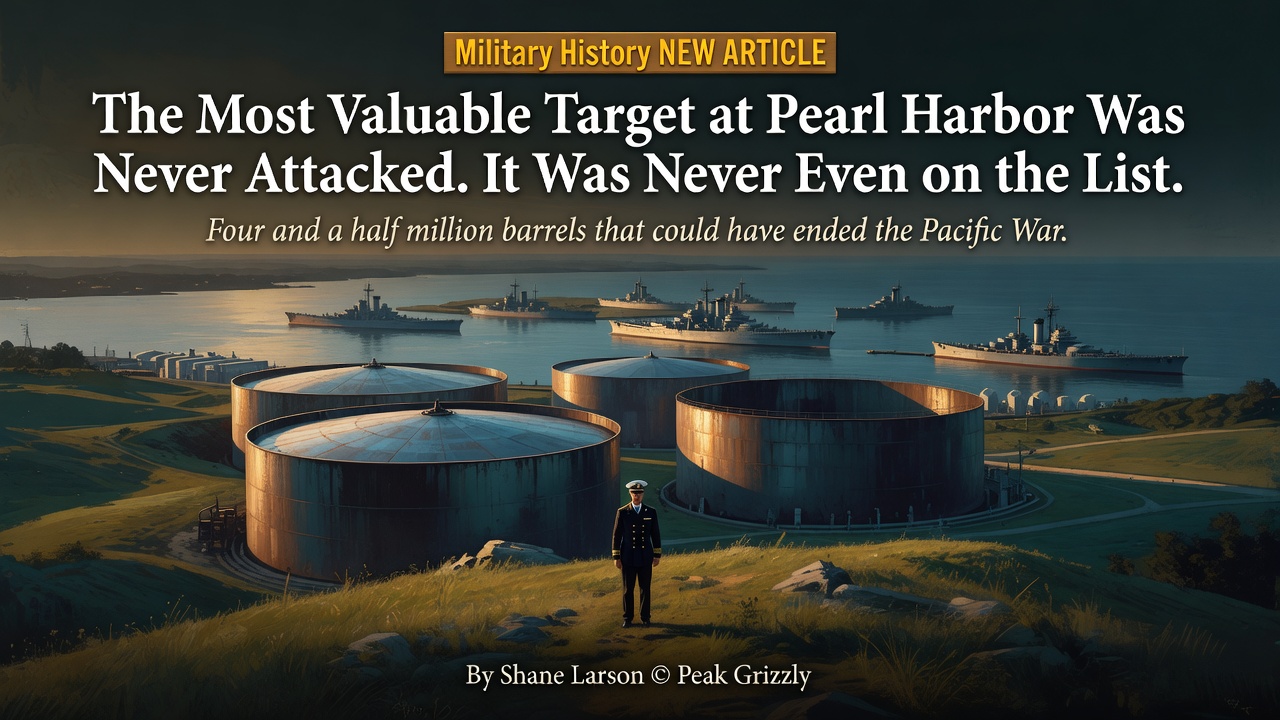
Stand on the rise above Pearl Harbor in December 1941 and the most important military installation in the Pacific was not the battleships moored two by two along Ford Island. It was a set of large steel tanks, painted and plainly visible, holding roughly four and a half million barrels of fuel oil above ground. No armor protected them. No revetments surrounded them. A single incendiary pass could have set them burning, and the fires would have been almost impossible to fight.
The Pacific Fleet ran on that oil. Every ship that sortied from Pearl Harbor drew from those tanks, and the nearest replacement supply sat on the American west coast, twenty-four hundred miles away. Chester Nimitz, who took command of the fleet three weeks after the attack, later gave his professional judgment that losing the fuel reserve would have forced the fleet back to California and might have lengthened the war by as much as two years.
On the morning of December 7, more than three hundred and fifty Japanese aircraft attacked Pearl Harbor in two waves. They sank or damaged eighteen ships, destroyed most of the American aircraft on Oahu, and killed over 2,400 Americans. Not one of them was assigned to the tanks. The most valuable target in the harbor was never attacked, because it was never a target at all.
The story everyone knows, and what is wrong with it
The popular account handles this fact with a story. In that story, a third attack wave stood ready on the Japanese carrier decks, briefed against the fuel farm, the dry docks, and the repair shops, and the strike commander pleaded for it, and Admiral Chuichi Nagumo, cautious to a fault, refused and turned for home, throwing away the war in a single failure of nerve.
Almost none of that survives contact with the record. There was no planned third wave. The Japanese operational orders for the attack assigned two waves against a specific list of targets: capital ships first, aircraft carriers if present, then airfields and the aircraft on them. Fuel storage, dry docks, machine shops, and the submarine base appear nowhere in the plan. No third-wave strike was drafted, no aircrews were briefed against the infrastructure, no target folders for the tank farm existed aboard the carriers. What happened on Nagumo's flagship after the second wave returned was not the rejection of a worked-out option. It was a short discussion about whether to improvise something the operation had never included, against a base that was now fully alerted, with the location of the American carriers unknown and the task force's own fuel margins on a northern route already tight. Nagumo declined, and by the standards of the plan he had been given, the decision was defensible.
The dramatic version of the story grew afterward, and it grew mostly from postwar recollections by surviving Japanese officers, recorded years later, in interviews and memoirs produced when everyone involved knew how the war had ended and what the tanks had turned out to be worth. Hindsight wrote the third wave into history. The documents from 1941 do not contain it.
Why the tanks were invisible to the planners
The more interesting question is not why the third wave was refused but why the tanks were never on the list in the first place, and the answer goes to the heart of how the Imperial Japanese Navy thought.
The attack on Pearl Harbor was conceived as the opening move of a decisive fleet engagement, not as the destruction of a base. Japanese naval doctrine had been built for decades around one idea, inherited from the victory over Russia in 1905: the enemy fleet is the target, and the war is decided by sinking it. The operation's purpose was to eliminate the American battle line for roughly six months, long enough for Japan to take and fortify Southeast Asia. Measured against that purpose, the plan made internal sense. Ships and aircraft were what the strike was for; everything else was somebody else's problem.
The Oil Was a Clock
What that doctrine had no category for was infrastructure, which is to say, the things that make a fleet a going concern rather than a collection of hulls. Fuel storage, repair capacity, and the submarine base were logistics, and the Japanese navy's inattention to logistics was not a quirk of one operation. The same blindness ran through the entire war that followed. Japan went to war for oil and never built enough tankers to move it. It conquered the richest resource area on earth and could not defend the shipping that carried the resources home. The empty spot on the Pearl Harbor target list and the empty slipways where the tanker fleet should have been are the same fact, observed at two different scales.
The irony is hard to overstate. The untouched dry docks repaired the carrier Yorktown in about seventy-two hours before the Battle of Midway, work that would otherwise have taken weeks and would have left the American side a carrier short at the moment it mattered most. The untouched submarine base ran the campaign that eventually destroyed the Japanese merchant marine. And the untouched oil kept the fleet at Pearl Harbor instead of San Diego, a difference of twenty-four hundred miles on every operation of the next year.
What the counterfactual is actually worth
So suppose the tanks had burned. Suppose the plan had included them, or the improvised strike had been launched and had succeeded. How much does history change?
A great deal, in the short run. The fleet withdraws to the west coast. Operations in the central Pacific become enormously harder, the early carrier raids likely do not happen, and the timetable that led to Midway in June 1942 is broken. Nimitz's estimate of up to two years deserves to be taken seriously, because no one was better placed to make it.
But the counterfactual is bounded, and honesty requires saying where the bounds are. The tanks would have been rebuilt, this time protected, and the rebuilding was within the capacity of an economy that was about to build entire fleets on a schedule Japan could not comprehend. The oil itself was replaceable from American fields that produced more in a few days than the farm held. And nothing about burning the reserve touches the deeper arithmetic: the American carriers, still at sea and unharmed; the two-ocean building program funded in July 1940, with hulls already on the ways; a training pipeline producing aviators by the thousand. A strike on the fuel farm buys Japan time, perhaps a lot of it. It does not buy a different ending, because the ending was never resting on what stood at Pearl Harbor that morning. It rested on what was being built elsewhere, and no attack could reach that.
The tanks are worth remembering not as the great missed chance but as a diagnostic. An attack plan is an X-ray of the mind that made it, and the Pearl Harbor plan shows a navy brilliant at battle and uninterested in war: superb at the ninety minutes, blind to the four years. The fuel farm was left standing by the same institution that left the tankers unbuilt, and the second omission, not the first, is the one that decided the Pacific.
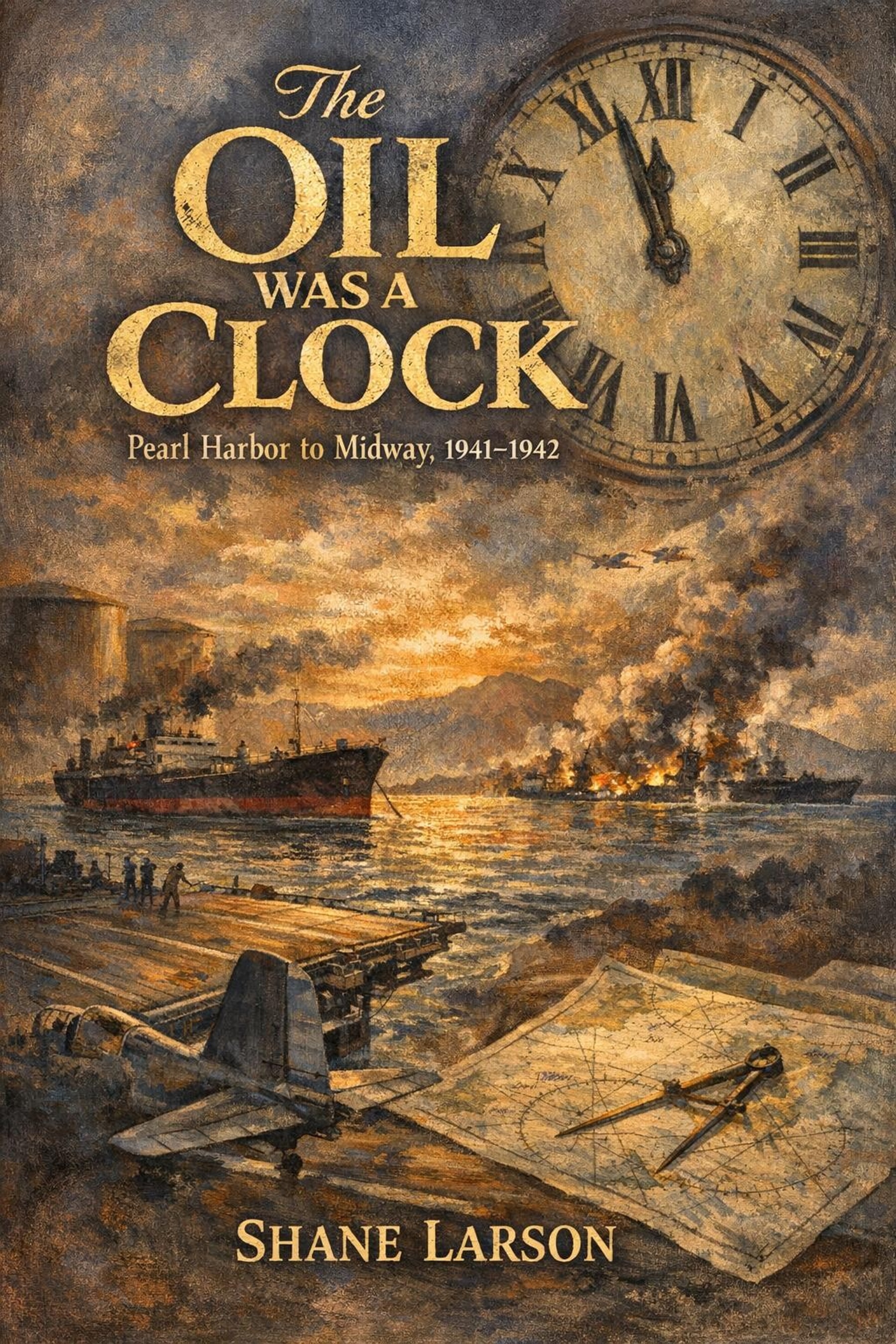
I tell the full story of the attack, the decision that launched it, and the six months that followed in The Oil Was a Clock: Pearl Harbor to Midway, 1941-1942, the fifth volume of my Second World War Chronicles. The book follows the target list argument through the whole period, from the oil embargo that put a date on Japan's decision to the five minutes off Midway where the run of victories ended, with every contested figure given as a range and no scenes invented. If the version of Pearl Harbor you know turns on a third wave that was never launched, the records tell a stranger story: it was never planned at all.
The Oil Was a Clock
New posts and releases, straight to your inbox. No spam, unsubscribe anytime.