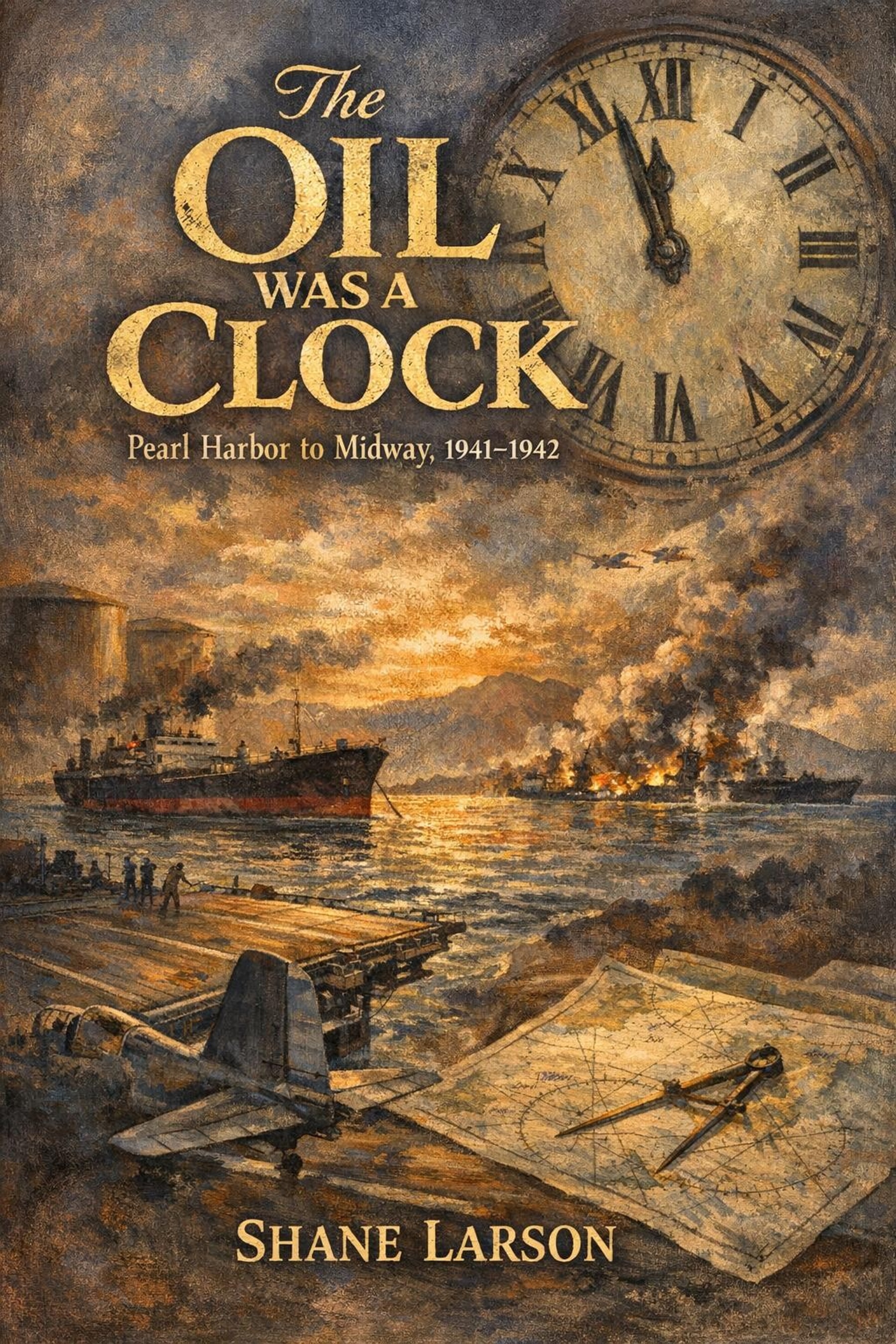
The Oil Was a Clock
Pearl Harbor to Midway, 1941-1942
By Shane Larson
About This Book
On the morning of December 7, 1941, four and a half million barrels of fuel oil stood in above-ground steel tanks on the rise overlooking Pearl Harbor: unarmored, undefended, and in plain sight of every Japanese pilot who flew over them. Across two attack waves and more than three hundred and fifty sorties, not one aircraft was assigned to them. The Pacific Fleet ran on that oil. Had it burned, the surviving ships would have fallen back to the American west coast, twenty-four hundred miles farther from the war.
Months earlier, in Tokyo, staff officers of the Imperial Japanese Navy had performed a simpler calculation. The American embargo had stopped the flow of oil into Japan, and the fleet consumed its reserve at a rate the Navy General Staff could state to its own government in tons per hour. Divide the stockpile by the rate of use and the answer is not a quantity. It is a date. Japan could fight in 1941. It could not fight in 1943. The men who ran that sum were the professional heads of a first-rate navy, and their government chose war with the numbers on the table.
This book is the story of what happened between those two facts: the countdown, the decision, the most successful surprise attack in naval history, six months of conquest across seven thousand miles, and the five minutes off an atoll called Midway where the run of victories stopped.
The Argument
The argument runs like this. The oil embargo of July 1941 did not cause the Pacific war by itself; the war in China had already made every settlement impossible, because withdrawal from China was the one American condition no Japanese government could accept and survive. What the embargo did was attach a date to the decision, and the date, not the grievance, is what drove it.
Pearl Harbor itself was a tactical triumph and a strategic catastrophe, for unglamorous reasons. The carriers were at sea. The battleships were mostly raised and returned to service. The fuel farm, the dry docks, and the submarine base were untouched, each worth more to the American war effort than Battleship Row. And a country that had argued about intervention for two years became unanimous in roughly ninety minutes.
The empire those ninety minutes opened could not be held. Five months of conquest produced the largest maritime perimeter any power has ever tried to defend, requiring more shipping than Japan possessed, with the tankers needed to move the captured oil home never built. Midway was a narrow thing, and the book treats it as one; the luck ran one way, and the outcome that morning was not inevitable. The arithmetic underneath it was.
What's Inside
- The resource ledger that is the book's spine: roughly 80 percent of Japan's oil came from the United States, and the reserve figures and consumption rates are laid out so the reader can run the countdown themselves.
- The autumn 1941 negotiations from both capitals, and the plain finding that no available settlement existed: the minimum each side could accept exceeded what the other could give.
- The Kido Butai, six fleet carriers operating as a single striking force before any other navy had done it, and the wooden-finned torpedoes that made shallow Pearl Harbor attackable at all.
- December 7 argued through what was hit and what was not: the fuel farm, the dry docks, and the submarine base untouched, three carriers absent, and the "third wave" story examined against what was actually on the table that morning.
- The same twenty-four hours across seven thousand miles: Malaya, Hong Kong, Wake, American aircraft destroyed on the ground in the Philippines nine hours after warning arrived, and two British capital ships sunk at sea.
- Singapore corrected: most of the fortress guns could and did fire landward, and the campaign was lost up-country in Malaya before the island was invested, ending in the largest surrender in British military history.
- Bataan and the prisoner-of-war regime, stated as crimes first, with contested figures given as ranges; and the Doolittle raid, including the reprisals in China that killed tens of thousands of civilians.
- The shipping arithmetic of the perimeter, which is the volume's central strategic argument: the empire Japan won in five months exceeded the merchant fleet it possessed.
- Station HYPO and the breaking of the Japanese naval code as inference rather than mail-reading, the water-shortage deception that confirmed Midway as the target, and the risk Nimitz accepted by acting on an estimate.
- Two full chapters on Midway, with the state of the hangar decks taken from the Japanese operational records, and an honest accounting of what the battle did and did not decide.
Why I Wrote This
What pulled me into this volume is that the arithmetic was not hidden. There is no secret archive here, no fact the participants lacked. The Japanese naval staff computed the date their own fleet would become unusable, reported it to their government, and recorded the computation in their own documents. Then the government chose war against a country its own planners rated at ten times Japan's industrial capacity. I wanted to understand a decision taken by people who had done the sums and did not like the answer, and what I found was not madness but machinery: a system in which the one survivable proposal was forward. The other reason is the state of the popular literature, which novelizes this war more than any other. I wanted a version where every scene is sourced, because this story does not need embellishing. The real one is stranger.
Frequently Asked Questions
Does this book cover the whole Pacific war?
No. It runs from the embargo of July 1941 to the aftermath of Midway in June 1942. Guadalcanal and everything after it belongs to Volume 10.
Do I need to read Volumes 1 through 4 first?
No. The introduction opens with a compressed account of the war so far, from the failed peace of 1919 to the German army stalled in front of Moscow, written for readers who come to the war through Pearl Harbor.
Is this book sympathetic to Japan?
It explains the Japanese decision from the inside, because a leadership portrayed as simply reckless makes the whole war incomprehensible, and explaining is not excusing. The book states plainly that the war Japan widened in 1941 cost Asia tens of millions of lives, most of them Chinese civilians, and treats the six months of victories as the opening of that catastrophe, not a separate story.
Does the book cover the atomic bombings of Hiroshima and Nagasaki?
No. The bombings belong to Volume 10, which carries the Pacific war from Guadalcanal to the surrender. This volume closes with Midway.
Did the guns at Singapore really point the wrong way?
Mostly, no. The majority of the fixed defenses could traverse landward and fired landward; the real problems were armor-piercing ammunition designed for ships and a campaign already lost up-country in Malaya. A chapter section covers why the tidier story has survived for eighty years.
Were the Japanese carriers really minutes from launching when the bombers arrived at Midway?
No. The Japanese operational records show fueled and armed aircraft in the hangars, not a spotted strike on deck ready to go. The book explains where the familiar image came from and what the timings actually were.
If You Liked This, You Might Like
- The Samurai Century: the warrior institutions and habits of mind the Imperial Japanese military inherited, three centuries before it put them to sea.
- The Empire Collapse Pattern: the question this volume asks about Japan, asked across two thousand years of powers that overreached their ability to hold what they won.
- The First Punic War: another naval war decided less by admirals than by which state could keep building ships, two millennia before the two-ocean navy.
A government computed the date of its own defeat, filed the paperwork, and attacked anyway. This book follows that decision from the conference rooms of Tokyo to the flight decks off Midway, and judges it by the standard its own staff officers used: the arithmetic. The Oil Was a Clock is Volume 5 of The Second World War Chronicles, a ten-volume history of the Second World War.
Included with Kindle Unlimited — read it free if you're a member.
New Military History releases and free chapters — no spam, unsubscribe anytime.