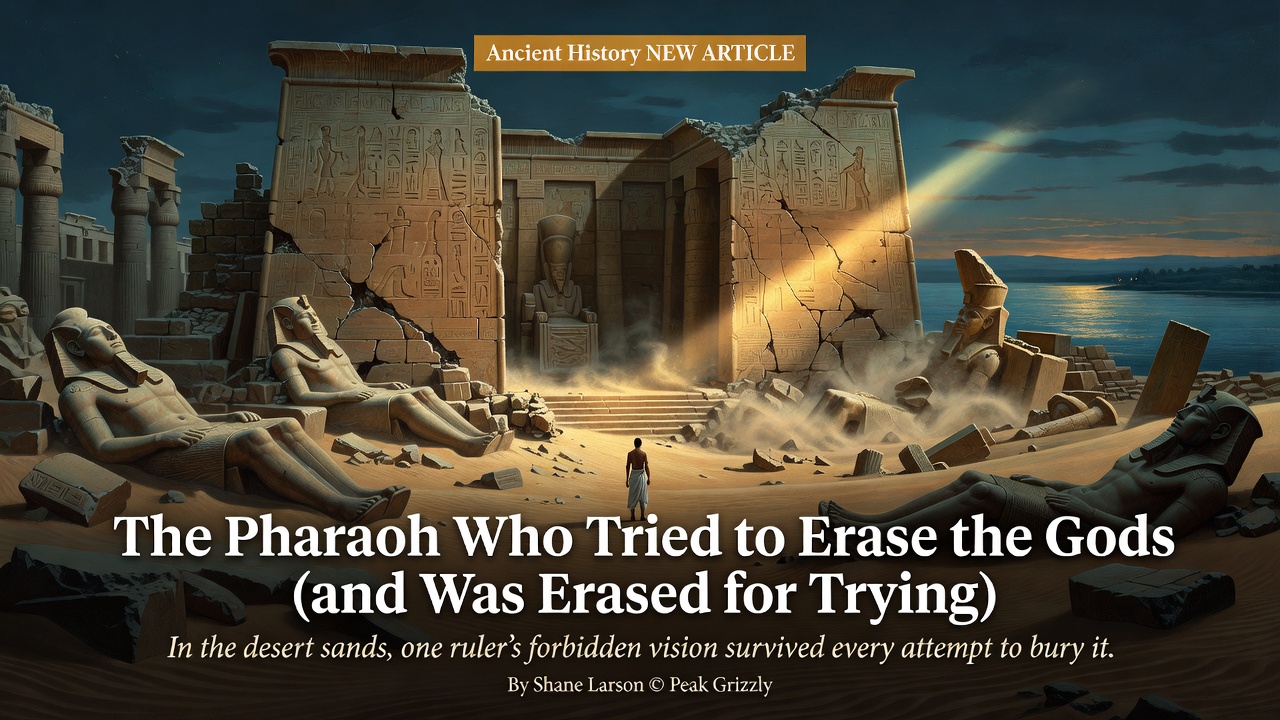
The Pharaoh Who Tried to Erase the Gods (and Was Erased for Trying)
May 21, 2026 · 9 min read
In December of 1912, in the ruins of an abandoned ancient city on the east bank of the Nile, a German archaeologist named Ludwig Borchardt was directing a final season of excavation when one of his Egyptian foremen brought him a head.
Life-size. Limestone. Modeled in plaster, painted with extraordinary precision. The eyes were inlaid — at least the right eye was. The left eye socket was empty. The face was that of a young woman of perhaps thirty, with a long neck, high cheekbones, and a tall blue cylindrical crown that had no Egyptian parallel.
Borchardt's hands shook. He had been studying the dynastic period to which she belonged for two decades, and he had seen reliefs of her face on the walls of the city's tombs, on the boundary stelae carved into the desert cliffs, on broken fragments of palace walls. He was looking at Nefertiti — the queen whose name had vanished from Egyptian official records nearly thirty-three centuries before, whose city had been demolished within a generation of her death, whose husband had been systematically erased from the king lists by the dynasty that succeeded him.
Three thousand and three hundred years after the workshop had closed, she had come back.
What Akhenaten Tried to Do
Her husband's birth name was Amenhotep IV. He inherited the throne of Egypt around 1353 BCE, when the Eighteenth Dynasty was at the peak of its imperial wealth and the state god, Amun of Thebes, controlled an estate larger than most contemporary kingdoms. The Amun priesthood had become a parallel power center that no pharaoh had managed to bring fully under royal control. Egypt's empire stretched from Nubia to the Euphrates. The tribute flowed in. Everything worked.
In the fifth year of his reign, Amenhotep IV changed his name to Akhenaten — "Effective for the Aten" — and announced that the visible disk of the sun, the Aten, was not one god among many. It was the only god worthy of worship.
He closed the temples of Amun. He confiscated their revenues. He sent stonemasons across Egypt to chisel Amun's name out of every monument they could reach — including, in the most extraordinary gesture of the campaign, out of his own dead father's cartouches, where the name Amenhotep III contained the offending syllable.
He abandoned Thebes, the religious and political capital of the New Kingdom for nearly two centuries, and built an entirely new city in the middle of nowhere. He picked a virgin desert site on the east bank of the Nile, halfway between Memphis and Thebes, in a natural amphitheater of cliffs. The land had never been dedicated to any god. He called it Akhetaten — "Horizon of the Aten" — and we call it Amarna.
He moved the court there. The bureaucracy. The army command. The royal family. He commissioned an artistic revolution that depicted him and Nefertiti with elongated skulls, full hips, and intimate domestic scenes of a kind Egyptian royal iconography had never admitted before. He elevated Nefertiti to a public prominence no royal consort had ever received. Possibly to coregency. Possibly to pharaonic rule in her own right under a new throne name.
And meanwhile, the empire fell apart. The Amarna letters — a diplomatic archive preserved by accident in the abandoned city's records office and rediscovered by a peasant woman named Selmâ in 1887 — show Egypt's vassals in Canaan and Syria writing increasingly desperate letters, begging for troops, gold, anything against the Hittite advance. The letters went unanswered, or were answered with reprimands. Akhenaten had pulled the center of the state out of the center of the state.
He died around 1336 BCE, in his seventeenth regnal year. The cause is unknown.
What Happened Next
Almost everything Akhenaten built came undone within a generation of his death.
The succession is contested in detail (the Smenkhkare puzzle is one of the genuinely unresolved questions in Egyptology), but the broad outline is clear. A figure named Smenkhkare ruled briefly. A queen named Neferneferuaten ruled briefly — she was probably Nefertiti, possibly briefly elevated to pharaonic rule. Then a nine-year-old boy named Tutankhaten took the throne. Within a few years, on the advice of his regents, he abandoned Amarna, changed his name to Tutankhamun, reopened the temples of Amun, redirected state revenue back to the priesthood, and signaled formal restoration of the old religion. He died before he was twenty.
His tomb, sealed in a side-valley of the Valley of the Kings and forgotten for more than three thousand years, would be discovered by Howard Carter in 1922 and become the most famous archaeological find in history.
By the time Carter found Tutankhamun's tomb, his father-in-law Akhenaten had been a ghost for thirty-three centuries. The general Horemheb, who took the throne after Tutankhamun's young successor Ay, had completed the systematic erasure of the Amarna pharaohs from the king lists. Akhenaten, Smenkhkare, Tutankhamun, and Ay were struck from the official chronology. Horemheb's regnal years were back-dated to begin at the death of Amenhotep III, as if the entire Amarna interlude had simply not occurred. The Amarna talatat blocks — small sandstone facing-blocks from the Aten temples — were broken up and reused as fill in later Theban temple pylons. The city of Amarna itself was abandoned to the desert.
Egyptian official inscriptions from later dynasties refer to Akhenaten only as "the criminal of Akhetaten." His name was unspoken. The king lists ran straight from Amenhotep III to Horemheb. For three thousand years he was simply gone.
What the Desert Kept
What survived, and what this book is built on, is what the erasure could not reach.
The city of Amarna itself, abandoned but never deliberately razed, was preserved by the desert. Its walls were stripped for stone but the foundations remained. The wall paintings, the painted pavements, the workshops, the workers' village — all of it preserved beneath drifting sand for three millennia.
Akhenaten
The boundary stelae carved into the cliffs were too remote to chisel out. They survive today, the Aten's iconography intact, the king's name intact, the original oath he swore that the city would never expand beyond these markers — all of it preserved in the rock.
The talatat blocks, broken up and reused as fill, were preserved inside the pylons of later temples. Modern archaeology has been recovering them block by block since the 1960s and reassembling, in a slow process that continues today, the lost wall scenes of Akhenaten's Karnak temples. We can see his original inscriptions, in his original colors, three thousand years later, because his enemies thought reusing them as construction material was a more efficient form of disposal than destroying them.
The Amarna letters were preserved because the bureau that housed them was simply abandoned and buried. They were rediscovered by a peasant woman in 1887 and now sit in major museums in Berlin, London, Cairo, and Paris.
The tombs of the Amarna officials, cut into the cliffs of the abandoned city, were too remote to dismantle. The Great Hymn to the Aten survives because it was inscribed in the tomb of the courtier Ay, who later became pharaoh. (Ay's own tomb at Amarna was abandoned and preserved; he was eventually buried at Thebes, but the early tomb is intact.)
The Berlin bust of Nefertiti was preserved because it was an unfinished sculptor's model, kept in the workshop, abandoned when the city was abandoned, buried in the workshop's collapse, found in 1912.
And the recent DNA studies of the royal mummies have added new evidence the ancient erasers could not have anticipated. The mummy in KV55 in the Valley of the Kings, found in 1907 in confused and mixed-up condition, is now most plausibly identified as Akhenaten himself. The "Younger Lady" mummy from KV35 is most plausibly his sister and the mother of Tutankhamun. The DNA evidence is methodologically imperfect (small sample, contamination concerns) but the convergence of independent lines of evidence is hard to dismiss.
The dynasty erased the man. The man's bones remain. So do his temples. So does his queen.
Why I Wrote the Book
I have come to think, after writing this book, that Akhenaten's reign is the cleanest case study in ancient history of a particular pattern: a one-person revolution against deep institutional interests rarely survives the death of the one person.
This is not a comforting observation. It implies that significant institutional change is hard, slow, and structurally biased against the kind of dramatic moral clarity that we sometimes want from history. But it is true. The Amun priesthood had been built up over four centuries. Akhenaten dismantled it in fifteen years. As soon as he was gone, the institutional gravity reasserted itself. The priesthood came back. The temples reopened. The state revenue redirected. The capital moved. The pharaohs of the recovery — Tutankhamun, Ay, Horemheb — did not have to argue against Akhenaten's program. They just had to outlive it.
What Akhenaten left behind, however — what survived the erasure — was not nothing. His religion did not become a world religion. His city did not become a permanent capital. His artistic style did not become the new Egyptian convention. But his disruption became part of the long Egyptian record. His name came back. His face came back. His queen's face became one of the most reproduced images in the history of art. Three thousand years later, the criminal of Akhetaten is one of the most studied pharaohs in the catalog. The institutions that erased him are gone. The fragments he left, the fragments his enemies thought they had destroyed, have outlasted them all.
That is, in its strange way, a kind of victory. Not the one Akhenaten was working toward — not religious revolution, not the establishment of the Aten as the universal god, not the triumph of his theological program — but a victory of survival. He could not impose his vision on his world. His vision survived anyway, in the fragments his world preserved while trying to throw them away.
The Book
There is no current narrative-driven, accessible book about Akhenaten aimed at general readers on Kindle. The standard academic biographies (Donald Redford, Nicholas Reeves) are over twenty years old and pitched for specialists. Joyce Tyldesley's Nefertiti is excellent but focused on the queen. Toby Wilkinson's Rise and Fall of Ancient Egypt gives Akhenaten one chapter. Readers who wanted the full story, told as a coherent narrative, with the source problems handled honestly, did not have a book to point to.
I wanted to write that book. I wanted to write it with the same narrative drive that defines the rest of my ancient Egypt catalog — Cleopatra's Egypt, Ramesses the Great, Hatshepsut, The Ptolemies — and to slot Akhenaten into the chronological gap between Hatshepsut (Eighteenth Dynasty earlier) and Ramesses (Nineteenth Dynasty later) where the catalog had no coverage. I wanted to take the source problems seriously: the Smenkhkare question, the coregency question, the late-reign disappearance of Nefertiti, the location of Akhenaten's actual burial, the methodological caveats on the DNA evidence — all of these are unsettled, and the book does not pretend to settle them.
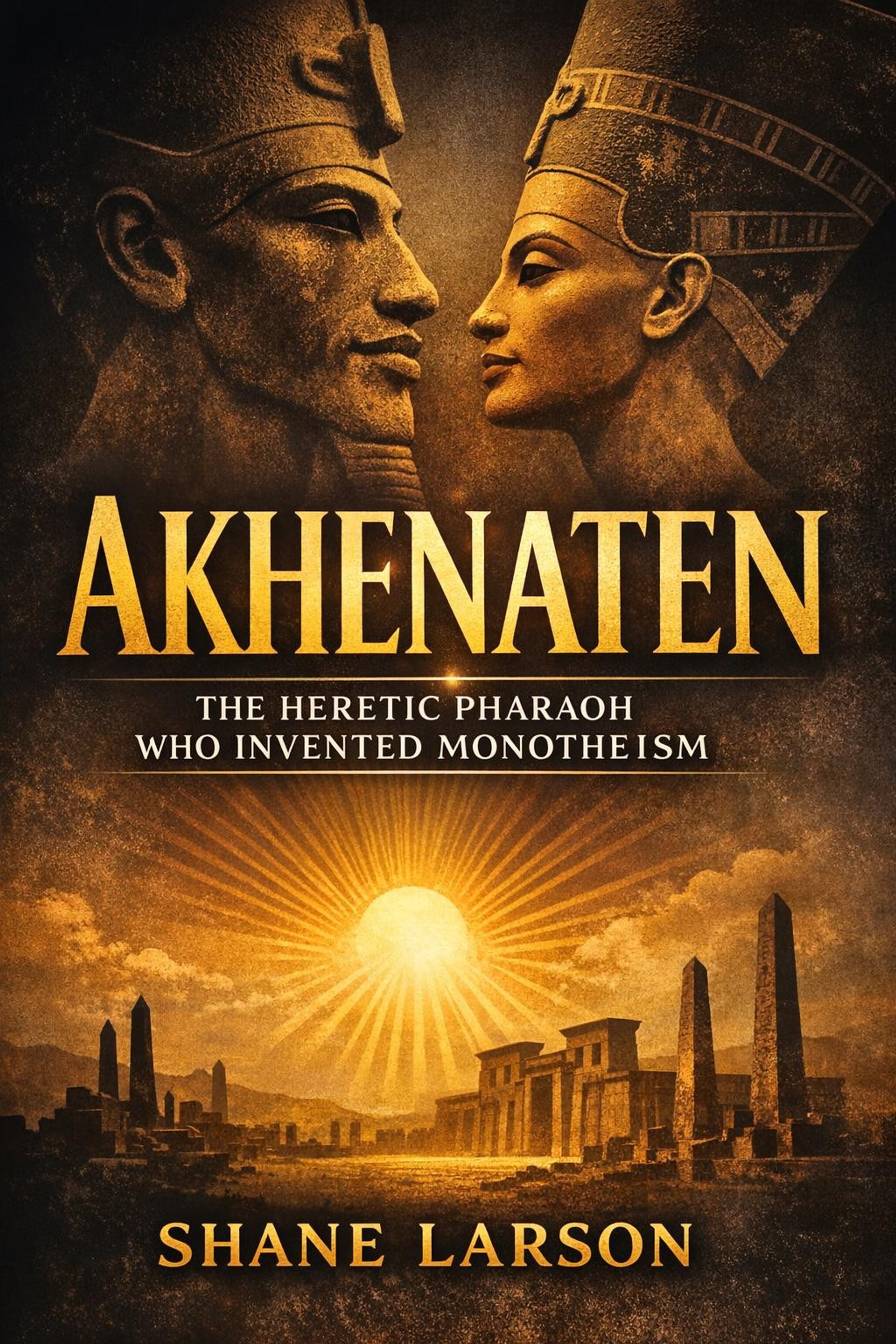
The book is called Akhenaten: The Heretic Pharaoh Who Invented Monotheism. It is available now on Amazon Kindle. If you have read Ramesses the Great or Hatshepsut or Cleopatra's Egypt, you already know the kind of book this is. If you have not, this is a reasonable place to start.
Selmâ the peasant woman, the one who accidentally rediscovered the Amarna letters in 1887 by digging fertilizer-earth from the abandoned ruins, was never named in the official record. We know her name from a single retrospective interview, decades later. The dynastic erasure of Akhenaten was eventually undone, partly by archaeologists and academics, partly by accident, and partly by people whose names we do not even fully record.
The Berlin bust still has only the right eye inlaid. The left socket remains empty. The unfinished face is, in some way, the right way to leave her. The story is not finished either.
Akhenaten
New posts and releases, straight to your inbox. No spam, unsubscribe anytime.