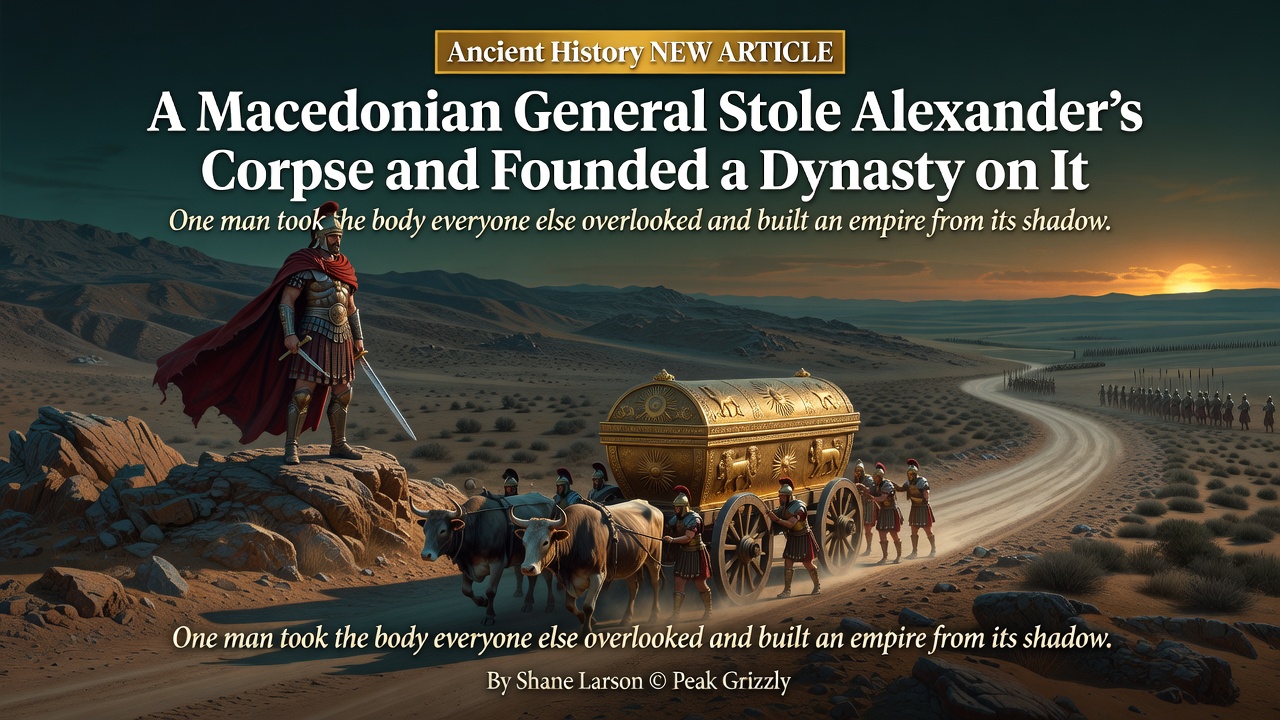
A Macedonian General Stole Alexander's Corpse and Founded a Dynasty on It
August 5, 2026 · 5 min read
Title: "A Macedonian General Stole Alexander's Corpse and Founded a Dynasty on It"
When Alexander died in Babylon in 323 BC at thirty-two, he left an empire stretching from Greece to the Indus and no arrangements whatsoever. Asked on his deathbed who should have it, he reportedly said: to the strongest.
That answer started a forty-year war among his generals.
Most of them fought over the obvious things — the regency, the armies, the title, the richest provinces. One of them asked for something smaller and then, on the road, took something nobody else had thought to want.
Ptolemy asked for Egypt. Then he stole Alexander's body.
Why a Corpse Was the Prize
The logic is not obvious to modern readers and would have been immediately clear to anyone standing in that tent.
Macedonian kingship ran on a mixture of bloodline, army acclamation, and political gravity, and there was no procedure for what had just happened. Alexander's half-brother was incapable of ruling. His wife Roxana was pregnant but had not delivered. His mother was in Macedon and feared. None of the available heirs could hold anything together, which meant legitimacy was suddenly an open question that would be settled by whoever could make the strongest claim to be Alexander's true successor.
In that contest, the body was an argument. Macedonian custom held that a king was buried by his successor — the man who performed the funeral rites was making a public statement about who he was. The same pattern had played out after Philip II's murder, when the swift arrangement of rites helped consolidate the next reign. And beyond custom, Alexander was already becoming something more than a dead king. His corpse was a relic, and possession of it was proof of a connection nobody could dispute. Soldiers who had marched with him still remembered the omens and victories that had attached to his person; holding the remains kept that living memory attached to one man rather than scattered among claimants.
So when the enormously elaborate funeral carriage — reportedly years in construction, gold-plated, drawn by dozens of mules — finally set out for Macedon in 321 BC, Ptolemy intercepted it in Syria and diverted it to Egypt.
The Man Who Died Trying to Get It Back
Perdiccas, the senior commander who held Alexander's signet ring and the strongest claim to the regency, understood exactly what had been taken from him.
He invaded Egypt to recover the body.
The campaign went badly in a way that reads as almost comically grim. Perdiccas attempted to cross the Nile, misjudged the river, and lost a large number of men — the sources describe soldiers drowning and, in one crossing, being taken by crocodiles. After repeated failures his own officers concluded he was going to get all of them killed and murdered him in his tent. The loss of so many troops in such a short span turned what should have been a quick strike into a drawn-out disaster that left the rest of the army demoralized and short on supplies.
The single most powerful of Alexander's successors died in a swamp, trying to retrieve a corpse from a man who had positioned himself as the least ambitious of the lot.
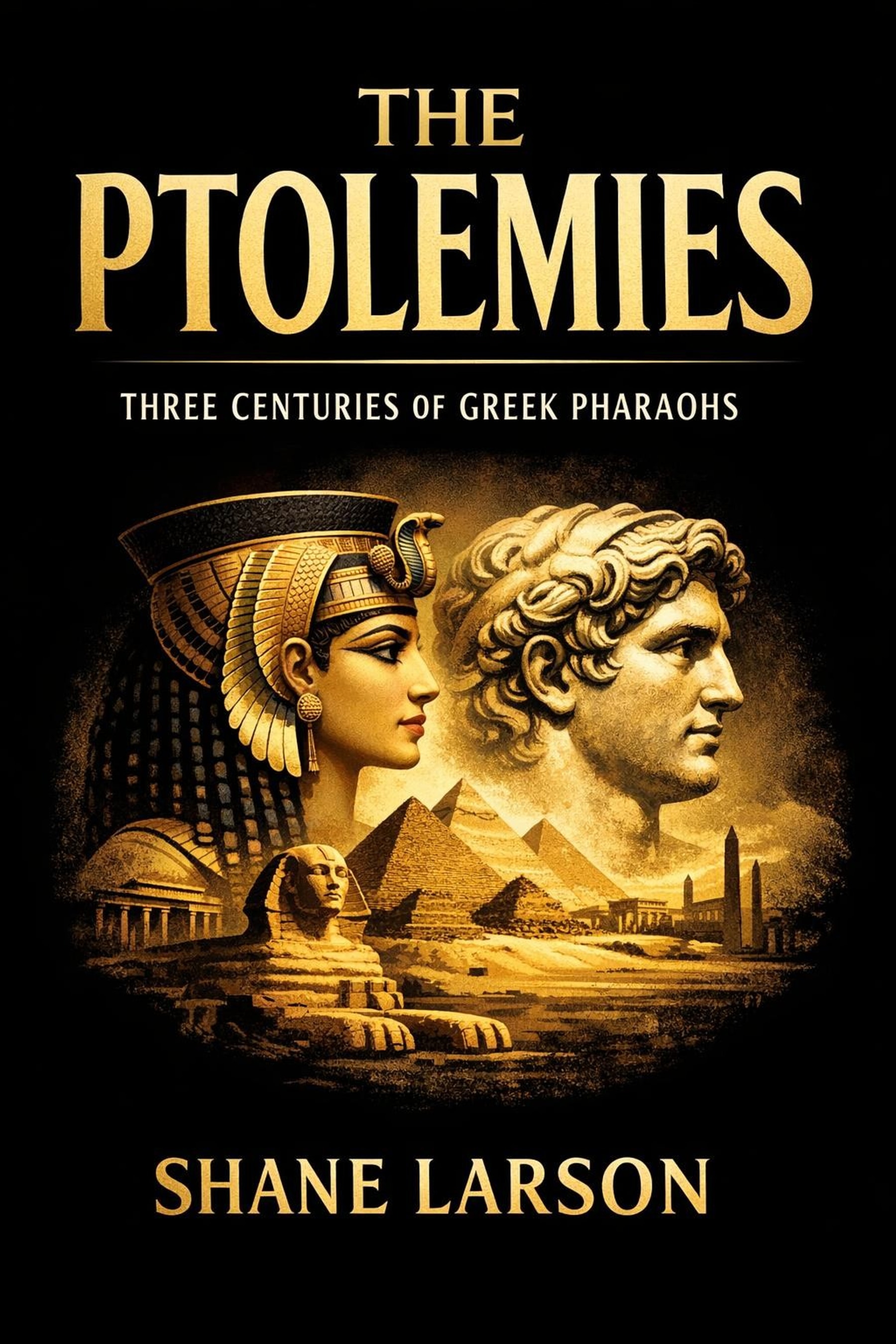
The Ptolemies
Ptolemy, meanwhile, held Egypt — a province that was defensible, agriculturally the richest in the Mediterranean, and reachable only through a small number of controllable approaches. While the other successors exhausted themselves fighting over the vast, indefensible interior of the old Persian empire, he sat behind a desert and a river with a grain surplus and the founder's body. The Nile's predictable floods and the narrow coastal routes into the Delta gave him natural choke points that later successors could only envy when they tried to move large armies across open plains.
The dynasty he started ruled Egypt for nearly three hundred years, longer than any other successor state.
What They Built Around It
The corpse went first to Memphis and later into a purpose-built tomb in Alexandria, the Soma, which became one of the most visited sites in the ancient world.
The Ptolemies constructed a whole apparatus of legitimacy around that possession. Alexandria became the intellectual capital of the Mediterranean — the Library and the Museum drawing scholars from everywhere with state salaries and no teaching obligations, an institutional research programme funded by a monarchy that understood prestige as infrastructure. The scholars worked on everything from geometry to textual criticism of Homer, their presence turning the city into a place where Greek learning was actively curated rather than merely preserved.
They also ran the most sophisticated administrative state of the era. Egypt under the Ptolemies was heavily bureaucratised, closely taxed, and organised down to the level of individual fields, with a documentary culture that has left an extraordinary papyrus record because the climate preserved it. Land registers tracked irrigation rights and crop yields; officials monitored everything from oil presses to temple incomes, creating a system that extracted revenue efficiently enough to support both a standing army and the cultural projects in Alexandria.
And they governed as two things at once: Greek kings to their Greek settlers, with a Greek court, Greek language, and Greek institutions — and pharaohs to the Egyptians, appearing on temple walls in traditional regalia, funding the priesthoods, participating in the old rituals. The Rosetta Stone is a Ptolemaic decree issued in three scripts precisely because the state had to speak to several populations at once. That dual presentation was pragmatic and it held for centuries, though it never fully dissolved the division between the Greek-speaking administration and the Egyptian population underneath it.
The Tomb Is Gone
Alexander's body remained a pilgrimage site for centuries. Julius Caesar visited. Augustus visited and, according to the story, damaged the nose while handling it. Caracalla visited. It was the closest thing the classical world had to a saint's relic before there were saints.
And then, at some point in late antiquity, the record simply stops. Earthquakes, subsidence, and the rebuilding of Alexandria erased it. Nobody knows where the tomb is. There have been well over a hundred recorded modern attempts to locate it, and none has succeeded.
The dynasty that was founded on possessing Alexander's body ended with Cleopatra and Rome. The body itself, which was worth a war, has been missing for something like sixteen hundred years.
The Ptolemies: Three Centuries of Greek Pharaohs runs the whole dynasty — the funeral heist, the building of the kingdom, the Library, the wars, the tangle of Greek and Egyptian identity, the queens, the dynastic bloodletting, the Roman entanglement, and the fall of the house.
The Ptolemies
New posts and releases, straight to your inbox. No spam, unsubscribe anytime.