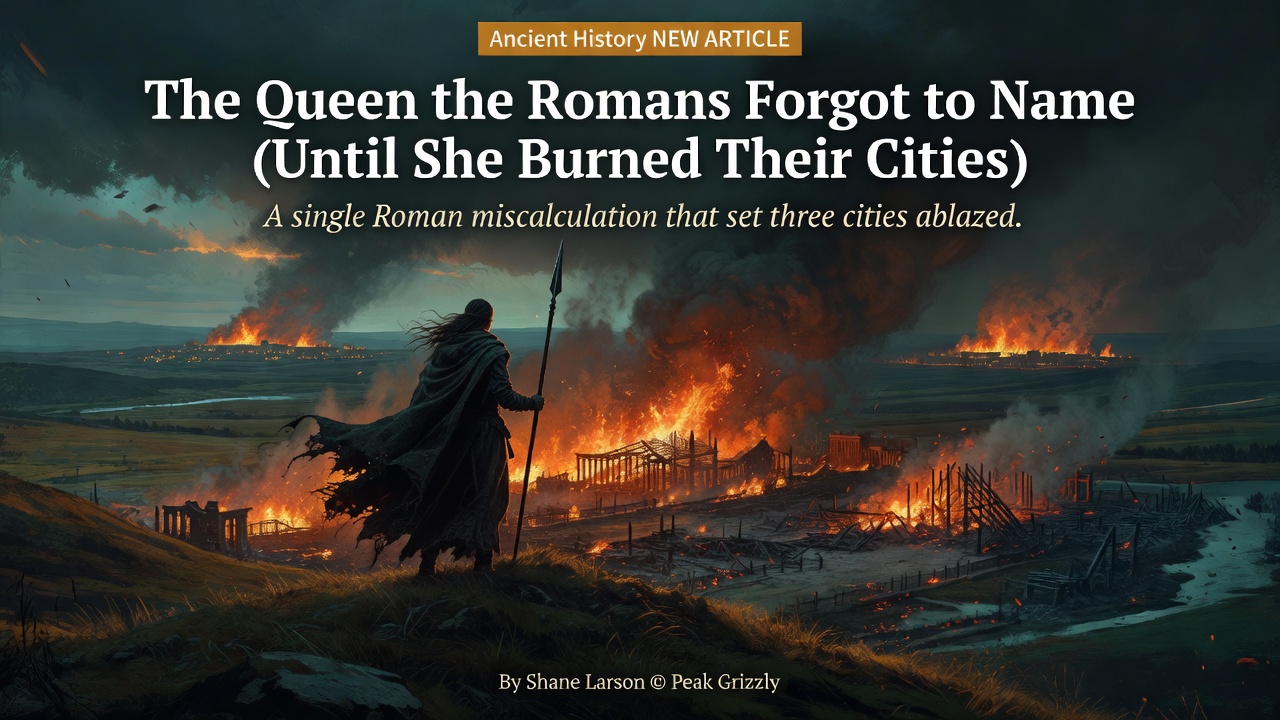
The Queen the Romans Forgot to Name (Until She Burned Their Cities)
April 29, 2026 · 8 min read
The procurator's office in Camulodunum, in the spring of 60 CE, did not consider the Iceni a serious problem.
The king of the Iceni, Prasutagus, had just died. He had been a Roman ally for over a decade. He had paid his tribute, hosted Roman traders, and managed his tribesmen with the cooperative efficiency that the imperial administration found ideal in a client king. His will, drafted in proper Roman legal form, named two co-heirs: his two daughters jointly, and the Emperor Nero. The arrangement was conventional client-kingdom practice. It was meant to bind Rome to honor the inheritance of his children.
The procurator, Catus Decianus, declared the will invalid.
This is the moment the standard textbooks skip past quickly. It is described, in Tacitus, as a procedural action — a Roman official annexing a kingdom because the legal instruments were ambiguous. What it actually was, in the field, was something else.
What Catus Decianus Did Next
Soldiers came onto the royal estate. They evicted the household staff. They inventoried the property. They seized the family heirlooms. They took the horses, the cattle, the gold. They reduced the queen and her daughters from sovereign rulers to private subjects of the Roman administration.
The procurator extended the annexation to the property of the Iceni nobility. Local aristocrats — the ones who had been good Roman clients, who had hosted the procurator's tax collectors at their hearths, who had paid their bills and educated their sons in Latin — were dispossessed alongside the rebels. The bills they had run up with Roman financiers — including, famously, with Seneca — were called in immediately, all at once. Some lost everything. Some, according to Tacitus, were enslaved.
Then someone — we do not know who, exactly; we do not know whether on order or on initiative — decided that the queen had to be made an example of.
She was tied to a post and beaten. Her two daughters were raped.
Tacitus describes this in two short sentences. He does not dwell. The Roman senatorial style does not dwell on violence against women. The result is a passage whose horror builds in the reader rather than being supplied by the writer.
The Calculation That Flipped
Empires manage conquered populations through a calculation that, when stated bluntly, is brutal: the conquered will absorb whatever is done to them, as long as resistance looks more expensive than submission. This calculation is mostly correct. It is correct most of the time, in most provinces, with most populations. The history of the Roman Empire is in large part the history of subject peoples absorbing extraordinary cruelty without rising — because rising looked, to them, even worse than absorbing.
The calculation depends on a few things being true at once. The conquered have to believe resistance is futile. The local elite has to believe cooperation pays. And the imperial administration has to maintain enough of a legitimating fiction that it can be argued, even cynically, that the empire provides some service in exchange for what it takes.
In the Iceni case in 60 CE, all three of these broke at once.
The flogging of the queen demonstrated that there was no protection: the highest-status woman in the kingdom could be physically violated without consequence to the men who did it. The annexation of the noble estates demonstrated that cooperation paid nothing: the families who had played by Roman rules were dispossessed alongside those who had not. And the conduct of the administration — confiscatory, contemptuous, openly extractive — demonstrated that the empire was not even pretending to provide a service.
The legitimating fiction collapsed. The calculation flipped. Six weeks later, three Roman cities were burning.
What Burned
Camulodunum, the colonia at modern Colchester. The first Roman city in Britain, built on Trinovantian land taken without compensation, settled with retired legionaries who treated locals contemptuously. It had no walls, because the colonists believed walls were a sign of insecurity.
The Iceni and Trinovantes arrived together. The veterans of the legions, with two hundred badly armed reinforcements sent by the procurator, attempted to defend the Temple of Claudius — the deified emperor's temple, built with British forced labor and funded by British taxes. They held out for two days. Then the temple burned, with them inside it.
Londinium, the trading hub on the Thames. By 60 CE it was already the most important commercial center in the province. The Roman governor, Suetonius Paulinus, racing east from Wales after his Anglesey campaign, reached the city ahead of his army. He looked at it. He made a cold decision: he could not hold it. He abandoned Londinium. Those who could leave with him did. The rest stayed.
The destruction of Londinium left a layer of red-orange ash beneath the modern City of London, up to half a meter thick in places, still found by archaeologists when they dig the foundations of new buildings. It is called the Boudican destruction horizon. The carbonized remains of timber buildings, of grain stores, of writing tablets, are sealed inside it. It is one of the most dramatic archaeological signatures in British history.
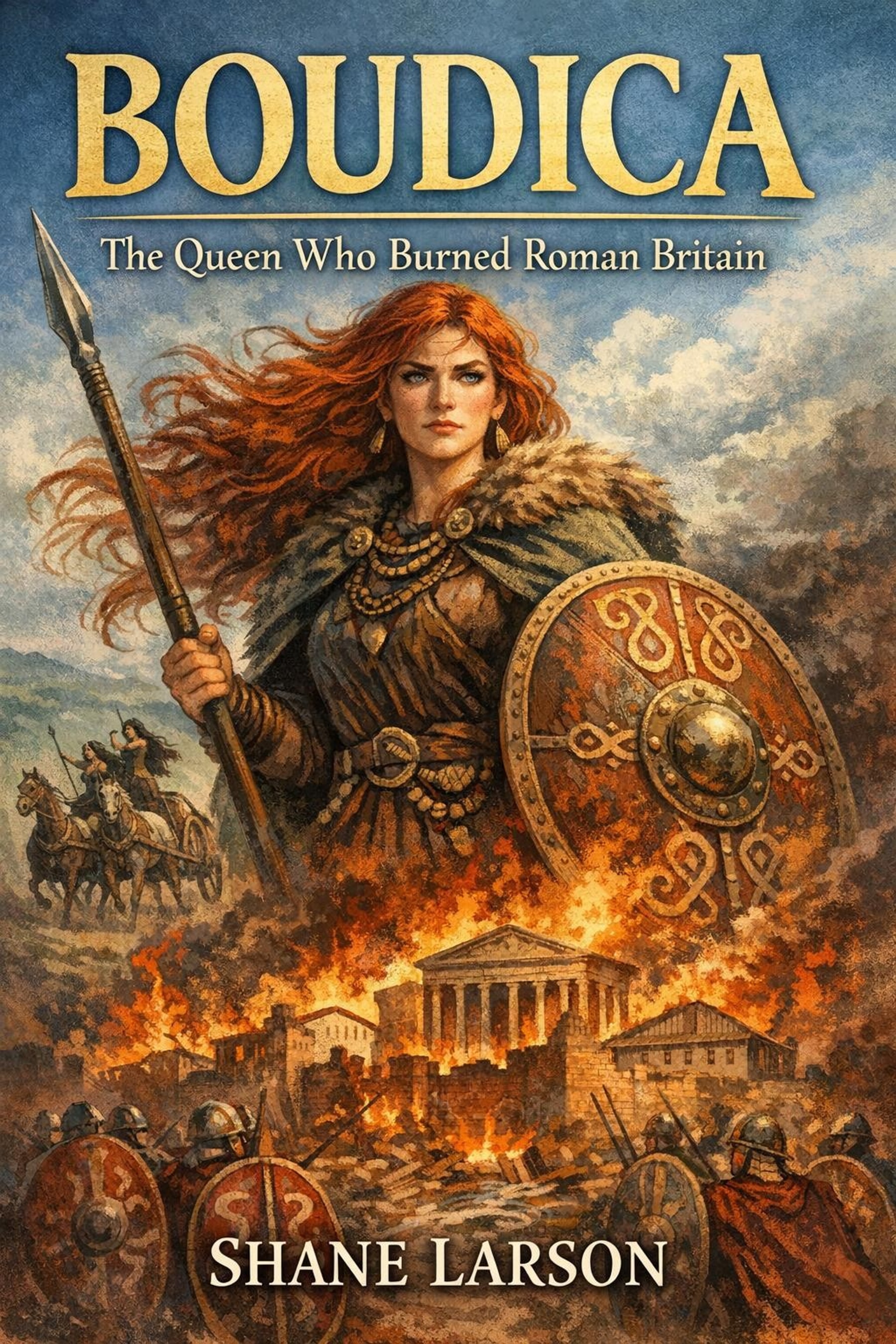
Boudica
Verulamium, the third city, fell next. The ancient sources put the dead at seventy thousand. The number is probably inflated; the destruction was not. Three cities, in something like six weeks, reduced to ash.
What Tells the Story
We have two literary sources for Boudica: Tacitus and Cassius Dio. Both were Roman senators. Both were writing decades or centuries after the events. Both put long speeches in Boudica's mouth — speeches she could not possibly have given, full of Roman literary commonplaces about decadent emperors and effeminate baths. Both describe her army at numbers (230,000) that are inflated by at least an order of magnitude. The speeches, the numbers, the descriptions of her appearance — these are not history. They are Roman literature making use of a barbarian queen to argue political points internal to Rome.
But the skeleton is sound. The destruction layers are real. The dates align. The geography of the campaign matches what the texts describe. We can know what happened. We just cannot, despite Roman literary insistence, know exactly what was said.
This is, to me, the more interesting story. Not "what Boudica said in her chariot before the final battle" — we do not know, and Tacitus did not know either. But "what happened on the Iceni royal estate the day the soldiers came" — that we can reconstruct, and the reconstruction tells us something more important than any speech.
What This Episode Is Actually About
I have come to believe, after writing this book, that Boudica's revolt is not primarily about gender. It is not primarily about nationhood. It is not primarily about Roman cruelty in a generic sense. It is about a specific kind of imperial failure — the failure of administrative rationality to imagine the people on whom it is being practiced.
Catus Decianus did not, I am sure, set out to destroy the eastern province. He did not wake up that morning planning to provoke a revolt that would burn three cities and require the recall of his governor. He made a decision that, in his frame of reference, was routine. He invalidated a will. He sent soldiers to inventory an estate. The soldiers, when they arrived, treated the situation as the kind of routine annexation they had carried out a hundred times before. They were not unusually cruel. They were, by the standards of Roman provincial military practice, ordinarily cruel. The cruelty was the policy, not a deviation from it.
What the procurator's office could not see, because it had no apparatus for seeing it, was that the people on the receiving end of routine cruelty are not interchangeable units of provincial administration. They have their own histories, their own thresholds, their own breaking points. The Iceni had been close to a breaking point for a generation. The flogging of their queen was the act that pushed them over it.
This is the lesson that empires keep relearning, badly, expensively, late. It is the lesson Rome would learn in 60 CE — at the cost of three cities, a legion, and the careers of the men who had insisted that the eastern province was perfectly stable. It is the lesson that empires of every kind, military and economic and political, keep learning.
The lesson does not stay learned. That is why we keep needing to tell the story.
Why I Wrote the Book
There is no current, narrative-driven, accessible book about Boudica aimed at general readers. The academic monographs are expensive and specialized. The popular treatments are mostly out of print. The fictional treatments are excellent (Manda Scott's series is genuinely good) but they are fiction. Readers who wanted to know what actually happened, told as a coherent narrative, with the source problems handled honestly, did not have a book to point to.
I wanted to write that book. I wanted to write it with the same narrative drive that defines the best contemporary popular history — Mary Beard, Tom Holland, Adrian Goldsworthy. I wanted to be honest about uncertainty. I wanted to follow the story all the way through to its long afterlife — the medieval silence, the Elizabethan rediscovery, the Victorian transformation that put Boudica's chariot at Westminster Bridge as a symbol of British imperial destiny (an irony so total it ought to make the bronze blush).
I wanted, most of all, to take Boudica seriously as a political and military actor — not as a symbol, not as a feminist icon retrofitted to modern needs, not as a Victorian metaphor — but as a queen who made decisions under pressure, with limited information, in a world that no longer exists, and whose decisions still cast a long enough shadow that we are still arguing about them two thousand years later.
The book is called Boudica: The Queen Who Burned Roman Britain. It is available now on Amazon Kindle. If you have read Cleopatra's Egypt or Zenobia of Palmyra, you already know the kind of book this is. If you have not, this is a reasonable place to start.
The bronze chariot is still at Westminster Bridge. The ash layer is still beneath London. The story is still worth telling.
Boudica
New posts and releases, straight to your inbox. No spam, unsubscribe anytime.