In 1575, Three Ranks of Peasants With Matchlocks Ended the Age of the Mounted Samurai
June 18, 2026 · 6 min read
Picture the samurai. You probably see a swordsman: a lone warrior in lacquered armor, a katana that has never lost a duel, bound by an ancient and unbreakable code of honor. He would rather die than retreat. He fights with the blade and disdains lesser weapons.
Almost none of that survives contact with the actual history.
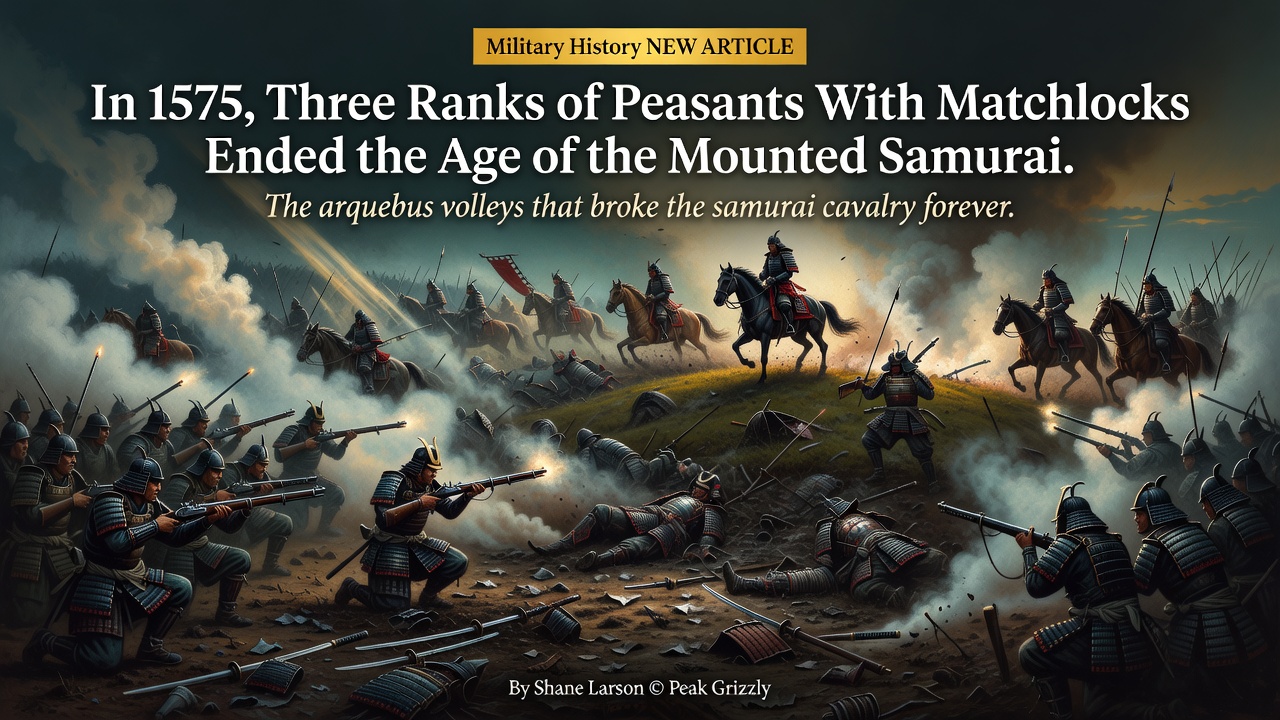
The samurai who fought through Japan's Age of Warring States — the Sengoku Jidai, from 1467 to 1603 — switched sides when it paid, broke oaths when they had to, and reached for whatever weapon won the battle in front of them. By the 1570s, the weapon that won battles was the matchlock gun. And on a single afternoon in 1575, at a place called Nagashino, ranks of common foot soldiers with firearms broke the most feared cavalry in Japan and quietly closed the age of the mounted samurai for good.
This is the gap I wanted to write about. Not the romance — the record.
A century with no one in charge
To understand why three guns mattered so much, you have to understand how broken Japan already was.
In 1467, a dispute over who would inherit the office of shogun curdled into open war between rival coalitions of lords. The fighting wrecked Kyoto, the capital, and — more importantly — it shattered the idea that anyone was actually in charge. The emperor had long been a ceremonial figure. Now the shogun became one too. Real power drained downward and outward to provincial strongmen who could field armies and hold land.
What followed was 136 years that the Japanese remember as the Age of Warring States. There was no functioning national government. There was no single law. There was only a patchwork of warlords — the daimyo — each holding what he could and eyeing what his neighbors had. Loyalty was real but conditional. A retainer served his lord until serving someone else made more sense, and the phrase the era produced for the pattern, gekokujo, translates roughly as "the low overcoming the high." Servants overthrew masters. Sons displaced fathers. The whole social order was up for grabs.
It is a brutal setting. It is also, for a writer, an extraordinary one, because chaos on that scale eventually produces people capable of ending it.
The disruptor: Oda Nobunaga
The first was Oda Nobunaga, and he is the reason the romantic version of the samurai falls apart on inspection.
Nobunaga was a minor lord from a middling province who understood two things his rivals were slow to grasp. The first was that the new firearms, dismissed by traditionalists as crude and dishonorable, were the future of war. The second was that the institutions everyone treated as untouchable — the great Buddhist monastery-fortresses, the old aristocratic customs, the comfortable assumptions about how warfare should be conducted — were obstacles to be removed, not respected.
So he removed them. He embraced guns when his enemies sneered at them. When the warrior-monks of Mount Hiei defied him, he burned the complex and killed the people in it. He was not interested in honor as performance. He was interested in winning, and he was very good at it. By the time he was assassinated by one of his own generals in 1582 — betrayed at the moment of his greatest strength — he had broken the back of the old order and made national unification thinkable for the first time in over a century.
He did not finish the job. Disruptors rarely do.
The consolidator: Toyotomi Hideyoshi
The man who finished it had no business doing so. Toyotomi Hideyoshi was born a peasant. He entered Nobunaga's service as a low-ranking foot soldier and rose, on raw ability and political cunning, to become the most powerful man in Japan. There is no Western parallel that quite captures it: imagine a private in an army becoming, within one lifetime, the absolute ruler of the nation.
The Samurai Century
Hideyoshi completed the unification Nobunaga had started, partly by force and partly by a genius for knowing when to fight and when to buy off an enemy with titles and land. He ordered the great land surveys and the famous "sword hunt" that disarmed the peasantry and froze the social classes into place — ironic, from a man who had climbed straight through those classes himself. For a moment he held everything together.
Then he overreached. Late in his life he launched two enormous invasions of Korea, wars that accomplished nothing and bled his armies for years. He died in 1598 with the campaign unwon and his succession unsettled, leaving an infant heir and a circle of ambitious lords who all knew the boy could not hold what his father had built.
The institution-builder: Tokugawa Ieyasu
Which brings us to the most patient man in this story, and the one who won.
Tokugawa Ieyasu had served both Nobunaga and Hideyoshi. He had spent years as a hostage in his youth, years as a careful ally in his prime, and a lifetime learning to wait. When Hideyoshi died, Ieyasu did not lunge for power. He maneuvered. He let the rival factions form, let his enemies commit, and in the autumn of 1600 staked everything on a single enormous battle at Sekigahara.
It was decided in one morning. Treachery on the field — a powerful commander who switched sides mid-battle — broke the opposing coalition, and by midday Ieyasu had effectively won Japan. Three years later the emperor named him shogun, and Ieyasu set about building something neither of his predecessors had managed: a system designed to outlast its founder.
The Tokugawa order he created held the country in peace for roughly 250 years. He did it by controlling the daimyo with a web of obligations — hostages held in the capital, alternating residence requirements, marriages and land grants that bound everyone to the center. It was not glamorous. It was administration. And it worked precisely because it was boring.
Where the legend comes from
Here is the part that surprises people most. The elaborate "samurai code" — bushido, the way of the warrior, with its rituals of honor and its romance of beautiful death — was largely written down during the Tokugawa peace, after the wars were over.
That makes sense once you think about it. A warrior class with no wars to fight is a problem. The Tokugawa had created hundreds of thousands of samurai with nothing to do. The codes, the philosophy, the cultivation of swordsmanship as a spiritual discipline — much of that was the answer to a peacetime question: what is a warrior for when there is no one to fight? The men who actually fought the Sengoku wars would have found a good deal of it unrecognizable. They were too busy surviving.
None of this makes the real history less interesting. It makes it more so. Strip away the romance and you are left with something better than a legend — a true story about ambition, technology, patience, and the strange, difficult work of building order out of a hundred years of chaos.
Read the whole century
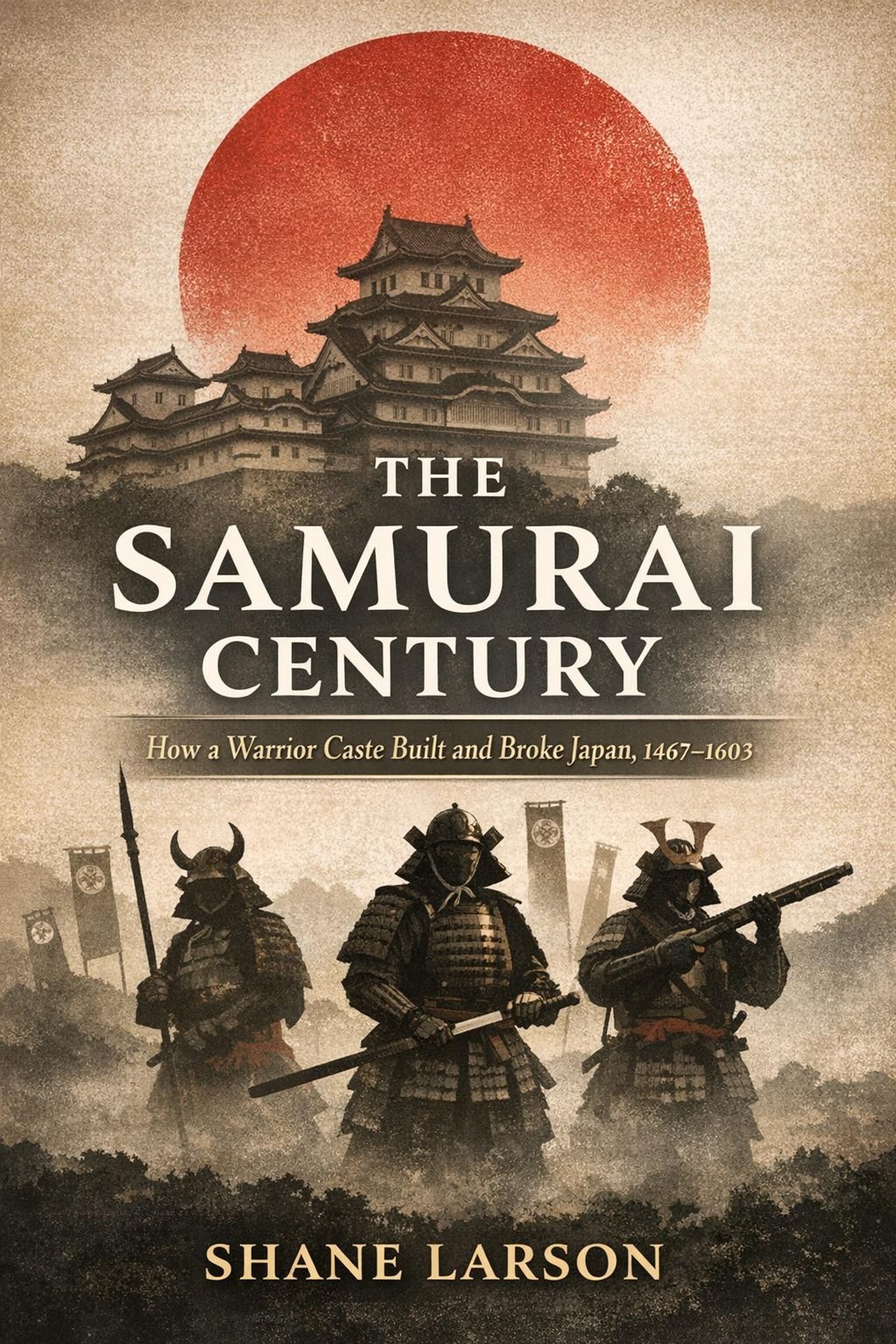
That is the book. The Samurai Century: How a Warrior Caste Built and Broke Japan, 1467-1603 runs the full arc — the collapse, the firearms revolution, the three unifiers, the great castles, the Jesuit missions, the Korean invasions, and the honest distance between the bushido myth and the documentary record. If you watched Shogun and wanted to know how much of it was real, this is that story, told straight.
It is out now, $3.99, and free to read on Kindle Unlimited.
If you enjoy narrative history that takes the legend apart and rebuilds it from the record, you may also like my books on Sparta and the ancient world and Marcus Aurelius and the Roman world — same approach, different empires.
The Samurai Century
New posts and releases, straight to your inbox. No spam, unsubscribe anytime.