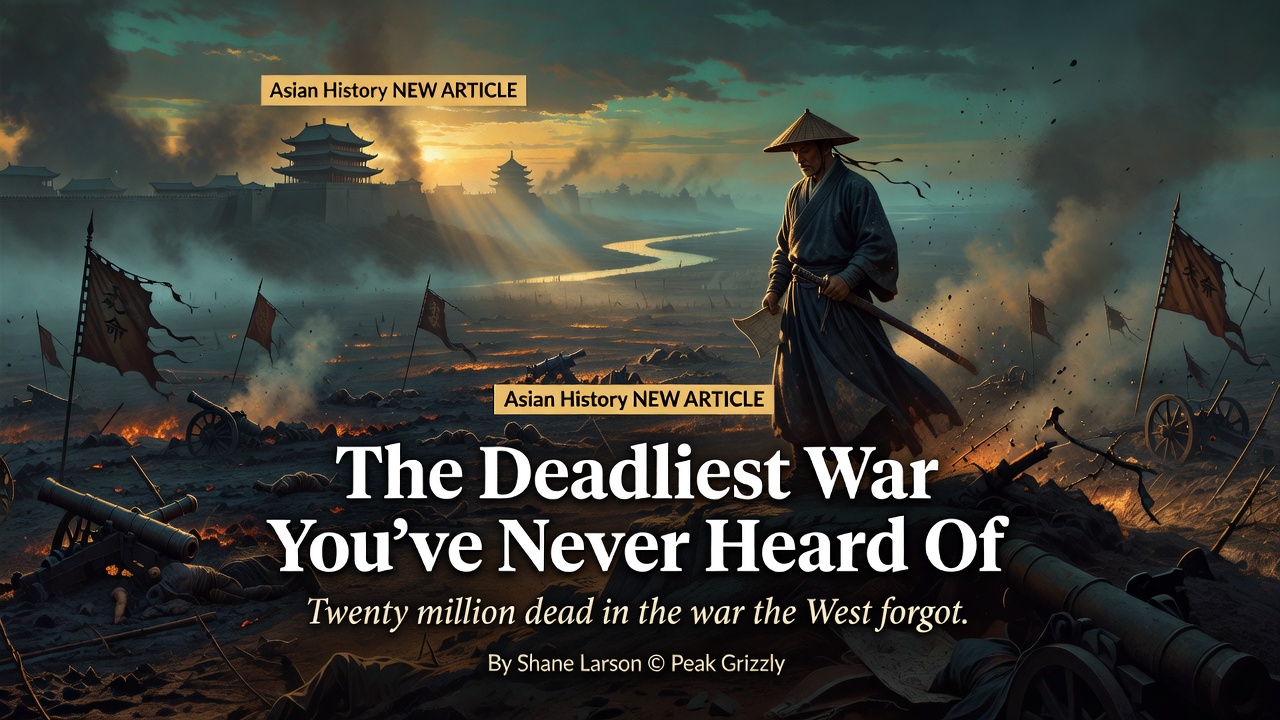
The Deadliest War You've Never Heard Of
June 18, 2026 · 6 min read
While America fought a civil war that killed 750,000, China fought one that killed 20 million—and you've probably never heard of it.
That sentence still stops people cold, and it should. The American Civil War (1861–1865) is one of the most studied conflicts in the English-speaking world. Libraries groan under the weight of books about it. We can name its battles, its generals, its turning points. Its death toll—recently revised upward to around 750,000—is rightly treated as a national trauma.
Now hold that number next to another one. In the very same decade, on the other side of the world, a civil war was killing somewhere between 20 and 30 million people. Most estimates put it well above the death toll of World War I. It was, by a wide margin, the bloodiest civil war in human history and one of the deadliest conflicts of any kind before the 20th century.
It was called the Taiping Rebellion. And in the West, it is almost a blank space.
How does a war that size get forgotten?
Part of the answer is simple distance. To 19th-century Europeans and Americans, China was a faraway market, a source of tea and silk and trouble, not a place whose internal politics demanded close attention. The reporting that did come back was filtered, fragmentary, and often more interested in trade than in the millions dying upcountry.
Part of it is that the war doesn't fit the stories the West tells about the 1800s. We frame that century around industrialization, empire, the rise of the nation-state, the American struggle over slavery. A Chinese theocratic uprising led by a man who believed he was the brother of Jesus doesn't slot neatly into any of those narratives. So it fell through the cracks.
And part of it, frankly, is that the scale is hard to absorb. Twenty million dead over fourteen years is not a number the human mind holds easily. It becomes an abstraction, and abstractions don't get remembered the way Gettysburg does.
But the Taiping Rebellion deserves better than to be a footnote. It is one of the great hinge events of modern history, and the story behind it is genuinely astonishing.
It started with a failed exam
For centuries, the path to power and prestige in imperial China ran through the civil service examinations—a punishing, multi-day ordeal that tested mastery of the Confucian classics. Pass, and you could enter the scholar-official class that ran the empire. Fail, and you went home to a village that knew exactly how you'd done.
Hong Xiuquan failed. Repeatedly. He was a bright young man from a Hakka farming family in the south, and the exams were his one ladder upward. After one of his failures, sometime around 1837, he collapsed into a fever that lasted for days. In his delirium he experienced vivid visions—of ascending to heaven, of an old bearded father figure, of an elder brother.
Years later, after encountering Christian missionary pamphlets, Hong reinterpreted those visions. The father was God. The elder brother was Jesus Christ. And Hong himself—this was the radical leap—was the younger brother of Jesus, a second son of God sent to earth with a divine mission: to destroy the demons who had usurped China and to establish a new kingdom of heaven on earth.
The "demons," in Hong's theology, were the Manchu rulers of the Qing dynasty.
From a fringe sect to an empire within an empire
It is easy to imagine this going nowhere—one more eccentric preacher in a vast country. Instead, Hong's message caught fire among people who had every reason to want the existing order destroyed.
The Qing dynasty in the mid-1800s was visibly faltering. It had just been humiliated by Britain in the First Opium War. Corruption was endemic, the population had exploded, land was scarce, and ordinary people—especially marginalized groups like Hong's own Hakka community—were squeezed hard. Hong's movement, the God Worshippers, offered something powerful: a vision of a world turned upside down, where the despised would inherit a kingdom and the oppressors would be swept away.
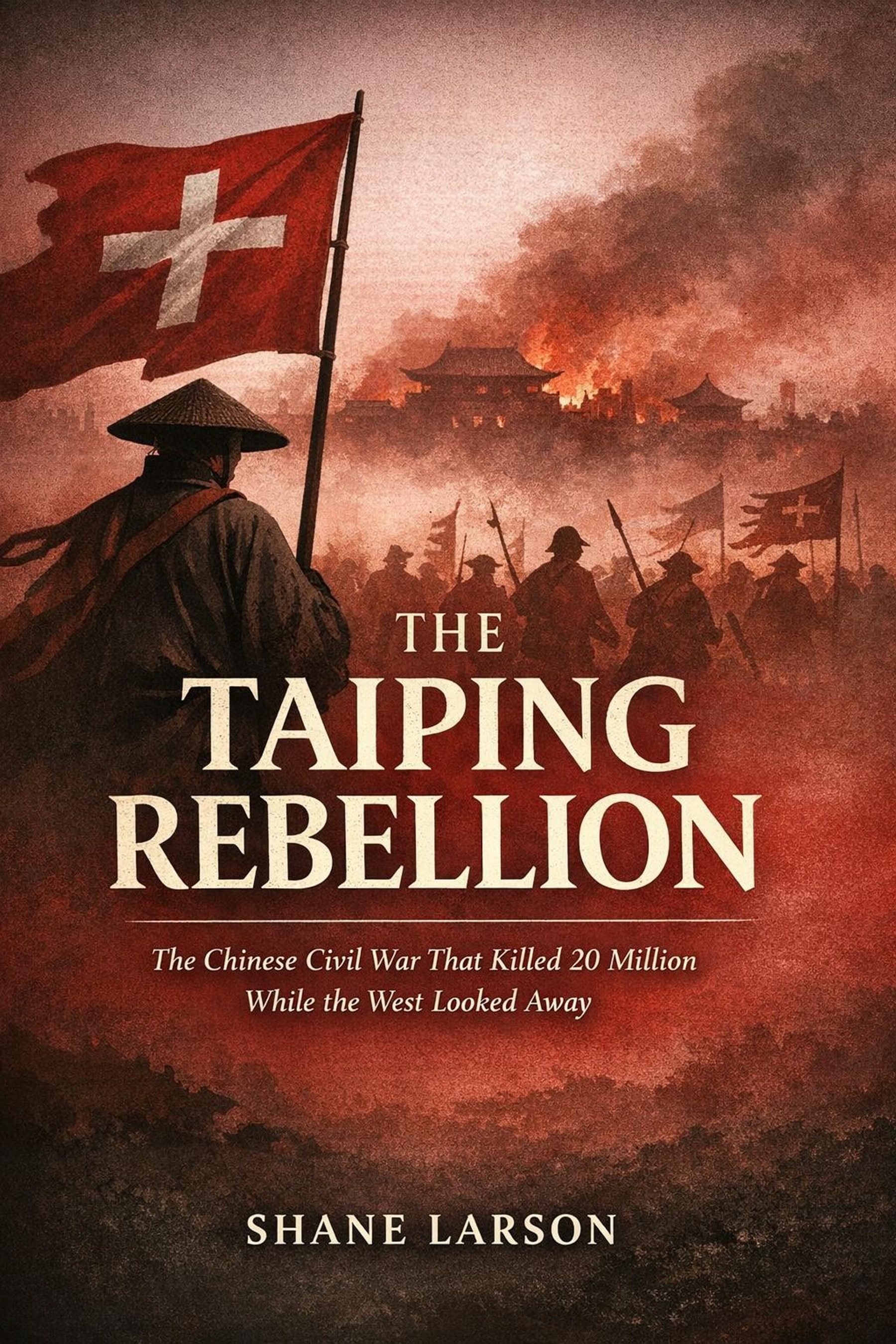
The Taiping Rebellion
It also offered discipline and structure. The Taiping built a real organization, a real army, and a real ideology. They banned opium and foot-binding. They preached a kind of radical communalism in which land and property were, at least in theory, held in common. They segregated men and women into separate camps and imposed a strict moral code. It was part religion, part army, part social revolution.
In 1851 they declared the founding of the Taiping Tianguo—the Heavenly Kingdom of Great Peace. By 1853 they had marched out of the southern hills, swelled into a force of hundreds of thousands, and captured the great city of Nanjing on the Yangtze River. They made it their capital and renamed it the Heavenly Capital. For more than a decade, an empire within an empire ruled the richest heartland of China.
The rebellion that destroyed itself
Here is where the story turns from improbable triumph to tragedy, and where it offers a lesson that outlasts its century.
The Taiping were not defeated, at first, by the Qing. They were nearly destroyed by themselves.
At the peak of their power, the movement's top leaders fell into a vicious internal struggle. Rival "kings" jockeyed for authority. In 1856 it exploded into the Tianjing Incident—a spasm of coups and counter-coups in the Heavenly Capital that left thousands of Taiping leaders and followers slaughtered by other Taiping. The movement's most capable commander was murdered. Its founding cohesion shattered. Hong himself withdrew further into seclusion and religious obsession.
It's a pattern worth sitting with. Movements and organizations rarely collapse first to their enemies. They collapse to their own contradictions—to the rivalries, paranoia, and rot that grow inside any concentration of power. The Taiping controlled the wealthiest region of a vast empire, and they spent their strength tearing one another apart.
How it finally ended—and why it still matters
The Qing court, for its part, had nearly proven incapable of saving itself. Its hereditary banner armies were a shadow of their former selves. What ultimately turned the tide was something new: regional armies raised and led by Chinese gentry officials, most famously Zeng Guofan and his protege Li Hongzhang. These were locally recruited, locally funded forces loyal to their commanders—a quiet revolution in how Chinese power actually worked, and one whose consequences would echo for decades.
They were helped, in the final phase, by foreign money and foreign soldiers. A mercenary force that became known as the Ever Victorious Army—led for a time by the British officer Charles "Chinese" Gordon—brought Western weapons and tactics to bear around Shanghai. The foreign powers, having decided a weak-but-stable Qing served their trade interests better than a Taiping victory, put their thumb on the scale.
Nanjing fell in 1864. Hong was already dead, probably from illness, possibly self-inflicted. The reconquest was merciless; the Heavenly Capital was devastated. The Heavenly Kingdom of Great Peace was finished.
But the Qing dynasty that survived was mortally wounded. It had been forced to hand real military power to regional strongmen, had bled its treasury white, had exposed its weakness to the world, and had presided over the deaths of tens of millions of its own people. The road from the Taiping catastrophe runs, in a real sense, straight to the dynasty's final collapse in 1911. To understand modern China—its deep wariness of internal chaos, of foreign intervention, of weak central authority—you have to understand the wound the Taiping Rebellion left behind.
Read the full story
I wrote The Taiping Rebellion: The Chinese Civil War That Killed 20 Million While the West Looked Away because this story has everything—visions and holy war, idealism and atrocity, betrayal, foreign gunboats, and the slow death of an empire—and almost no one outside specialist circles knows it.
If you've read my work on the fall of Rome or my book on the patterns behind civilizational collapse, this is the same approach pointed at East Asia: a fast, clear narrative built for curious readers, not a footnoted brick built for academics.
The deadliest war you've never heard of is worth a few hours of your attention. The book is out now, priced at $3.99 and free on Kindle Unlimited.
The Taiping Rebellion
New posts and releases, straight to your inbox. No spam, unsubscribe anytime.