The City Beneath Mexico City: What Tenochtitlan Actually Was
May 31, 2026 · 9 min read
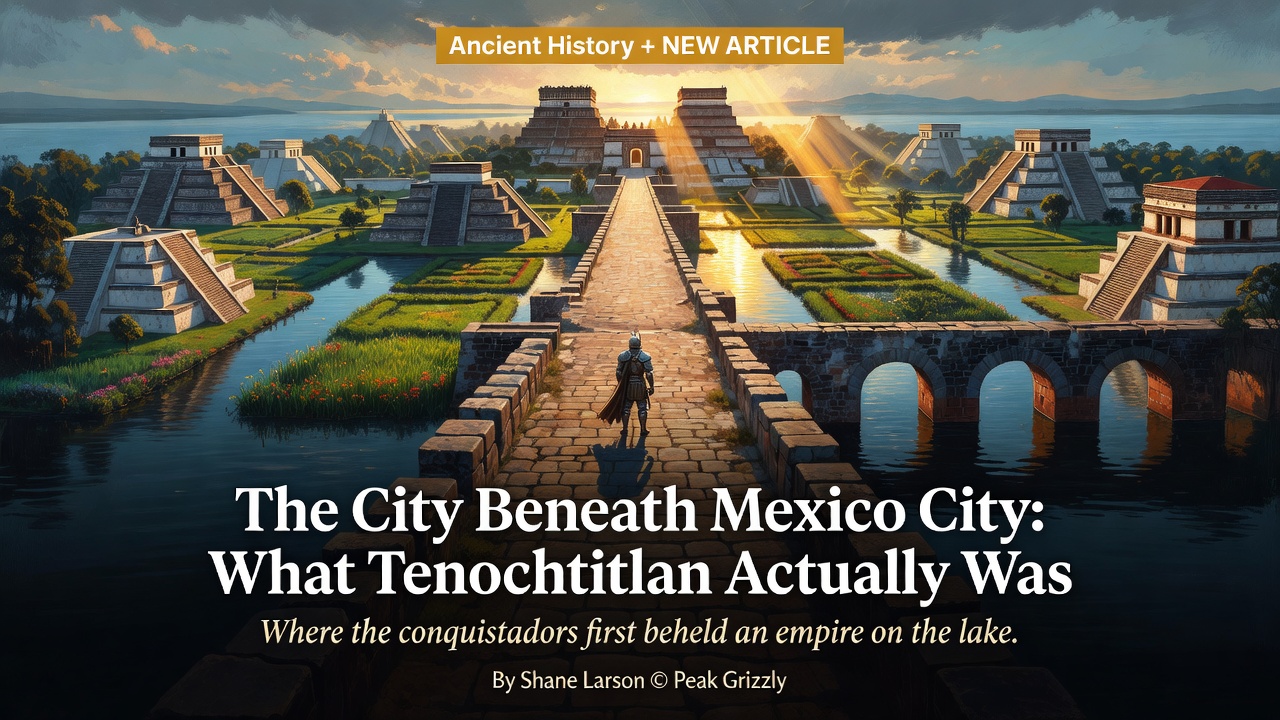
On November 8, 1519, Hernán Cortés and roughly four hundred Spanish soldiers walked across a stone causeway into a city that none of them could have imagined existed.
They had spent the previous months marching inland from the coast. They had fought their way through the Tlaxcalans and then turned them into allies. They had walked through Cholula, where the bones of the massacre they had ordered still lay in the streets. They had climbed up out of the hot coast and over the high passes between the great volcanoes, Popocatépetl and Iztaccíhuatl. They had come down into the Valley of Mexico, a wide green bowl ringed by mountains, dotted with city-states, and centered on a shallow lake.
And in the middle of that lake was Tenochtitlan.
The Spanish saw it for the first time from the causeway. The city rose out of the water. White-walled buildings, temples taller than the cathedrals of Seville, a grid of streets and canals stretching across an island that should not have been habitable. Bernal Díaz del Castillo, who walked in that day and survived to write about it decades later, said that some of his comrades wondered if they were dreaming, because they had read about cities like this only in stories of chivalry.
He was not exaggerating. Tenochtitlan was bigger than Seville. It was bigger than any city in Spain. It was probably bigger than any city in Europe. Its sister-city market at Tlatelolco handled tens of thousands of buyers and sellers in a single day, which made it busier than anything in Rome or Constantinople. The streets were swept. The water was clean. A dual-channel aqueduct from the springs at Chapultepec brought fresh water in, with one channel always reservable for maintenance, so that the supply never had to stop. The Mexica had built all of this in under two centuries, on a swampy island that nobody else had wanted.
Twenty-two months later, the city was rubble. The Spanish were building their own capital on top of the ruins. The cathedral over the temple. The viceroy's palace over the emperor's. The lake itself, drained over the following centuries, is gone. Mexico City still sits on the bones of Tenochtitlan, and every few years, a subway dig or a utility excavation turns up another piece of it.
I just published a book about that city. The rise, the institutions, the conquest, and the city beneath. The short version of why is this: Tenochtitlan deserves to be a household name in pre-modern urban history, on the same shelf as Rome and Constantinople and the Indus Valley capitals, and it mostly is not.
The City That Should Not Have Existed
The Mexica were latecomers to the Valley of Mexico. The valley was already crowded when they arrived in the thirteenth century — a network of established city-states ringing the lake, with deep ties of dynasty and tribute and rivalry. The Mexica had a reputation as a quarrelsome group of mercenaries with bad manners. Nobody wanted them as neighbors.
The traditional founding story says that they ended up on the island in 1325 because they saw an eagle on a cactus eating a snake — the sign their god Huitzilopochtli had promised them. The historical version is more pragmatic: they ended up on a swampy, brushy island in the lake because every piece of good lakeshore land had already been claimed by someone stronger, and the island was the only place they were not actively being chased off.
It was terrible real estate. The ground was soft. There was no fresh water. The island flooded. There was not enough farmland to feed a settlement of any size.
So they made the ground harder. They drove palm-trunk stakes into the lake mud and built up artificial islands on top. They built dikes and canals. They extended the original island in every direction until it was several times its natural size. They invented an agricultural system — the chinampas — that turned the lake itself into a year-round, multi-crop farm.
A chinampa is not a floating garden. The English-language translation has done a lot of damage. A chinampa is a long, narrow plot of muck and vegetation, rooted to the lake bottom by willows planted along its edges. The Mexica built thousands of them. They were ferociously productive. They could be cropped two or three or four times a year. Sediment dredged from the canals between them was thrown up onto the plots as fertilizer. The water table was always right there, so they did not need irrigation. By 1500, the chinampa system was feeding a city of perhaps 200,000 people.
For comparison: the largest city in Spain in 1519 was Seville, at maybe 60,000.
The Engineering
Once you understand what the chinampa system was doing, the rest of the city makes sense.
Three long stone causeways connected the island to the mainland. They were not just roads. They were dikes that controlled water flow, walls that controlled access, and platforms for aqueducts. They had wooden drawbridges at intervals, which could be raised to cut the city off from the mainland in case of attack. The Spanish would later learn what those drawbridges felt like from the wrong side.
The aqueduct from Chapultepec brought fresh water from springs on the mainland into the heart of the city. It was a paired channel — two parallel channels running side by side — so that one could be drained and cleaned while the other continued to flow. This is the kind of solution that betrays a long institutional memory and a culture that took infrastructure seriously.
Nezahualcoyotl's great dike — built in the mid-fifteenth century by the ruler of the allied city of Texcoco — ran for several miles north-to-south across the lake, separating the brackish water of the eastern lake from the fresh water of the western lake where the city sat. It protected the chinampas from salt incursion. It is one of the great pieces of pre-modern hydraulic engineering anywhere in the world. It is also gone, drained along with the rest of the lake.
Tenochtitlan
All of this was built without iron, without draft animals, without the wheel for transport, without the arch. The Mexica had different tools and they did the work anyway.
The Empire
A city of 200,000 in 1519 needed more food than even the chinampas could provide. Most of the rest came in as tribute.
Tenochtitlan was the senior partner in the Triple Alliance, the political structure that we usually just call the Aztec Empire. The other two members were Texcoco and Tlacopan. Together they controlled, directly or indirectly, central Mexico from the Gulf coast to the Pacific. Subject states paid in food, cotton, cacao, gold, jade, feathers, military service, and human captives for sacrifice.
The structure was deliberately loose. The Mexica did not generally garrison subject cities or replace local rulers. They simply established the tribute schedule and showed up to collect, with whatever level of violence was required to make the schedule continue to be paid the following year. This kept administrative costs low and gave the empire its characteristic reach. It also meant that subject peoples did not particularly love the Mexica, and several of the strongest among them — the Tlaxcalans on Mexica's eastern flank, the Tarascans on the western — had stayed unconquered and resentful.
That mattered in 1519. When Cortés arrived, his greatest strategic asset was not Spanish steel or Spanish horses. It was the willingness of the Tlaxcalans, the Cempoalans, and eventually a long list of others to march on Tenochtitlan beside him.
The Fall
The conquest is usually told as a story of Spanish brilliance. The corrected version is a story of indigenous politics and disease.
The first phase, in 1519 and early 1520, ran as a strange diplomatic standoff. Cortés walked into the city, was lodged in a palace, and effectively took Moctezuma into custody while pretending to be his guest. This held together for several months. It broke when Cortés had to leave the city to deal with a rival Spanish expedition on the coast and left Pedro de Alvarado in charge. Alvarado, panicking at the size of a festival assembling in the Templo Mayor precinct, ordered a massacre. The city erupted. By the time Cortés got back, the Spanish were trapped.
The night of June 30, 1520, the Spanish tried to sneak out of the city across the western causeway. The Mexica caught them on the bridges. Two-thirds of the Spanish died. Cortés sat down under a tree and wept. The Mexica chronicles call this the night of victory. The Spanish call it La Noche Triste.
It should have been the end. The new tlatoani, Cuitláhuac, had driven the conquistadors out. The empire was intact. Cortés was rebuilding in Tlaxcala, but his force was a shadow of what it had been.
Then smallpox arrived.
It came up from the coast, brought by a member of the second Spanish expedition that Cortés had defeated and absorbed. It hit Tenochtitlan in late summer and ran for months. The Mexica had no immunity. Estimates of mortality run from a quarter to a third of the city's population. Cuitláhuac, who had just driven the Spanish out, was one of the dead. The political leadership was decimated. By the time the siege of 1521 began, the city was already broken.
The siege itself ran for eighty days. The Spanish, now with tens of thousands of indigenous allies and a small fleet of brigantines they had built inland and carried over the mountains, took the city neighborhood by neighborhood. Cuauhtémoc surrendered on August 13, 1521, standing in the ruins. The Spanish began demolishing the temples almost immediately. By the end of the decade, they were laying out the streets of a new Spanish capital on the foundations.
What Survives
Mexico City is built directly on top of Tenochtitlan. The Zócalo, the great central plaza, sits where the ceremonial precinct stood. The cathedral was built using stone from the temples it replaced.
The Templo Mayor itself, the twin pyramid of the rain god Tlaloc and the war god Huitzilopochtli, was buried for nearly 450 years. In February 1978, electrical workers digging a trench behind the cathedral hit a large carved stone disk. When they uncovered it, they were looking at the goddess Coyolxauhqui — the murdered sister of Huitzilopochtli, dismembered at the foot of the temple in the founding myth, here carved in exactly that pose on a stone almost eleven feet across.
The Mexican government suspended construction and started digging. They have been digging ever since. The Proyecto Templo Mayor has produced more new physical evidence about Tenochtitlan in the last fifty years than the previous four centuries combined. The great skull rack — the tzompantli — was rediscovered in 2015. A ceremonial wolf burial in 2017. Offering caches by the hundreds. The city is still down there.
This is what makes Tenochtitlan such a strange subject. It is one of the great pre-modern cities, almost entirely destroyed, and yet still partially intact under the feet of one of the largest cities on the planet today. Most readers who could name two Roman emperors could not name two tlatoque. Most readers who could explain how the Roman aqueducts worked have never heard of the dual-channel Chapultepec aqueduct or Nezahualcoyotl's dike.
That gap is what the book is trying to close.
The Book
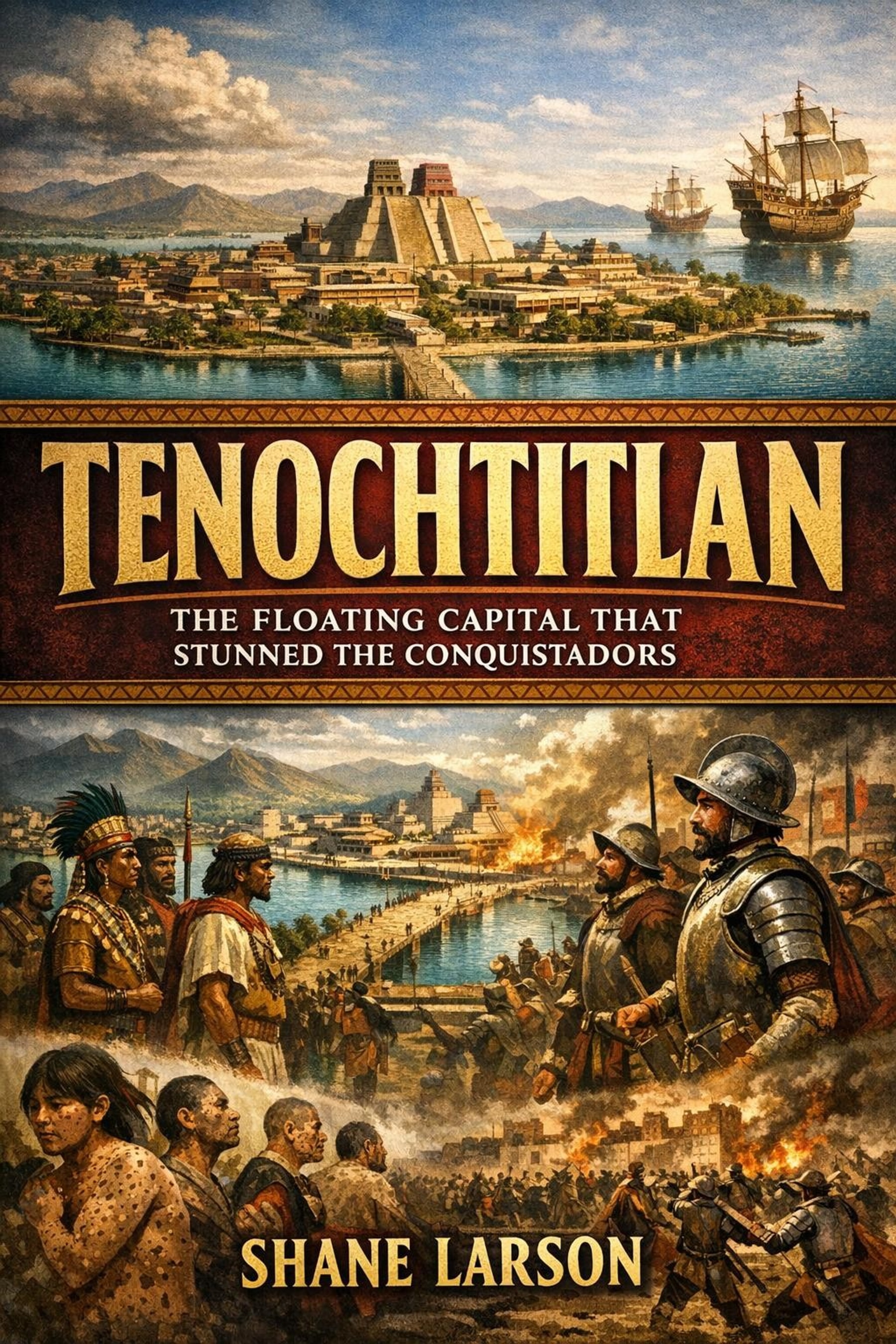
Tenochtitlan: The Floating Capital That Stunned the Conquistadors is out now on Kindle. It is the latest in my ancient history catalog and pairs naturally with The Ancient World's Greatest Engineers and The Hittite Empire. It covers the founding, the chinampa system, the engineering, the tribute empire, the institutions, the conquest, and what has been recovered since 1978.
If you have ever walked across the Zócalo and wondered what is buried under your feet, this is your book.
Tenochtitlan
New posts and releases, straight to your inbox. No spam, unsubscribe anytime.