The Greatest City in Ancient America Has No Name, No Known Language, and No Kings
August 27, 2026 · 7 min read
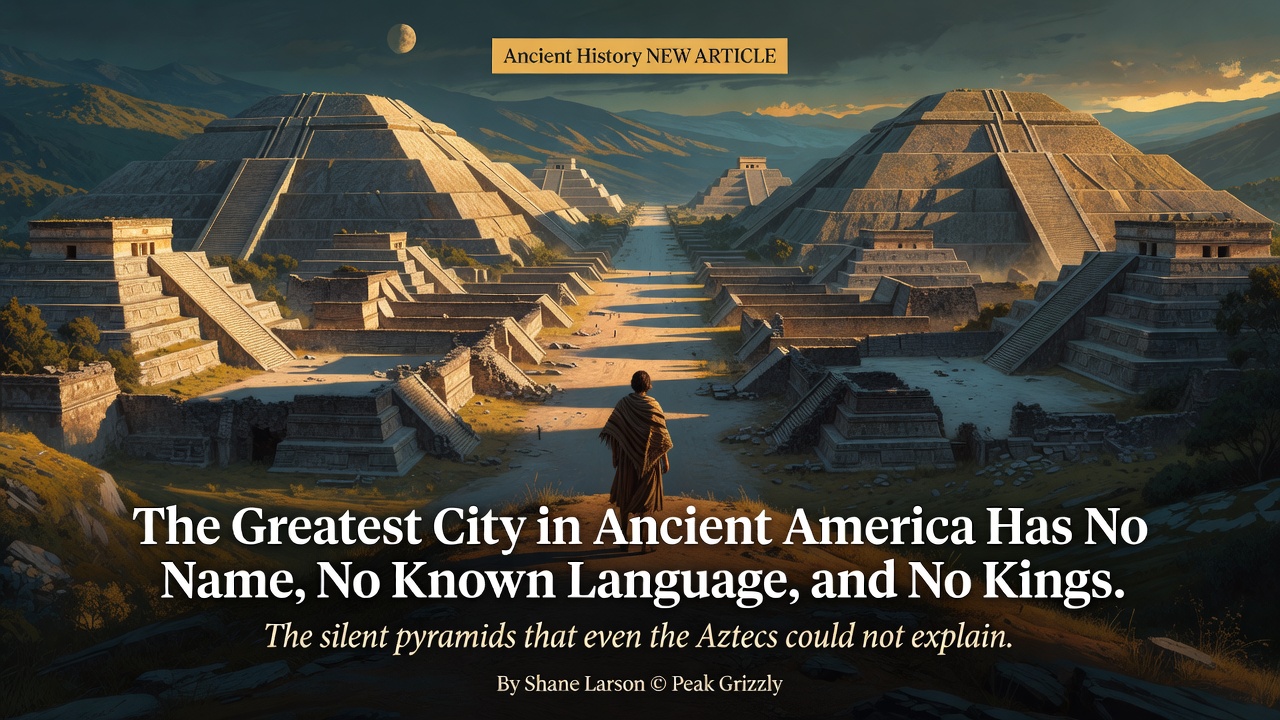
Sometime in the fourteenth century, a migrating people walked into a highland valley northeast of what is now Mexico City and found something that should not have existed. Two pyramids on a scale nothing in their world could match, facing a dead-straight avenue miles long, surrounded by square mile after square mile of ruined walls — all of it silent, all of it centuries abandoned. The newcomers were the Mexica, the people we call the Aztecs, and they were no strangers to monumental building. They would go on to raise Tenochtitlan, one of the great cities of the early modern world. But standing in that valley, they concluded that no human beings could have built what they were looking at. They named the place in their own language, Nahuatl: Teotihuacan — the place where the gods were born, or where one becomes a god. The two great mounds became the Pyramid of the Sun and the Pyramid of the Moon. The avenue between the ruins, lined with what they took for tombs, became the Avenue of the Dead.
Every one of those names is a guess by later people who knew nothing about the city. And here is the uncomfortable part: neither do we, in the ways that matter most. We do not know what the city's builders called it. We do not know what language they spoke — the serious candidates come from several unrelated language families, and none of them is settled. We do not know the name of a single person who ruled it. For a civilization that was, for several centuries, the dominant power in the Americas, that is not a small gap in the record. It may be the most important fact about the place.
A superpower that declined to introduce itself
Start with the scale, because the scale is the problem. At its height around AD 400, Teotihuacan covered some twenty square kilometers and housed perhaps 125,000 people — estimates range on both sides of that figure, but every serious one makes it among the largest cities on earth at the time, larger than anything in Europe outside Rome, and larger than any city in the Americas until the Aztecs. It was planned. The whole city sits on a rigid grid, uniformly rotated about 15.5 degrees east of true north for reasons still argued about, with drainage, reservoirs, and more than two thousand walled apartment compounds — multi-family residential blocks with courtyards, shrines, and murals, laid out with a regularity that implies central authority and real surveying. Most of the ancient world's ordinary people are archaeologically invisible. Teotihuacan's lived in planned housing that has been excavated by the block, which makes it the best-documented ancient city anywhere for how normal urban families actually lived.
It was cosmopolitan, too. One district — archaeologists call it the Oaxaca barrio — was home to families from the Zapotec world hundreds of kilometers away who kept their own pottery and their own burial customs for generations. Another quarter held people and goods from the Gulf coast; there is evidence of Maya residents as well. And the city's reach ran far past its valley. Its green obsidian moved across Mesoamerica. In AD 378, Maya inscriptions record the arrival of armed strangers at Tikal, seven hundred miles away, followed by the death of Tikal's king and the installation of a new dynasty — a dynasty that advertised its connections to the great city in the west. Whether that was conquest, a coup with foreign backing, or something stranger is one of the liveliest arguments in Mesoamerican archaeology. That it happened, and that Teotihuacan was the gravity behind it, is now widely accepted.
Every other early state we know at this scale — Egypt, Mesopotamia, China, the Maya themselves — produced kings' names, royal portraits, boastful inscriptions. It is close to a rule of ancient states that power writes its own name on everything. Teotihuacan produced almost none of that. No king lists. No dynastic monuments. Its magnificent murals are full of gods, priests, animals, and paradise imagery, and nearly empty of identifiable individual rulers. Some archaeologists think the city was ruled collectively — by councils, lineages, or corporate groups rather than a glorified king — and that the anonymity was a political choice. Others think the rulers existed and their monuments were destroyed or simply haven't been found. The honest answer is that we don't know. But the silence is so total, in a city otherwise so eager to decorate every wall, that the silence itself starts to look like a statement.
Teotihuacan
The sinkhole and the sky underground
In October 2003, after days of heavy rain, the ground opened near the Temple of the Feathered Serpent, the lavishly sculpted pyramid at the ceremonial complex called the Ciudadela. A sinkhole had dropped into a void. Sergio Gómez, an archaeologist with Mexico's National Institute of Anthropology and History, was lowered by rope into the gap and found himself in a man-made tunnel that had been deliberately sealed — packed with earth and closed off, it turned out, around eighteen hundred years ago, and never reopened since.
Excavating it took more than a decade, part of it done by small remote-controlled robots sent ahead through the rubble. What came out of that tunnel is one of the great archaeological finds of this century: on the order of a hundred thousand objects, including greenstone statues still standing where they were placed, jaguar remains, rubber balls, imported shells, seeds, and pools of liquid mercury — a substance brutally difficult to produce in quantity with ancient methods, and one whose shimmer many researchers read as standing for an underworld river or lake, though that reading is interpretation, not certainty. Strangest of all, the tunnel's walls and ceiling had been dusted with powdered pyrite and magnetite, so that torchlight made the passage glitter. Whoever built it engineered a night sky underground: a model cosmos beneath the city's most ideologically charged monument.
What the tunnel was for is still argued. Gómez hoped it might end at a royal tomb — the burial that would finally put a name and a face on Teotihuacan's power. It did not, or has not yet. The chambers at the end held offerings, not an identifiable king. Even under its most sacred pyramid, the city kept its rulers out of sight.
The fire that knew what it was looking for
Then there is the ending, which is the strangest evidence of all.
Sometime around AD 550 — the date is argued within a few decades — the center of Teotihuacan burned. Not the whole city: the fire was selective, and its selectivity is the point. The temples, palaces, and public buildings along the Avenue of the Dead were systematically torched. State sculpture was smashed and scattered. Excavators have traced the destruction up and down the ceremonial core, concentrated with remarkable consistency on the monuments and symbols of authority. The residential compounds where ordinary people lived — the overwhelming majority of the city — were largely left alone.
That pattern is hard to square with a foreign sack. Invaders burn indiscriminately, loot the rich districts, and leave the kind of general destruction layer that sacked cities show everywhere in the archaeological record. No known rival power of the period looks capable of taking Teotihuacan by storm in any case. What the pattern does resemble — and many archaeologists now argue this outright, while others still weigh factional warfare, ritual termination, or drought-driven breakdown behind it — is a city turning on its own rulers: an uprising, aimed not at the population but precisely at the institutions that governed it. The city did not empty overnight; people went on living in the ruins for generations. But the state that had planned the grid, raised the pyramids, and reached seven hundred miles into the Maya world never functioned again.
Put the two facts side by side and they start to feel connected. A regime that, uniquely in the ancient world, never told anyone its rulers' names. And an ending in which the only things burned were the symbols of those rulers' power. Whatever happened in Teotihuacan around 550, the people who did it knew exactly what they were angry at — and eight hundred years later, the Aztecs walked into the silence that was left and mistook it for the birthplace of the gods.
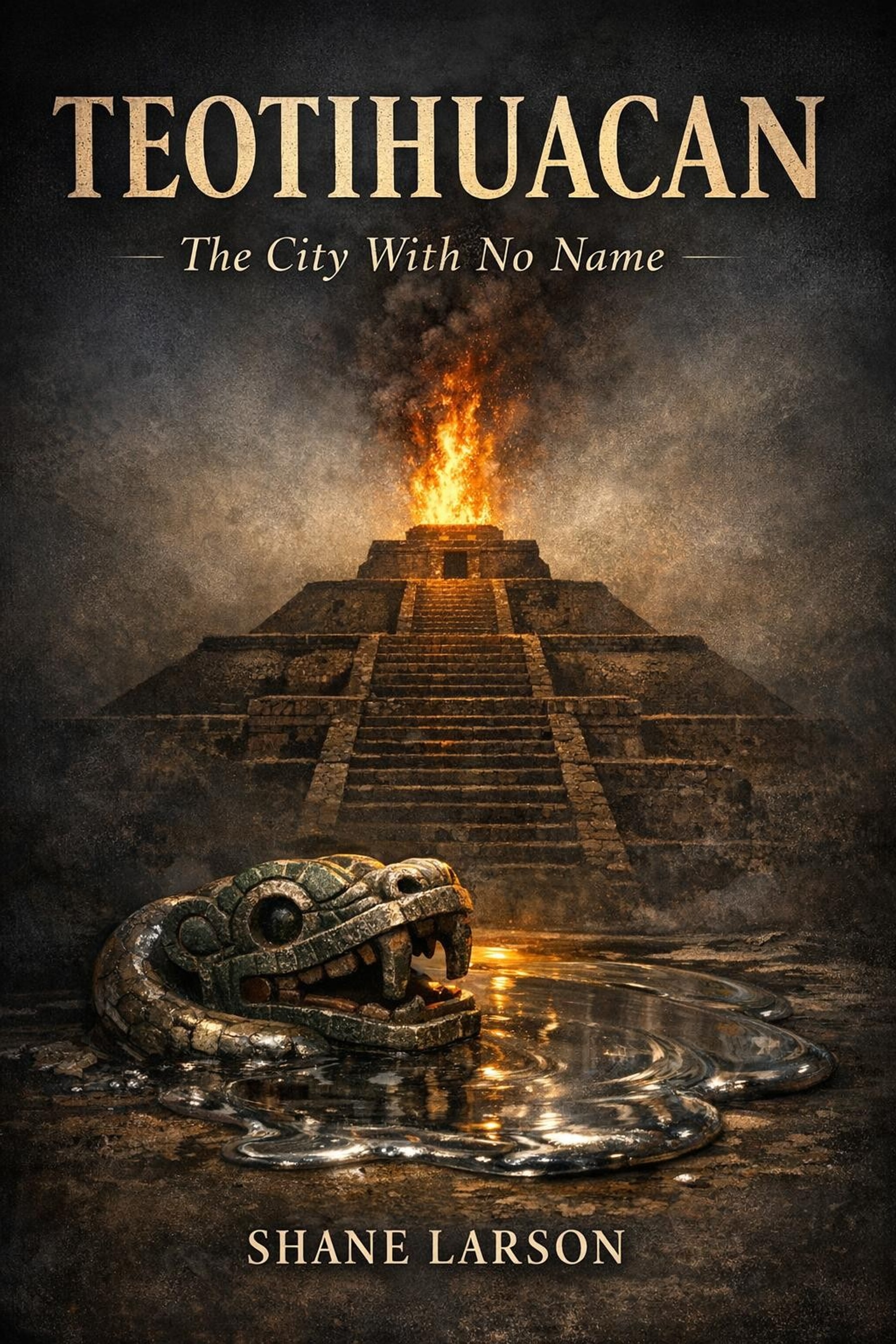
Shane Larson's new book, Teotihuacan: The City With No Name, reconstructs the whole story — the grid, the apartment compounds, the foreign quarters, the tunnel, the sacrificial burials, and the evidence for how it ended — for readers who want the real archaeology without the mystery-mongering. It joins his companion histories The Olmecs and The Maya Collapse in exploring the lost civilizations of ancient Mesoamerica.
Teotihuacan
New posts and releases, straight to your inbox. No spam, unsubscribe anytime.