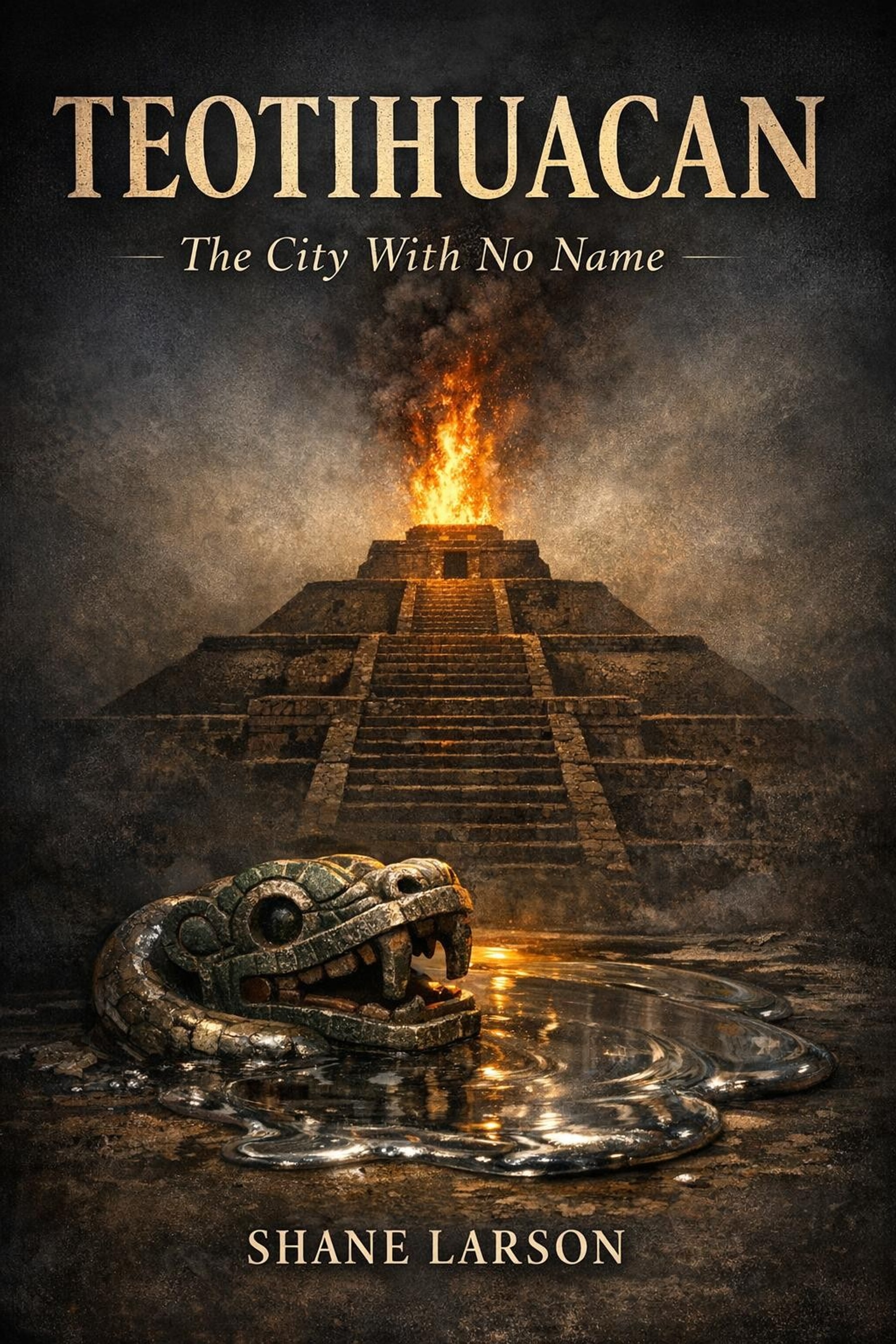
Teotihuacan
The City With No Name
By Shane Larson
About This Book
In the autumn of 2003, after days of heavy rain, a sinkhole opened in front of the Temple of the Feathered Serpent at Teotihuacan. An archaeologist named Sergio Gómez was lowered into it on a rope. At the bottom, in the dark, he found the mouth of a tunnel that had been deliberately sealed for more than eighteen hundred years — packed shut with tons of earth by the very people who dug it. It took his team years to clear. When they finally reached the chambers under the pyramid's heart, they found walls dusted with crushed pyrite so that torchlight turned them into a night sky, miniature mountain landscapes, greenstone figures standing together as if in conversation, and pools of liquid mercury — an underworld, built and lit and furnished, then closed forever.
No inscription explains any of it. Nothing at this city explains anything. And that is the real story.
The metropolis above that tunnel was, around the year 400, one of the largest cities on earth — perhaps 125,000 people living on a planned grid covering twenty square kilometers of the Mexican highlands. It raised the Pyramid of the Sun, a building whose footprint rivals the greatest pyramid of Egypt. It ran the obsidian trade of an entire hemisphere. Its soldiers appear to have marched seven hundred miles into the Maya jungle and replaced a king. Yet the people of this superpower left behind no name for themselves, no readable writing, no royal tombs, no portraits of their rulers — not even one. Everything we call the place, starting with the word Teotihuacan itself, was invented by the Aztecs, who arrived nearly a thousand years after the fall, found the ruins already ancient, and concluded that gods must have built them.
The Story
This book is a reconstruction from silence. Other ancient capitals speak for themselves — king lists, boasting inscriptions, carved conquests. Teotihuacan refused, and the refusal looks deliberate. Contemporary Maya cities a fraction of its size covered themselves in royal names; the largest power in the Americas appears to have made a political choice not to. So the book works the way the archaeologists have to work: from the things themselves. The grid and what it took to build it. The bound warriors buried by the hundred in the foundations of the great pyramids, and the isotope chemistry in their teeth that says where each of them grew up. The two thousand standardized apartment compounds — the best evidence anywhere on earth for how ordinary city people lived in the ancient world — including whole neighborhoods of foreigners from Oaxaca and the Gulf coast who kept their own pottery, their own tombs, and their own identities for three centuries inside someone else's capital.
And then the ending, which may be the strangest thing about the place. Around the year 550 the ceremonial heart of the city burned. The temples along the great avenue, the palaces, the sculpture of the state — smashed and torched with methodical thoroughness, while the apartment districts where people actually lived went largely untouched. A foreign army does not burn that way. A city that has turned on its own rulers might. The book walks through every serious explanation — revolt, civil war among the elite, ritual termination, drought — and follows the pattern of the ash to the most unsettling one.
Between the pyramids and the fire, this is also a story about how we know anything at all: mapping projects, tunnel robots, isotope chemistry — and the Aztec antiquarians who were excavating the ruins four centuries before archaeology existed.
Why I Wrote This
I have stood on top of the Pyramid of the Sun twice, and both times I came down realizing I knew less than I thought I did on the way up. Every other ancient place I have written about talks — Mesopotamia brags, Egypt lists, Rome litigates. This city, bigger than most of them, says nothing, and the more I read the more convinced I became that the silence was not an accident of preservation but a decision someone made, sixteen centuries ago, about how power should present itself. A superpower with no visible ruler is either a puzzle or a warning, and I wanted to find out which. This book is the result of trying to take a city at its word when it refuses to say one.
Frequently Asked Questions
Do I need to read The Olmecs or The Maya Collapse first?
No. The three books cover different civilizations and each stands alone. They share a region and a set of questions, so they reward reading together — the Olmecs come before Teotihuacan, the Maya collapse comes after — but there is no required order.
Is this a travel guide to the Teotihuacan ruins?
It is a narrative history, not a guidebook — but Appendix A is a structure-by-structure walk down the Avenue of the Dead with dates, dimensions, what was found in each building, and an honest accounting of what is original versus twentieth-century reconstruction. Several readers will get more out of a site visit with it than without it.
Did the Aztecs build Teotihuacan?
No, and the gap surprises most people: the city fell around eight hundred years before the Aztecs rose. The Aztecs were tourists and pilgrims at Teotihuacan, not builders of it — they found the ruins, named them, excavated them, and wove them into their own mythology. Chapter 1 tells that story; it is how the book opens.
Was there really liquid mercury under the pyramid?
Yes — pools of it, in the sealed tunnel beneath the Temple of the Feathered Serpent, along with chambers dressed to imitate the night sky. Mercury does not occur in that form naturally; someone refined it from cinnabar and carried it underground on purpose. What it meant is argued about, and the book lays the argument out honestly.
What happened to Teotihuacan in the end?
Around 550, the city's ceremonial core was burned and its state sculpture smashed, while the residential districts mostly were not touched — a pattern that fits an internal uprising better than a foreign invasion. People kept living in the ruins for generations afterward, but the state never recovered. The last third of the book is about that ending and the evidence for each explanation of it.
How long is the book?
About 73,000 words — fifteen chapters plus an introduction, conclusion, and three appendices, roughly 250 pages in print.
If You Liked This, You Might Like
- The Olmecs — the civilization that came first: where Mesoamerica's pyramids, calendars, and ritual world began, a thousand years before Teotihuacan's grid was laid.
- The Maya Collapse — the other side of the 378 entrada: the lowland kingdoms Teotihuacan reached into, and their own slow-motion walking-away centuries later.
- Cahokia — North America's version of the same mystery: a huge, planned, anonymous city abandoned without explanation.
- The Collapse Pattern — the framework volume: what endings like Teotihuacan's fire have in common across five thousand years of failed states.
A city does not need a name to leave a story. This one left the strangest in the Americas — and everything needed to read it is still lying in the ground.
What You'll Learn
- Why the Aztecs made pilgrimages to a ruin built by a people they never knew
- What it took to lay out, build, and feed a planned city of 125,000 without wheels or draft animals
- What the tunnel under the Feathered Serpent Pyramid contained — and what it was for
- How isotope science identified the bound men buried under the pyramids, and where they came from
- What daily life looked like inside the apartment compounds, the best-documented homes in the ancient Americas
- The 378 AD "arrival of strangers" at Tikal — the day Teotihuacan reached into the Maya world
- Why a city this powerful left almost no writing, and what that silence may have been saying
- The evidence behind the burning of 550 — revolt, civil war, ritual termination, or drought
Included with Kindle Unlimited — read it free if you're a member.
New Ancient History releases and free chapters — no spam, unsubscribe anytime.