The Body Must Have Changed: How Europe Explained Away the Evidence on Its Own Dissection Tables
September 19, 2026 · 6 min read
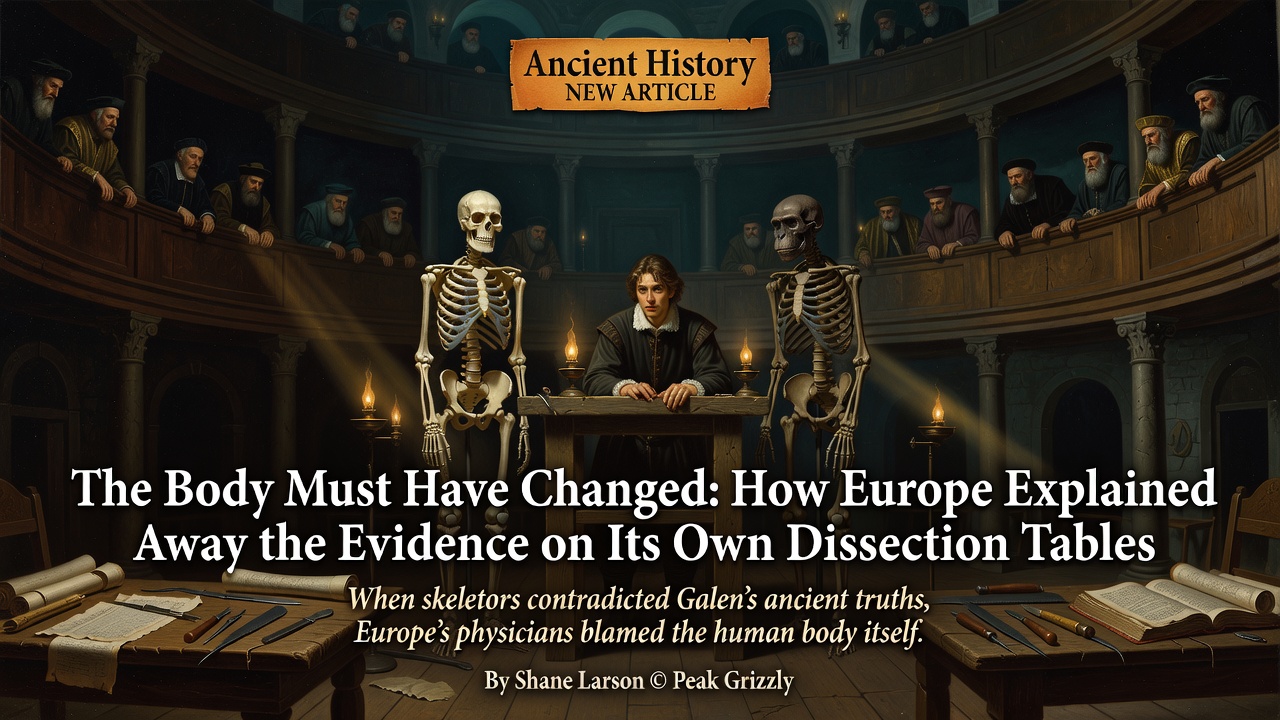
In the winter of 1540, in a packed anatomical theatre in Bologna, a twenty-five-year-old Flemish anatomist named Andreas Vesalius set up two articulated skeletons side by side — one human, one ape — and invited his audience to check them against the anatomy every physician in the room had been taught.
The textbook anatomy said the human breastbone had seven segments. The human skeleton in front of them had three. It said the lower jaw was formed of two bones joined at the chin. The jaw before them was plainly one. It described, at the base of the brain, a marvellous net of fine vessels — the rete mirabile — where the body was supposed to refine the vital spirit that powered thought. In the human skull there was no such net. There is one in oxen. There is one in sheep.
That was the tell, and Vesalius knew it. The authoritative description of the human body — authoritative for roughly forty generations — had been written in the second century AD by Galen of Pergamon, physician to emperors, the most prolific and most systematic medical writer of antiquity. And Galen, for all his brilliance, had never dissected a human being. Roman law and custom forbade it. He had dissected pigs, sheep, oxen, and Barbary macaques, and he had written up what he found with such completeness and such confidence that Europe spent fourteen hundred years mistaking his animals for itself.
Two hundred corrections
Vesalius spent the next three years cutting into human cadavers — a practice that had only recently become respectable, and only barely — and cataloguing every place where the master's account and the actual body parted company. He found more than two hundred.
The human liver was not five-lobed, as it is in a dog. The uterus was not horned, as it is in a pig. The great vessels did not run where Galen said they ran. The thigh bone, which Galen had described as curved, was straight. In 1543 Vesalius published the results as De humani corporis fabrica — "On the Fabric of the Human Body" — seven hundred pages of meticulous description and some of the most astonishing woodcuts ever printed, and he named the source of the errors without flinching: Galen had described animals, and medicine had been reading his animals as people ever since.
Here is the moment worth slowing down for. The evidence was not hidden. It was lying open on dissection tables in Bologna and Padua, available to anyone willing to look. What did the medical establishment do?
The trousers defence
Vesalius's own former teacher in Paris, Jacobus Sylvius, was among the most celebrated anatomy instructors in Europe — a man so devoted to the ancient texts that he is said to have told students that when a cadaver lacked a structure Galen described, the deficiency was the cadaver's. Sylvius took up his pen against his former pupil, and his answer to the discrepancies was not that Galen had been wrong.
It was that the human body had changed since Galen's day.
The straight femur on the dissection table? Galen had described it as curved, and Galen did not err — so the bone must have straightened in the intervening centuries. Sylvius suggested a mechanism: narrow trousers. Fourteen hundred years of tailoring had, on this account, gradually reshaped the human thigh.
It is one of the strangest sentences in the history of science, and the easy response is to laugh at it. The easy response is a mistake — and seeing why is worth more than the laugh.
Why Sylvius was not a fool
Sylvius was not a crank defending a superstition. He was a learned, serious, professionally accomplished man at the top of his field, and given what he knew — and what he had no honest way of knowing — his reply was very nearly forced on him.
Ancient Medicine
Consider the choice as it actually presented itself. The premise underneath Sylvius's entire discipline, shared by his teachers and their teachers back forty generations, was that Galen's anatomy described human beings. Nobody alive in 1543 knew otherwise, because the fact that the descriptions came from apes and pigs had been effaced by thirteen centuries in which almost nobody was permitted to check. Human dissection had been forbidden or taboo across nearly the whole of the ancient and medieval world. Galen's animal anatomy was never a lazy substitute for human dissection; it was the closest approach to it that law and culture allowed, and by the time the prohibition finally loosened, his account had hardened from a description into a foundation.
So when a cadaver contradicted the text, Sylvius was not weighing evidence against evidence. He was weighing one anomalous body against the foundation of everything he knew. Bodies vary. Bodies degenerate. Bodies, perhaps, change. But if the text was wrong, then the whole edifice of learned medicine — his own life's work included — rested on a description of animals. A man does not abandon a library on the testimony of a thigh bone. Sylvius reasoned soundly from premises he had inherited; the premises were wrong; and nothing in his world gave him a way to find that out.
Even the dissections that medieval Europe did eventually perform had been captured by the text. The standard university anatomy was staged, in perfect good faith, as an illustration of Galen: a lector reading the ancient account aloud from a raised chair, a demonstrator pointing with a wand, a barber doing the cutting. The body was on the table to confirm the book. For centuries, the one instrument that could have exposed the error was set to work demonstrating it.
What it took to break
The strangest part of the story is what happened next: not much. Vesalius corrected the anatomy, and anatomy improved rapidly — and the underlying medical system sailed on, essentially untouched. The theory of the four humours had never been a claim about the shape of bones, so every corrected bone could be conceded without yielding an inch. What finally broke Galenic physiology, nearly a century later, was not better looking but arithmetic: William Harvey measured the heart's output, multiplied by the pulse, and showed that the blood must circulate rather than being continuously manufactured and consumed. A description can be renegotiated. A number is either right or wrong. It was the first claim in the whole system that had no room to move — and it was the one that fell.
The trousers defence, in other words, was not an aberration. It was the visible tip of a structure: a discipline barred for over a millennium from checking its own foundational text, organised around an authority too comprehensive to argue with, and built on a theory flexible enough to absorb any result. Inside a structure like that, intelligent people explain away straight femurs. The failure was never stupidity. It was a system with no way to be wrong.
This is one thread from my book Ancient Medicine: Hippocrates, Galen, and Two Thousand Years of Being Confidently Wrong, a history of how ancient physicians got nearly every mechanism wrong and stayed genuinely useful anyway — from the Egyptian surgical papyri and the four humours to the brief, extraordinary window in Alexandria when human dissection was allowed, and down fourteen hundred years to the dissection table where someone finally looked.
Ancient Medicine
New posts and releases, straight to your inbox. No spam, unsubscribe anytime.