The Man in the Room: Writing Cleopatra From the Bedside
May 22, 2026 · 5 min read
The Man in the Room: Writing Cleopatra From the Bedside
There is no shortage of novels about Cleopatra. That was the problem.
When I set out to write one, I did what you do: I read the shelf. And the shelf, for all its richness, mostly tells one story. Cleopatra meets Caesar. Cleopatra meets Antony. Rome closes in, and there is an asp, and the curtain comes down. The queen is a lover, and then she is a victim, and the camera never leaves her face. Even when the novels differ in emphasis—some linger on the political maneuvering in Alexandria, others on the pageantry of the royal barge at Tarsus—they still orbit the same narrow arc of romance and defeat.
That is a fine story. It has lasted two thousand years. But it has been told, and told well, and I had no interest in repainting a room everyone has already seen.
So I went looking for a door that was still shut. I found it in a single sentence of Plutarch.
Writing the death of Cleopatra, Plutarch — careful, magpie-minded Plutarch — pauses to name one of his sources. The queen's physician, he says. A man called Olympos, who was there in the last days, and who afterwards wrote a memoir of them. Plutarch read that memoir. We cannot. It is gone, like so much of the ancient world, and what survives of Olympos is that one mention: he existed, he was her doctor, he was in the room, and he wrote it down. The offhand reference sits among Plutarch’s other details of her final hours—the basket of figs, the pricked arm, the failed attempt to open the tomb doors—yet it points to an entire vantage point that no later writer bothered to occupy.
That was the book. Not another telling of the queen — a telling of the man in the room.
A physician turned out to be the ideal witness, and for a reason that goes deeper than access. A doctor in a royal house is intimate with power without being powerful. He can move where a courtier cannot: into the sickroom, into the war camp, down into the city among people the palace never sees. He is trusted with bodies, which means he is trusted with secrets. And his trade sits precisely on the nerve I wanted the book to press. In a court where loyalty was measured in doses and antidotes, the man who mixed the medicines also measured the risks.
Here is the thing I kept coming back to. The Greeks had a single word — pharmakon — and it meant the remedy and it meant the poison. Not two words that sound alike. One word, for both. The difference between healing and killing was the dose, and the intent, and nothing else. A physician of the ancient world did not work on one side of a clean line. He was the line. He stood at the exact place where the cure becomes the poison, and he spent his life deciding, draught by draught, which one he was making. That ambiguity followed him into every consultation: a sleeping draught for a restless child could be repurposed; a treatment for a fever could tip into something else entirely if the patient’s survival no longer served the dynasty’s needs.
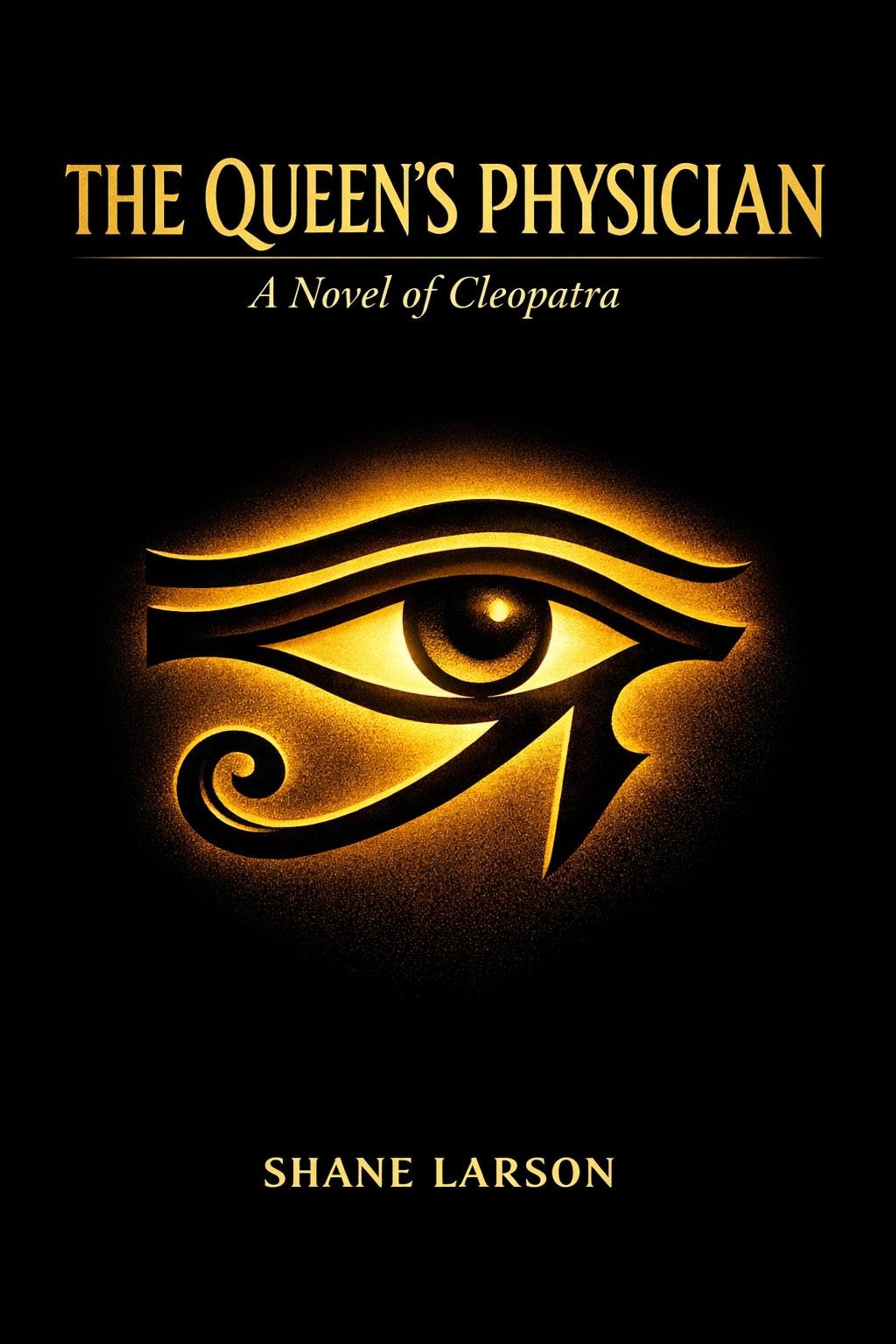
The Queen's Physician
Drop a man like that into the court of the last Ptolemy — a dynasty famous, even by the standards of antiquity, for murdering its own — and you do not have a bystander. You have someone implicated in the deepest question the period can ask. Cleopatra, the record tells us plainly, studied poisons. In her final months she tested them, looking for a death that was quick and not disfiguring, because she had decided Rome would not parade her alive. A queen who does that needs a physician who understands what she is doing. My Olympos is that physician, for thirty years, and the cost of those years is the spine of the book.
People ask whether it is "accurate." It is as accurate as I could make the bones of it. The events are the documented events, on the documented dates: the siege of Alexandria, the burning of the harbour, the Nile, Rome, the Ides, Tarsus, Actium, the mausoleum. The real figures are real, and I have tried to let them be as strange and as un-modern as they actually were — not to dress an ancient queen in a modern conscience and call it empathy. Where the record speaks, I followed it. Where it goes silent — and around a working physician's daily life it is almost entirely silent — I invented, and I have told the reader exactly where, in an Author's Note at the back, because readers of this genre deserve that and reviewers rightly punish its absence.
What I did not do is quote the ancient texts. When a character in this book prays, or recites an oracle, or remembers a poem, the words are mine — freshly written, not lifted from someone else's translation. That is partly a matter of law and partly a matter of craft: a paraphrase in the novel's own voice sits better on the page than a borrowed one anyway.
The book is called The Queen's Physician. It is a novel of Cleopatra, but it is told by the man at her bedside — the one who could not, in the end, keep her alive, and who understood that there was still one service a physician could do for the dead.
For two thousand years, Cleopatra has mostly been written by Rome, and by people downstream of Rome, and they had their reasons. This is one more telling, and it makes no claim to be the last. But I wanted, at least once, to hand the story to the witness history forgot it had — and to let him keep the queen true.
The Queen's Physician is available now. The first chapter is free to read; the link is below.
The Queen's Physician
New posts and releases, straight to your inbox. No spam, unsubscribe anytime.