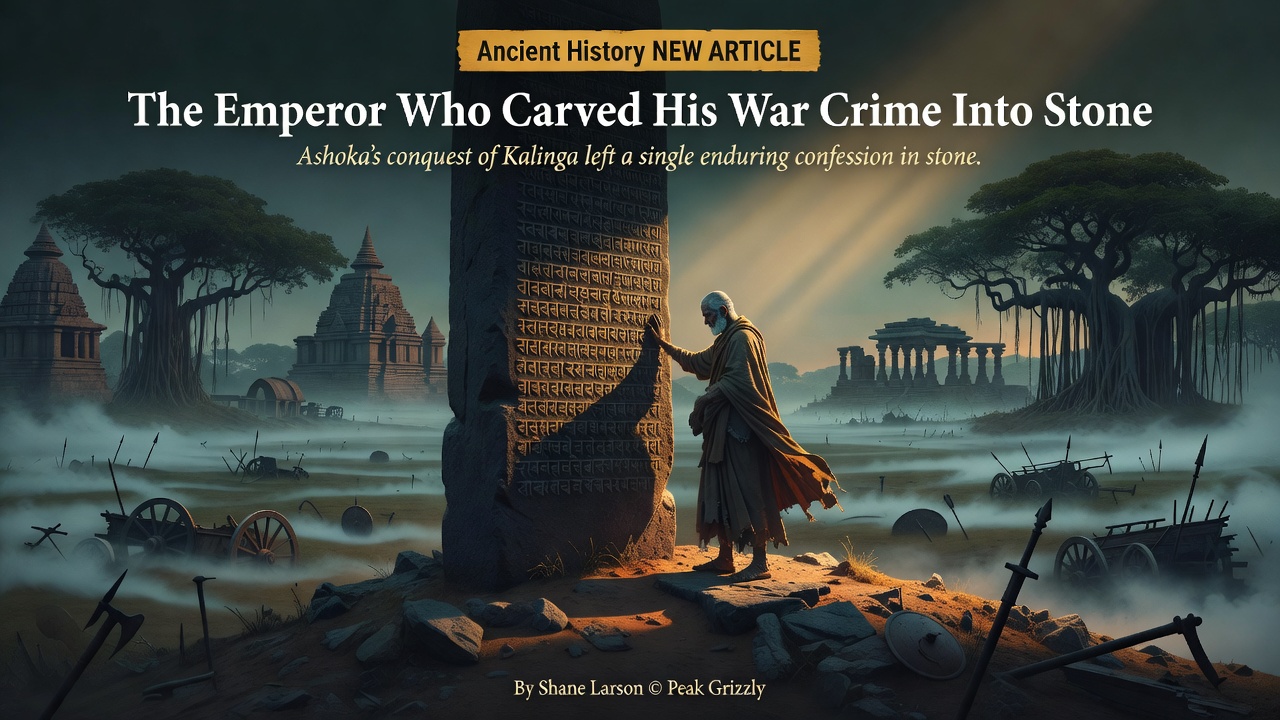
The Emperor Who Carved His War Crime Into Stone
June 17, 2026 · 7 min read
The most powerful thing an emperor ever did was carve his own war crime into stone and tell everyone he regretted it.
Around 261 BCE, the Mauryan ruler Ashoka conquered the eastern kingdom of Kalinga. By his own account, around 100,000 people were killed in the fighting, many times that number died from its aftermath, and 150,000 were deported. These are not the numbers a defeated enemy invents to shame a tyrant. They are the numbers the conqueror published about himself.
That is the part that stops you cold. Ancient kings did not advertise their atrocities. They advertised victories, gifts to the gods, the size of their armies, the length of their lineage. Ashoka inscribed a confession. On rock faces and on polished stone pillars set up across an empire that stretched from Afghanistan to Bengal, he had it written that the slaughter at Kalinga filled him with sorrow and regret, and that he had turned away from conquest toward something he called dhamma — a public ethics of restraint, tolerance, and non-violence.
We can argue about how sincere he was. We should. But the gesture itself is almost without precedent in the ancient world, and it is the reason a king who died more than two thousand years ago is still an argument we have not finished having.
An empire built out of a vacuum
To understand how a man got into a position to make that gesture, you have to go back about sixty years, to the moment Alexander the Great turned around.
In 326 BCE, Alexander pushed into the Punjab, won a hard battle against a regional king, and then watched his exhausted army refuse to go any further. He withdrew. He died not long after in Babylon, and the northwest of the Indian world was left full of garrisons, broken loyalties, and opportunity.
A man named Chandragupta Maurya walked into that opening. We are not certain where he came from — the sources disagree, and some of them are openly legendary — but the consistent thread is that he was not royal. He was an adventurer with a genius for the main chance, and he had something better than royal blood. He had an advisor.
Chanakya, also called Kautilya, is credited with the Arthashastra, the great Indian treatise on statecraft. If you have only ever heard the cliché that it is "the Indian Machiavelli," set the cliché aside, because the comparison undersells it. The Arthashastra is colder, more systematic, and far more comprehensive than anything Machiavelli wrote. It covers the running of a spy network, the management of famine, the taxation of every trade, the controlled succession of power, and the calculus of when to make war and when to wait. It is a manual for total administration of a state.
With Chanakya's strategy and his own nerve, Chandragupta overthrew the ruling Nanda dynasty and made himself master of the Ganges plain. Then he turned northwest, toward the territory Alexander's death had left in play.
Half of Persia for five hundred elephants
Around 303 BCE, Chandragupta collided with Seleucus, one of Alexander's most capable successors, who was trying to reassemble the eastern half of Alexander's conquests under his own crown. They fought, and the fighting did not produce a clear winner. It produced a treaty, and the treaty is one of the great trades in ancient history.
Seleucus ceded the eastern provinces — roughly modern Afghanistan and the borderlands — to Chandragupta. In exchange, Chandragupta gave Seleucus 500 war elephants. That sounds like an odd settlement until you remember what war elephants were worth to a Hellenistic king fighting other Hellenistic kings on open ground. Seleucus took those animals west, and they would later help decide a battle far away in the Mediterranean world. The Mauryan Empire, meanwhile, now ran across the top of the subcontinent and down into the heart of it.
This is the kind of moment I love writing about, because it connects worlds that we usually keep in separate boxes. The same wars that produced the successor kingdoms of the Greek east also produced, at the far edge of the map, the first Indian empire. (If you came to my work through the story of Alexander's generals, this is where the two threads touch — I say more about that connection on shanelarson.com.)
The grandson
Chandragupta built the machine. His son Bindusara kept it running. But the empire belongs, in memory, to the grandson.
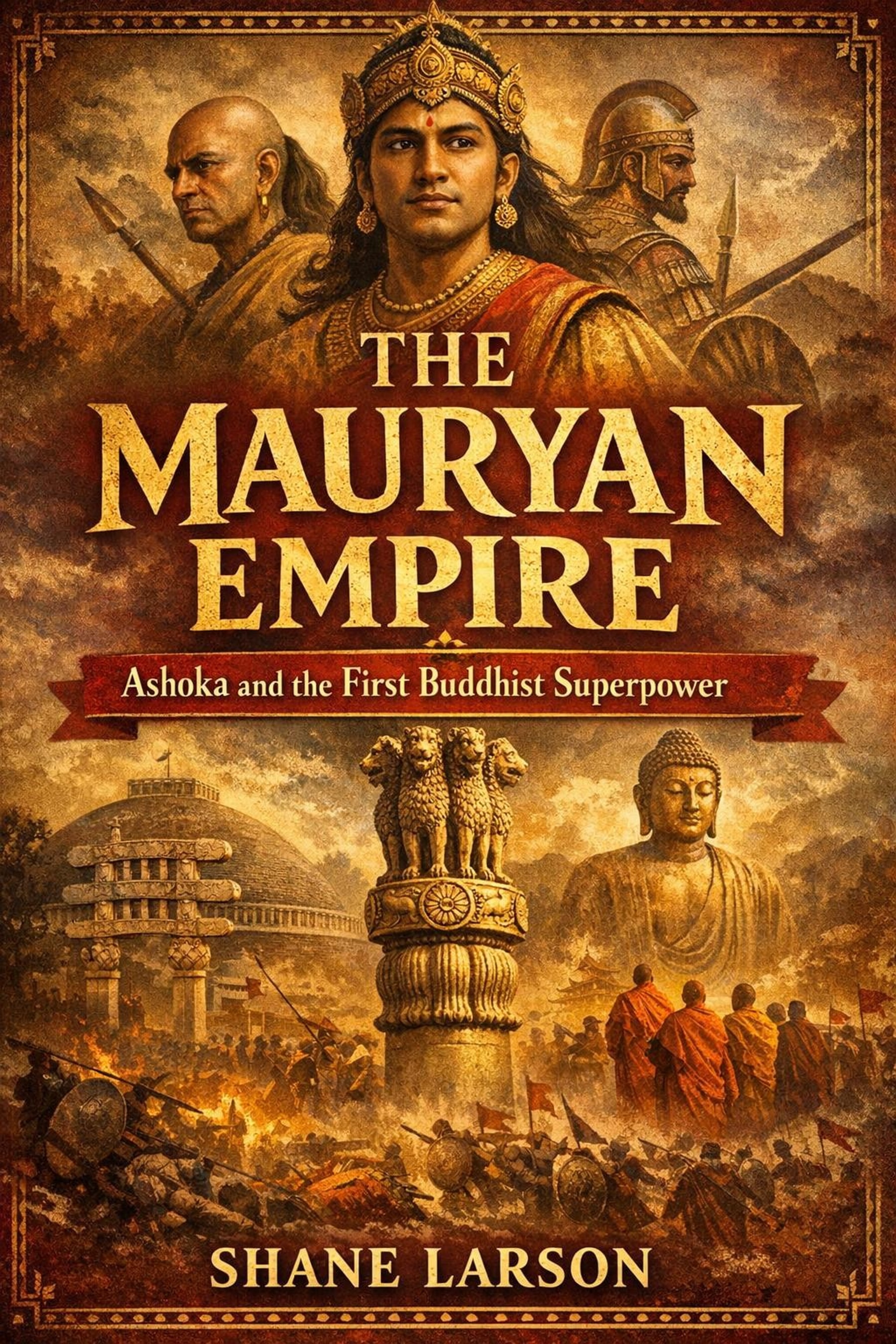
The Mauryan Empire
Ashoka came to the throne after a succession struggle that the later tradition paints in dark colors, and he ruled, at first, the way the Arthashastra would have advised: firmly, expansively, without apology. Kalinga was the last great conquest of that phase, and by the evidence of his own edicts, it was also the thing that broke the pattern.
What happened after Kalinga is where history and legend pull apart, and where an honest book has to slow down and admit it. The Buddhist tradition gives us a converted saint, a model king, a patron who called a great council and sent missionaries to the ends of the known world. The inscriptions give us something subtler: a working monarch, still running an iron-fisted state, still maintaining a capacity for force, but reorienting the public language of his reign around dhamma — ethical conduct, religious tolerance, care for subjects and animals, restraint in the use of power.
Both of these Ashokas are real. The miracle-working saint of the Buddhist legends is not the same person as the administrator who left us the edicts, and the most interesting work is in the gap between them. I have tried not to collapse that gap in either direction — not to flatten the king into a fairy tale, and not to sneer the saint out of existence in the name of being hard-headed.
What the edicts actually do
The edicts are the closest thing we have to Ashoka's own voice, and they are remarkable simply as objects. Here was a ruler who decided that the way to govern a subcontinent was to write down what he expected — of himself and of everyone else — and put it where people would see it. Tolerance between sects. Kindness to the old and to servants. Limits on animal slaughter. Officials charged with the welfare of subjects. The promotion of dhamma over the older glory of conquest.
It is government as published conscience. You do not have to believe Ashoka lived up to every word to find the act extraordinary. He turned the surface of his empire into a moral argument addressed to the future, and the future — us — is still reading it.
Missions, and the making of a world religion
The other thing Ashoka did, or is credited with doing, was to send Buddhist missions outward. The most famous went south to Sri Lanka, where the tradition took root and from which it would later be transmitted onward; others are said to have gone to the Greek-ruled west and into Central Asia. Whatever the exact details, the long-term effect is not in doubt. A faith that had been one regional movement among many in the Ganges valley became, over the centuries that followed, a religion of half a continent.
It is hard to think of another case where a single ruler's patronage so plausibly changed the religious map of the world. That alone would make Ashoka worth a book.
The fall, and the parallel
The unsentimental coda is that it did not last. Within about fifty years of Ashoka's death, the empire he and his grandfather built had fragmented. The reasons are debated — overextension, weak successors, the sheer difficulty of holding so much with the tools of the age — and the book lays out the cases without pretending to a certainty the sources do not support.
But the figure outlived the empire. Ashoka belongs to a small and strange company of rulers who held absolute power and then turned the question of what power is for into the central drama of their reigns. The obvious companion is Marcus Aurelius, the Roman emperor-philosopher I have written about elsewhere, and the comparison is more than decorative: two men at the top of two worlds, each leaving behind a written record of trying to be good at a job that does not reward goodness. (I draw the parallel out further in my book on Marcus, also at shanelarson.com.)
That is the story I wanted to tell — not a hagiography and not a takedown, but the actual, complicated history of the first time the Indian subcontinent was ruled as one thing, and of the man who tried to govern it by conscience and left the evidence in stone.
The Mauryan Empire: Ashoka and the First Buddhist Superpower is out now on Kindle, $3.99 and free on Kindle Unlimited. If you enjoy clear, honest narrative history of the ancient world, it's the same territory as my books on Alexander's generals, Marcus Aurelius, and the rise of Akkad.
The Mauryan Empire
New posts and releases, straight to your inbox. No spam, unsubscribe anytime.