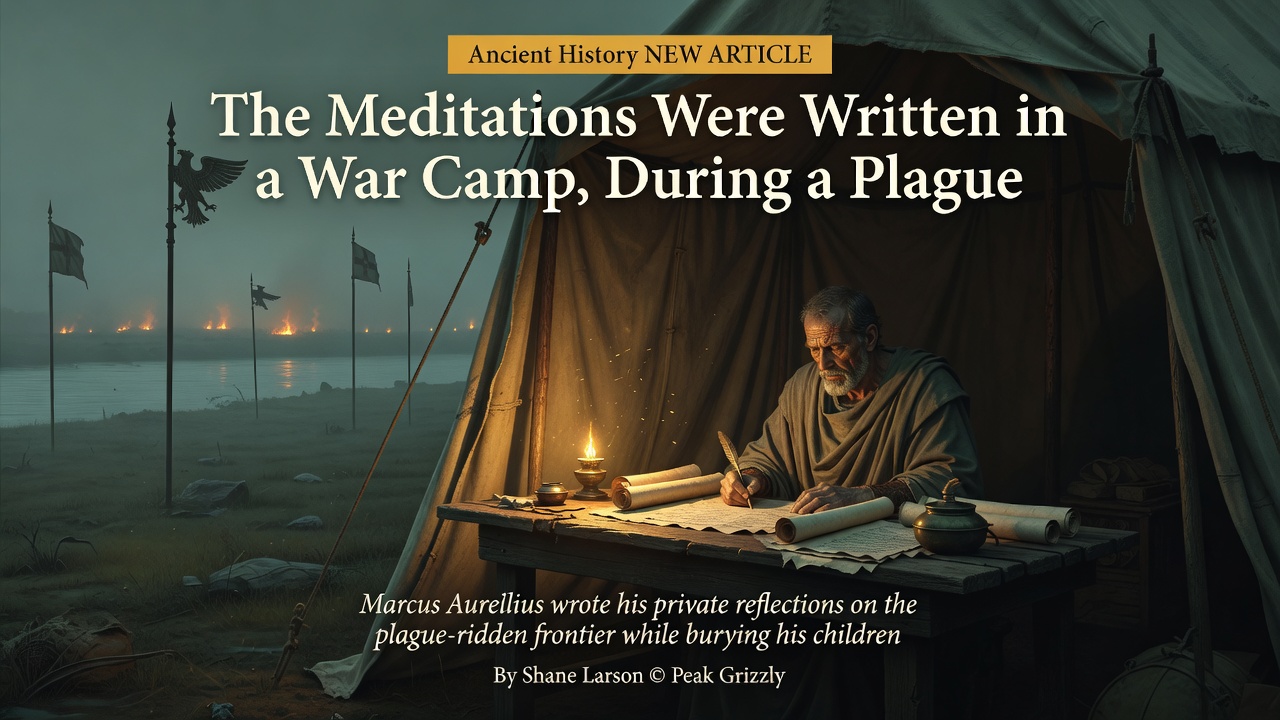
The Meditations Were Written in a War Camp, During a Plague
September 5, 2026 · 6 min read
The Meditations of Marcus Aurelius may be the most widely owned book to survive from the ancient world. It has been translated into every major language, printed in the millions, pressed into the hands of graduates and grievers, and read for centuries as the calmest voice antiquity produced. And because the voice is calm, readers tend to imagine calm surroundings — a marble study, an emperor at leisure, philosophy composed in the security of absolute power.
The text itself says otherwise, and it says so in almost the only stage directions it contains. In the manuscript tradition, two of the work's twelve books carry place-notes: one was written among the Quadi, on the River Granua — a tributary of the Danube in what is now Slovakia — and another at Carnuntum, a legionary fortress on the river east of modern Vienna. These are not philosophical retreats. They are army bases on a frontier at war. The most serene book in the classical canon was written in winter quarters, by lamplight, by the commander of the armies camped around it.
The decade that produced it
To understand what those place-notes mean, you have to know what the 160s and 170s were for the man writing.
When Marcus Aurelius became emperor in 161, at thirty-nine, he inherited the Roman Empire at the highest point it would ever reach — the peak that Edward Gibbon, surveying all of recorded history from the vantage of 1776, would famously judge the happiest and most prosperous condition the human race had ever known. The empire ran from northern Britain to the Euphrates. Its interior had known no serious war in living memory. Its cities were unwalled because nobody could imagine an enemy reaching them.
Then, in 165 or 166, a victorious Roman army came home from a war against Parthia, marching west along the finest roads in the world, and it brought something with it. For roughly the next fifteen years an epidemic the Mediterranean had apparently never met before moved through the empire in waves — into the cities, through the legionary camps, down into the villages. Galen, the greatest physician of antiquity, was in Rome when it arrived; he recorded the fever, the rash, and the black ulcerating pustules in clinical detail, and decades later he was still calling it the longest-lasting plague he had known. The biographical tradition on Marcus's reign describes the dead being hauled out of Rome in carts. The serious modern estimates of the total put it somewhere between two and ten percent of the empire's population — roughly a million to seven million people — and the honest position, which is the one worth respecting, is that the evidence will not narrow the range.
Within a few years of the epidemic's outbreak, the northern frontier broke. The Marcomanni and Quadi came across the Danube, and a foreign army penetrated to Aquileia in northern Italy — the first in some two and a half centuries. Marcus fought back with legions he could not bring up to strength. He enlisted slaves, gladiators, and brigands, measures Rome had avoided for centuries and which tell you the ordinary sources of men had failed. He raised two new legions and struggled to fill them. And when the treasury ran short, he held an auction in Trajan's Forum and sold the palace furnishings — the gold vessels, the imperial plate, the empress's silk-and-gold robes — rather than raise taxes on provinces that had just buried a portion of their taxpayers. It went on for weeks. Romans could walk through the Forum and buy the emperor's tableware.
That is the war the Meditations came out of. Marcus spent most of the last decade of his life on the Danube, in camp, through winters cold enough that the river froze and battles were fought on the ice. He was in his fifties. He would never see Rome for more than brief intervals again.
The Antonine Plague
The private losses
The public catastrophe had a private mirror. His co-emperor and adoptive brother, Lucius Verus — the man whose army had brought the disease home — died suddenly in 169, on the road back from the frontier. His wife Faustina, who had traveled with him on campaign, died in 175. And of the thirteen or more children she had borne him, most died young; he buried son after son, and of all the boys, exactly one — Commodus — lived to grow up. The emperor writing philosophy by lamplight on the Granua was a man who had stood at the funerals of most of his own children, and who governed an empire doing the same arithmetic in every household.
What the notebook actually is
It helps to be clear about what the Meditations is, because it is not a book in the ordinary sense. Marcus wrote it in Greek, for no reader but himself. It has no title in the manuscripts — the conventional Greek one simply means "to himself" — no structure beyond the accidents of compilation, and no argument built for an audience. It is a working notebook: a man in an impossible position, writing down, over and over, the things he needed to stay true.
What it returns to, again and again, reads differently once you know where it was written. He argues with himself at dawn about getting out of bed to do a human being's work. He lists the dead — whole courts of earlier emperors, the famous and the forgotten alike, gone and mostly unremembered — and reminds himself that the physicians who once frowned over their patients followed them soon enough. He tells himself that the length of a life changes nothing about how it should be spent; that fame is an echo; that nature takes back what it lends without malice; that the task in front of him is owed its full attention whether or not anyone ever knows. None of this is abstract consolation composed at leisure. It is the working method of a man conducting a war, an economy, and a mass-mortality event at the same time, with no evidence he expected to survive any of them.
And here is the strangest fact of all: the epidemic that surrounded the writing barely appears in it. The plague that defined his reign surfaces in the notebook almost only once, in a passing remark to the effect that a corrupted mind is a worse contagion than any disease in the air around us. He did not write about the catastrophe. He wrote inside it, and wrote past it, which may be the most Stoic fact about the most famous Stoic text in existence.
Marcus died in March of 180, at the age of fifty-eight, at or near Vindobona — the camp that became Vienna — still on the frontier, still at war. Ancient sources say the plague killed him. The claim cannot be proven, but nothing about it is implausible: the disease was in its final great wave, and it was everywhere his army was. The notebook survived him by luck; nothing suggests he ever intended anyone to read it.
So the next time you see the Meditations on a shelf, radiating its famous calm, it is worth remembering what the calm cost and where it was manufactured: not in the happiest age of the human race, but in the decade that age came apart — in a frozen camp, during a plague, by a man in his fifties who had already buried most of the people he loved, telling himself to get up in the morning anyway.
The epidemic that surrounded the writing — where it came from, what Galen saw, how the dead are counted from tax registers, brick stamps, and the fallout of Roman mines preserved in Greenland ice, and what fifteen years of disease did to an empire at its peak — is the subject of my book The Antonine Plague: The Pandemic That Broke the Roman Peace. It is the story of Rome's first great epidemic, told from the evidence an empire's paperwork leaves behind.
The Antonine Plague
New posts and releases, straight to your inbox. No spam, unsubscribe anytime.