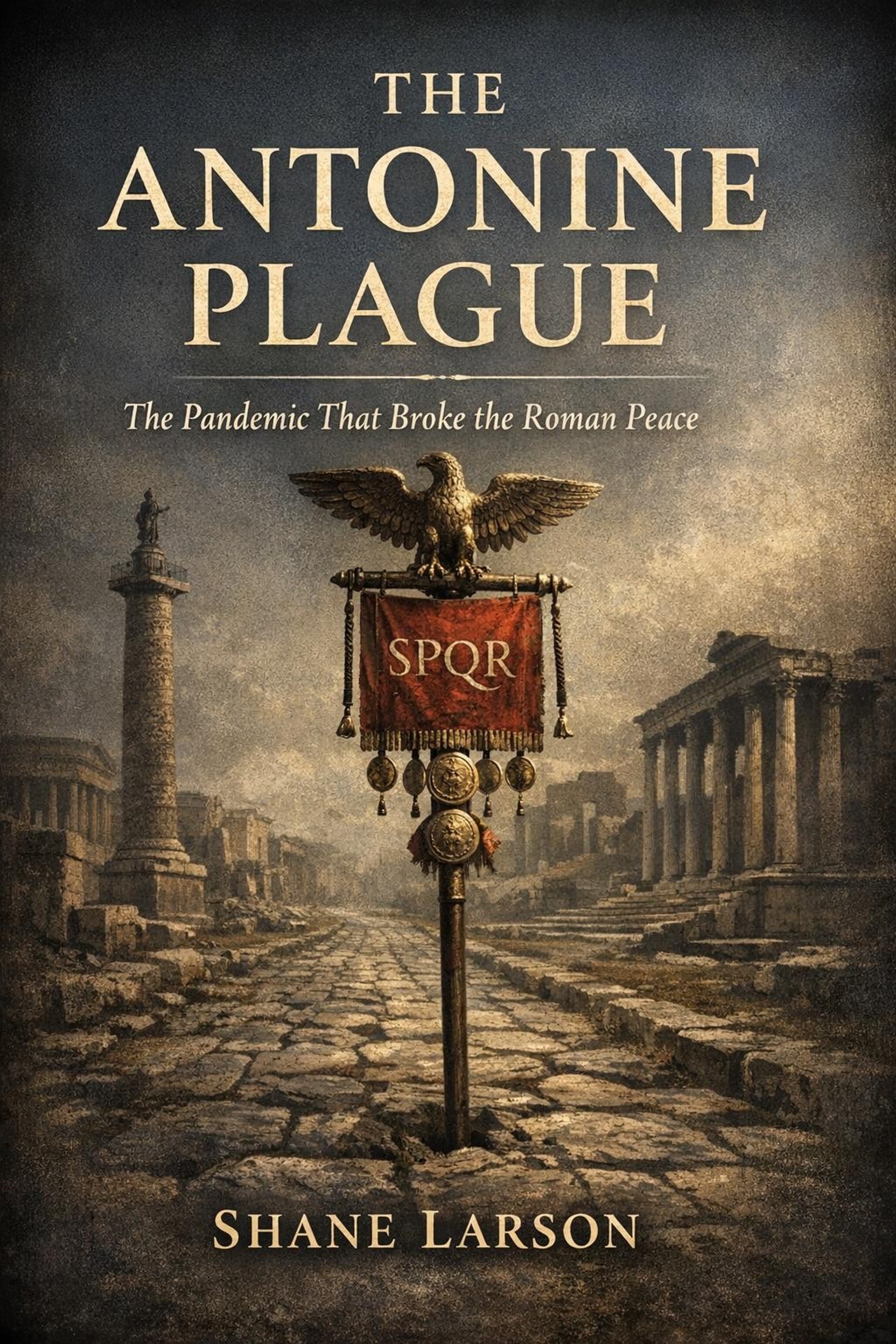
The Antonine Plague
The Pandemic That Broke the Roman Peace
By Shane Larson
About This Book
In a Greenland ice core there is a layer of snow that fell in the second century, and in that layer there is lead. Not much — a few parts per trillion — but measurable, and it is Roman. It blew north from the smelting works of Spain and the Balkans, where ore was roasted to extract silver, and it settled on the ice year after year in quantities that track how hard the empire's mines were being worked.
The line rises through the first century and into the second. Then, in the 160s, it thins.
That is one of several instruments, and no single one of them is worth much. But a papyrus from a village in the Egyptian Fayum shows the same decade going wrong in a different way: names in a tax register that are not in the next register, holdings marked as abandoned, a petition asking for relief on land nobody is farming. Brick stamps from the Tiber valley, which carry consular dates and are therefore countable by year, thin out in the same window. So do inscriptions across the empire. So do military discharge diplomas.
None of these things measures deaths. Every one of them measures something else — mining output, tax liability, construction, the habit of carving stone — and turning any of them into a statement about mortality requires an assumption you have to argue for out loud. That is what this book spends a chapter doing, and it is one of the better chapters, because the answer is genuinely interesting: somewhere between two and ten percent of everyone under Roman rule. A million people, or seven million. The range is that wide because the evidence will not narrow it, and a book that picked a number to sound confident would be telling you something it does not know.
The Empire at Its Peak, and the Thing It Carried Home
Edward Gibbon, writing in 1776, named the reign of the Antonines as the period in which the human race had been happiest and most prosperous. He was describing the 160s.
In 165 or 166 a Roman army came home from a victorious war in the East. It marched west along the best road system the world had yet built, quartering in cities along the way, demobilizing in stages over months. It brought something with it, and for the next fifteen years that something moved through the empire in waves.
The timing is what makes this a book rather than a chapter in someone else's. This was not an epidemic finishing off a state already in decline. It arrived at the exact peak, at an empire running at full extension with no slack anywhere — and the thing that distributed it was the empire's single greatest achievement. The roads, the ports, the grain fleet, the annual rotation of soldiers and officials and traders: the network that made Rome work is the network that carried the disease. Nobody could have separated the two, because they are the same fact described twice.
Within a decade the Danube frontier gave way and a foreign army stood in Italy for the first time in roughly two and a half centuries. The emperor auctioned the palace furnishings in Trajan's Forum to pay for the war that followed, spent the rest of his life on that frontier, and wrote the Meditations there.
What's Inside
- Galen, who was there. The greatest physician of antiquity watched this disease, described the fever, the rash, the black ulcerated pustules and the course of the illness — and then left Rome at the height of it. His account is precise, invaluable, and was never written as an account of an epidemic at all: it is clinical material scattered through a lifetime of medical argument, which is why it is both exact and maddeningly incomplete.
- What it actually was, argued honestly. Retrospective diagnosis is harder than it looks. The smallpox case, the measles case, the weaker candidates, and the reason no ancient DNA has settled it. The book's verdict is probably smallpox, not established — and it holds that line for the rest of its length instead of firming it up when a firm word would be convenient.
- The counting chapter, which shows you how mortality is reconstructed for an event nobody recorded: tax registers, inscriptions, brick stamps, diplomas, shipwrecks, and the ice. What each instrument measures, and the assumption that turns it into a death toll.
- The Egyptian villages, where the documentation is the best in the ancient world and the interpretation is hardest. A name missing from a later register may be dead, or moved, or hiding from the tax collector, and the whole subject turns on that ambiguity.
- The army, where the consequences are most traceable — and where the emperor enlisted slaves, gladiators, brigands and Germanic recruits, measures that tell you the ordinary sources of manpower had failed.
- The money. The silver content of the denarius across the century, where the debasement steepens, and what the palace auction can plausibly have raised — which is the question most accounts of that famous gesture never ask.
- Marcus Aurelius, and the Meditations read in their actual setting: written on campaign, in the plague years, on a frozen frontier, by a man in his fifties who had buried most of his own children.
- The chain afterward, argued with its weak links named: a second epidemic eighty years later, the third-century crisis, and the difference between saying the plague contributed to those things and saying it caused them.
Why I Wrote This
I came to this sideways, through Marcus Aurelius. I had read the Meditations the way most people read it — as a book of maxims, floating free of anywhere — and then I found out where and when it was written, and I could not read it the same way afterward. A man in a war camp on the Danube, in his fifties, in the middle of a fifteen-year epidemic, having buried most of his children, writing notes to himself about not being afraid of dying. Nobody had told me that. It is not a small piece of context.
Following that back led to the epidemic, and the epidemic turned out to be the more interesting subject and the less written one. There is no single trade book about it. The nearest thing is a broader work covering three Roman epidemics and five centuries of climate data.
What I did not expect was how much of it is countable. I had assumed a second-century pandemic would be all rhetoric and guesswork. Instead there are tax rolls, dated bricks, discharge documents, and lead in polar ice — a whole apparatus for measuring something that nobody at the time thought to measure. Watching a number get built out of that is, to me, more satisfying than being handed one.
Frequently Asked Questions
Do I need to know Roman history to read this?
No. The empire, the imperial politics, the army and the sources are all explained where they first matter. If you have read other Roman books it will slot into a frame you already have, but nothing is assumed.
Does the book say what the disease was?
It says probably smallpox, and not established — and then means it. An early chapter lays out the candidates and the reasons none of them can be confirmed from the evidence that exists, and the later chapters do not quietly assume a firmer answer. Ancient DNA would settle it. None has been recovered for this epidemic.
How many people died?
Between about two and ten percent of the empire's population, which is somewhere from one to seven million people. That range is the honest answer, and one chapter is devoted to showing you exactly why it cannot currently be narrowed.
Does it argue the plague caused the fall of Rome?
No, and it says so in those words. The argument is narrower and better supported: the plague materially contributed to the frontier wars, to the fiscal deterioration, and to the reduced condition in which the empire met the disasters of the following century. Every point where the case shifts from demonstrated to inferred is marked in plain language on the page.
Is this a book about the Meditations?
One chapter is. The rest is the epidemic, the empire, and the evidence. But that chapter changes how the Meditations reads, and it is the reason the book exists.
How long is it?
Around 79,000 words: an introduction, fourteen chapters in four parts, a conclusion, and three appendices — Galen's scattered references assembled, the full evidence base with each instrument's biases, and a timeline distinguishing what is securely dated from what is not. The paperback runs 261 pages.
If You Liked This, You Might Like
- Marcus Aurelius — The life. This book is the fifteen years in the middle of it, from the outside, and the two together explain each other.
- The Height of Empire — The Flavian and Antonine century at its fullest extent: the world the epidemic arrived in, described before it was damaged.
- The Crisis of the Third Century — Where the argument in the last chapters ends up. Fifty years that nearly finished Rome, met by an empire that had been running short of soldiers and silver for two generations.
- The Black Death — The other great pre-modern mortality event, and the comparison every reader of this book will want to make. Far higher mortality, a very different pathogen, a very differently organized world.
A layer of lead in polar ice, a name missing from a village register, a line of dated bricks running thin. Nobody counted the dead. This is how we know roughly how many there were, and why the honest answer is still a range.
What You'll Learn
- How mortality is reconstructed for an event nobody recorded — tax registers, dated brick stamps, military discharge diplomas, shipwrecks, and Roman lead in Greenland ice
- Why the honest death toll is a range — two to ten percent of everyone under Roman rule — and why the evidence will not narrow it
- What Galen actually saw and wrote, and why his account is both clinically exact and maddeningly incomplete
- The retrospective diagnosis argued honestly: the smallpox case, the measles case, and why no ancient DNA has settled it
- How the empire's road network, ports and grain fleet — its single greatest achievement — became the machinery of transmission
- What fifteen years of epidemic did to the army, the coinage, and the Danube frontier that broke a decade later
- The Meditations read in their actual setting: a war camp, a frozen frontier, and a man in his fifties who had buried most of his children
- Where the chain to the third-century crisis holds and where it does not — with every inferential joint named on the page
Included with Kindle Unlimited — read it free if you're a member.
New Ancient History releases and free chapters — no spam, unsubscribe anytime.