The Roman Emperor Who Died a Prisoner in Persia
August 29, 2026 · 7 min read
Rome lost armies. It lost armies at Cannae, in the Teutoburg Forest, at Adrianople — disasters the Romans themselves catalogued, dissected, and turned into literature. But in the whole thousand-year run of the Roman state, from the first consuls to the fall of Constantinople, exactly one reigning emperor was ever captured alive by a foreign enemy. It happened in the early summer of AD 260, near the city of Edessa in northern Mesopotamia. The emperor was Valerian, a man in his sixties who had ruled for seven years. The enemy was Shapur I, second king of the Sasanian dynasty of Persia. Valerian was never ransomed, never rescued, and never seen in Roman territory again. He grew old in captivity and died there.
You would expect this to be one of the most famous events in Roman history. It is one of the least. The Romans barely wrote about it, the accounts that do survive contradict each other on almost everything, and the fullest version of the story is not a text at all — it is carved into a cliff face in the province of Fars, on the funerary monument of Persian kings who had been dead for seven hundred years. Every part of that is worth unpacking.
The Road to Edessa
Valerian took the throne in 253, in the middle of what historians now call the crisis of the third century, and the eastern half of that crisis had a name: Shapur. The Sasanian dynasty was barely a generation old — it had overthrown the Parthians in the 220s — and it had arrived with an appetite the Parthians never showed. Shapur had already destroyed one Roman field army in 244, a defeat that killed the young emperor Gordian III on campaign and forced his successor, Philip the Arab, to buy peace with an enormous payment in gold. In the 250s Shapur came again, overran the Roman defenses on the Euphrates, and sacked Antioch — the third city of the Roman world — carrying off much of its population to Persia.
Valerian went east to restore the situation, and for a few years he held it. Then, around 259–260, everything went wrong at once. Plague — the great epidemic the Romans associated with these decades — was burning through the army. Shapur invaded again and besieged Edessa. Valerian marched to relieve the city with a large force, the sources suggest tens of thousands of men, many of them sick. Somewhere near Edessa in 260, the Roman army and the Roman emperor fell into Persian hands together — officers, engineers, treasury, and all.
What Actually Happened There
Here the sources split, and the split is instructive, because each side tells the story its dignity required.
Several later Roman writers describe treachery: Valerian, with his army wasting from disease and his position collapsing, sought a parley with Shapur to negotiate terms — and was seized at the meeting, in violation of every convention that protected envoys. In this telling the emperor was not beaten; he was cheated. It preserves something important for Roman pride, and it was written by men with every reason to preserve it.
Shapur told it differently, and — uniquely for an event in Rome's third century — we have his version in his own words. On a stone tower at Naqsh-e Rustam in Fars, Shapur had his account of his Roman wars inscribed in three languages, Middle Persian, Parthian, and Greek. In it he describes a great battle at Edessa against an enormous Roman force, lists the provinces that army had been drawn from, and states plainly that he captured the emperor with his own hands, along with the praetorian prefect, senators, and the whole command staff. No parley, no trick — a battle, and a victory so total that the enemy's ruler was physically in his grip.
Which is true? The inscription is propaganda addressed to posterity, and its numbers should be treated the way all royal numbers should. The Roman parley story surfaces generations later, in authors writing at a comfortable distance. The honest answer is that the capture is among the most certain facts of the century and the mechanism is unrecoverable. What no one disputes is the result: an entire Roman field army gone, and a living Augustus in Persian custody.
The Sassanids
The Two Captivities
What happened to Valerian afterward depends, again, on who is telling it — and the two versions are so different that they barely describe the same man.
The famous version comes from the Christian writer Lactantius, composing more than fifty years later. In his telling, Shapur kept the old emperor as a living trophy and used him as a footstool — making him kneel so the king could step on his back when mounting his horse — and after Valerian's death had his skin preserved and displayed as a warning to Roman ambassadors. It is the version everyone remembers, and it deserves suspicion. Lactantius was not writing history; he was writing a catalogue of the terrible deaths God visited on emperors who persecuted Christians, and Valerian had issued exactly such persecution edicts in 257 and 258. A humiliated, flayed Valerian was theologically necessary to the book he was writing. No earlier source knows any of it.
The Persian tradition tells a story with a completely different texture — not of a trophy, but of a workforce. The tens of thousands of Roman prisoners taken with Valerian were not massacred; they were resettled deep in the empire, deliberately, as an asset. Roman soldiers and engineers were put to work on Persian projects, and you can still see one: at Shushtar, in the old Persian heartland, a massive combined bridge and dam across the river Karun was known for centuries afterward as the "Caesar's dam," built with Roman captive labor and Roman engineering technique. Captives were settled in new cities Shapur founded, including Bishapur — "Shapur's city" — and later Persian tradition places Valerian himself there, living out his days in something closer to provincial exile than to a cage. Deportation, in the Sasanian system, was not spite. Skilled population was a war objective, listed in the same breath as captured cities.
Between the flayed footstool and the retired engineer-emperor there is no way to split the difference. What the gap itself tells you is how completely each empire owned its version of the story — and that the loudest Roman account was written by a man settling a score with the emperor's soul, not recording his fate.
The Scene Carved in Stone
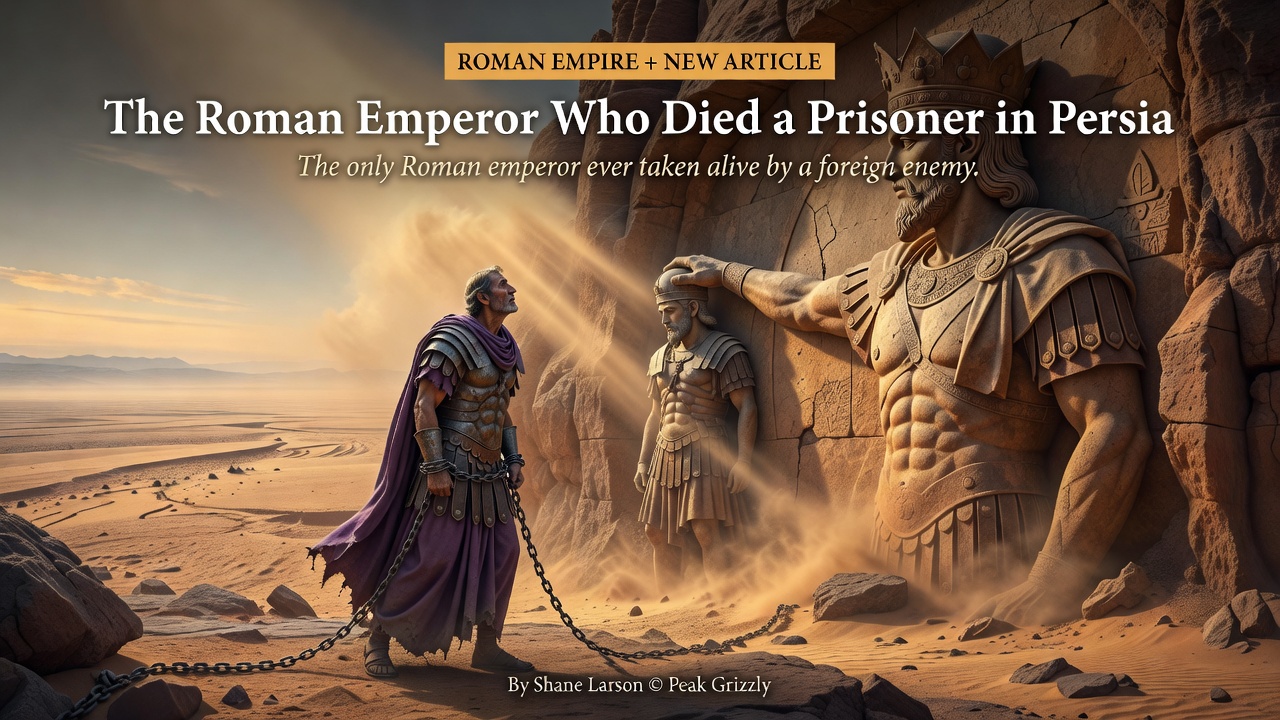
Shapur made sure the event would outlast every text. At Naqsh-e Rustam — the cliff in Fars where Darius the Great and Xerxes were entombed in the sixth and fifth centuries BC — he had a relief cut at eye level, below the ancient royal tombs. It shows the king on horseback, calm, monumental. Before his horse a Roman emperor kneels with arms outstretched: Philip the Arab, the man who paid. Beside him a second Roman emperor stands upright while the king holds him by the wrist: Valerian, the man who was taken. The grip is the whole message. It is the gesture of ownership, and it matches the claim in the inscription a few steps away — captured with my own hands.
And the location was the point. The Sasanians claimed, from their first year in power, to be the restoration of the ancient Achaemenid line of Cyrus and Darius after five centuries of interruption. By carving his triumph over Rome onto the Achaemenids' own funerary cliff, Shapur was making an argument in stone: the old Persia is back, and here is what it does to emperors. Rome, meanwhile, said almost nothing. Valerian's own son and co-emperor, Gallienus, mounted no rescue and paid no ransom, and the Roman historical tradition passed over the whole affair with a kind of shocked brevity. Some humiliations were too large to narrate.
Rome and Persia would fight for another 350 years after Edessa — the longest rivalry between two great powers in ancient history, and one that ended by destroying them both. I tell that whole story, from Ardashir's revolt to the fall of Ctesiphon, in The Sassanids: Persia Reborn and the War That Exhausted Two Empires — the empire behind the relief, told for once from the Persian side of the river.
The Sassanids
New posts and releases, straight to your inbox. No spam, unsubscribe anytime.