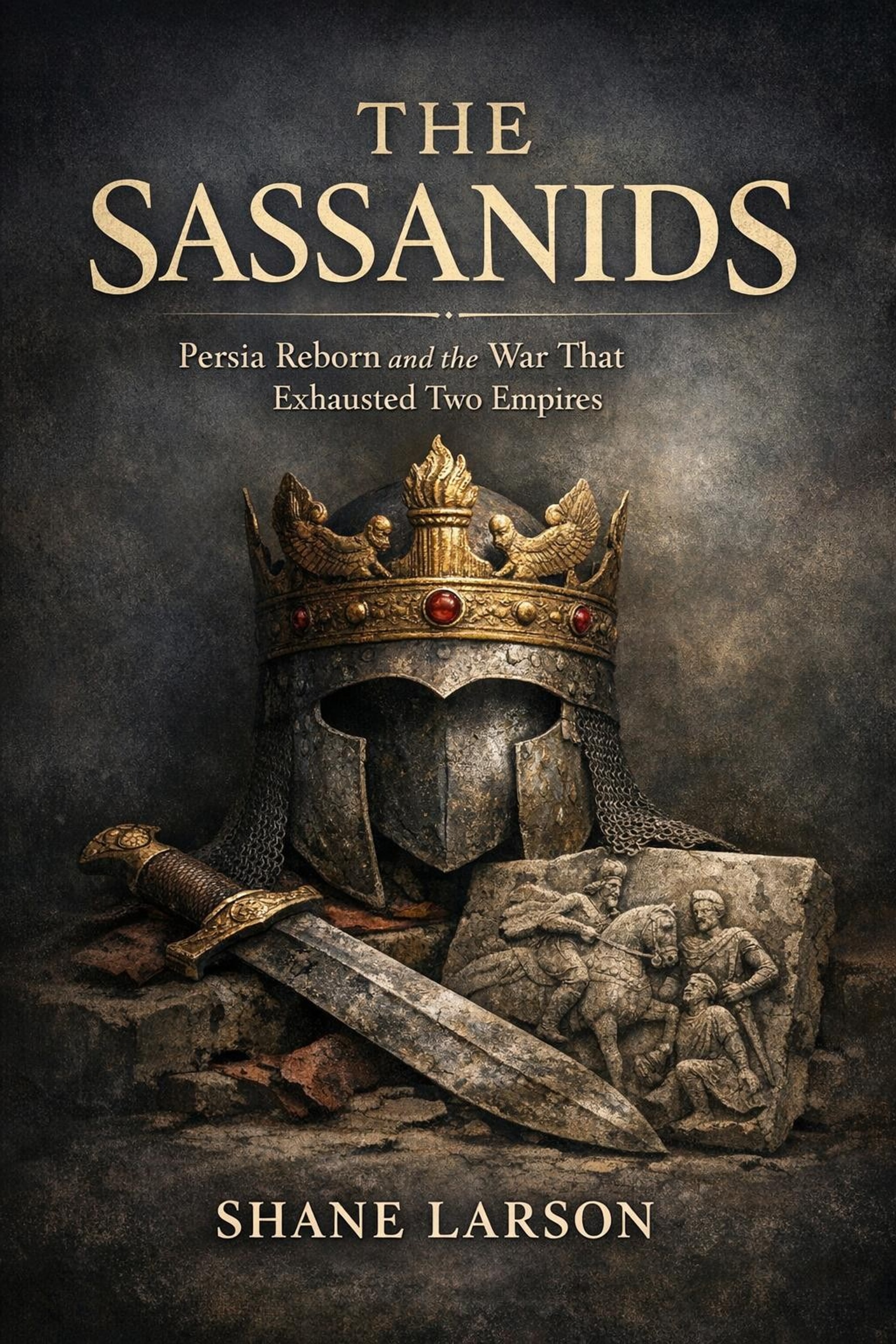
The Sassanids
Persia Reborn and the War That Exhausted Two Empires
By Shane Larson
About This Book
On the river Karun, near the city of Shushtar, there is a dam almost half a kilometre long, built of Roman masonry in the 260s AD. Local tradition never forgot who laid the stones: the structure is called the Band-e Kaisar, Caesar's dam. It was built by Roman soldiers — the army taken prisoner at Edessa in 260 along with the emperor Valerian — put to work by the king who captured them. Parts of it were still carrying water seventeen centuries later — it outlasted both of the empires that made it.
That dam tells you most of what you need to know about the Sassanids. To Shapur I, a captured Roman army was not a trophy to parade. It was tens of thousands of skilled workers — engineers, surveyors, masons — and he marched them east and founded cities around them. This was a state that measured victory in infrastructure — canals dug, land surveyed, revenue assessed — and that machinery, not any single battle, is what made it the one enemy Rome could never put down.
Between AD 224 and 651, the Sasanian dynasty ruled the last Persian empire of antiquity, and for all of it faced Rome across a strip of Mesopotamia and Armenia that a dozen major wars never lastingly moved. Four centuries of fighting, fortresses that changed hands and changed back, and a border that ended roughly where it began. This book is about why — and about what finally broke the stalemate, which was neither empire winning.
The Sassanids began as vassals in the hills of Fars, keepers of a fire temple, subjects of the Parthian kings. When Ardashir overthrew his overlords in 224, he presented himself not as a usurper but as a restorer: the heir of Cyrus and Darius, returned after five centuries of interruption. The claim — Persia reborn — was pressed in stone, on coinage, and on the battlefield. The Parthians had been horsemen without siegecraft, dangerous in the field and helpless before a wall. The Sasanians built a real state behind their cavalry: a bureaucracy that surveyed every field in the empire, a Zoroastrian priesthood organized like a second government, and an army that could take fortified cities and keep them.
The book follows that state from its founding revolt to its extinction — through the century of crisis when a king of kings died fighting steppe nomads and a radical preacher named Mazdak shook the social order; through the reforms of Khosrow I, which rebuilt the tax system so thoroughly that the empire's eventual conquerors kept it running; and into the final catastrophe. From 602 to 628, Persia and Rome fought a total war in which Persian armies held Jerusalem and Egypt for a decade and a Roman emperor gambled his capital to strike at the Persian heartland. The peace restored the old border and ruined both signatories. What happened next — the sudden conquest of one empire and the amputation of the other by armies out of Arabia — only makes sense as the final entry in a four-hundred-year ledger of mutual exhaustion. That ledger is this book's argument, settled line by line.
What's Inside
- Ardashir's revolt, from the fire temple at Istakhr to the death of the last Parthian king in battle in 224 — and the program of restoration that turned a provincial coup into a claim on a five-hundred-year-old throne.
- Kartir and Mani: a chief priest who served four kings and boasted in his own inscriptions of crushing rival faiths, and a prophet who founded a world religion at the Persian court and was executed by it.
- Deportation as statecraft: why whole Roman cities were marched east, and how prisoner labor built dams, founded Gundeshapur, and made skilled populations a war objective in their own right.
- Julian's march on Ctesiphon in 363: the last great Roman invasion of Persia, the fleet burned on the Euphrates, an emperor dead on the retreat, and the treaty that surrendered Nisibis without a fight.
- Armenia and the Christians of Persia: how a buffer kingdom's conversion redrew the strategic map, and how the Church of the East split from Rome so that Persian Christians could be loyal subjects of a Zoroastrian king.
- Khosrow I's revolution: the fixed land tax, the crown-equipped dehqan cavalry, and a reputation for justice so durable that the civilization which destroyed his empire adopted him as its model king.
- The war of 602–628 in full: Jerusalem and Egypt lost, Constantinople besieged by two armies at once, Heraclius's winter campaigns, Nineveh, and a Persian king murdered by his own son.
- Qadisiyyah and Nahavand: why two empires that were unconquerable in 600 could both be broken within a single generation.
Why I Wrote This
I came to the Sassanids straight from writing about the Parthians — an empire that humiliated Rome at Carrhae, was never conquered by it, and then vanished from history so completely that its own successors erased the records. I wanted to know what replaced it. The answer turned out to be a better story than the one I'd just finished: a dynasty that fought the same Roman war four hundred years longer than the Parthians did, built the most sophisticated state west of China to sustain it, and came within one campaigning season of ending the Roman Empire outright — then lost everything, in a decade, to a third power neither empire had thought worth watching. Rome's fall gets shelves of books. The empire that fell beside it, in the same decades, for connected reasons, barely gets one. This is that book.
Frequently Asked Questions
Who were the Sassanids, and how are they different from the Parthians?
Both were Iranian dynasties that ruled Persia and fought Rome. The Parthians ran a loose feudal confederation, brilliant at cavalry warfare and bad at everything a state does between wars. The Sassanids overthrew them in 224 and built the opposite: a centralized monarchy with a state religion, a professional bureaucracy, siegecraft, and a tax system — a far more dangerous opponent for far longer.
Was a Roman emperor really captured alive by Persia?
Yes. Valerian was taken in the field near Edessa in 260, with most of his army, and died in captivity — the only time in Roman history it happened. The book weighs Shapur's own trilingual inscription against the later Roman accounts, which are late, hostile, and treated accordingly.
Do I need to have read anything else first?
No. The book explains everything it uses — including Zoroastrianism, which gets both a chapter and an appendix. It stands on its own, though readers of The Persian Empire will recognize the Achaemenid inheritance the Sasanian kings kept invoking.
What sources survive from the Persian side?
Fewer than we would like. Most narratives come from Rome or from authors writing centuries after the empire fell. The corrective is what the Sasanians left themselves: royal inscriptions in three languages, Kartir's carved autobiography, thousands of administrative seal impressions, reliefs, and a coinage so well dated it anchors the whole chronology.
How long is the book and how is it organized?
About 78,000 words: fourteen chapters in five parts, from Ardashir's revolt to the death of the last king at Merv in 651, plus three appendices — a king list with contested successions flagged, a war-by-war ledger of the whole four-century conflict, and a plain-language guide to Zoroastrianism in practice.
If You Liked This, You Might Like
- The Persian Empire: The World's First Superstate — the Achaemenid empire of Cyrus and Darius, which is the inheritance the Sasanian dynasty spent four hundred years claiming to have restored.
- The Crisis of the Third Century: Fifty Years That Nearly Ended Rome — the view from the other side of the frontier during Shapur's wars, when Valerian's capture was one disaster among many.
- Justinian and Theodora: The Plague, the Riots, and Rome's Last Chance — the court that signed the Endless Peace with Khosrow I, and the western half of the sixth-century world this book narrates from the east.
The Roman–Persian frontier is usually told as Rome's eastern problem. Told from Persia looking west, it becomes the story of how the ancient world's longest rivalry consumed both of its participants and cleared the ground for everything that came after.
What You'll Learn
- Ardashir's revolt, from the fire temple at Istakhr to the death of the last Parthian king in battle in 224 — and the program of restoration that turned a provincial coup into a claim on a five-hundred-year-old throne.
- Kartir and Mani: a chief priest who served four kings and boasted in his own inscriptions of crushing rival faiths, and a prophet who founded a world religion at the Persian court and was executed by it.
- Deportation as statecraft: why whole Roman cities were marched east, and how prisoner labor built dams, founded Gundeshapur, and made skilled populations a war objective in their own right.
- Julian's march on Ctesiphon in 363: the last great Roman invasion of Persia, the fleet burned on the Euphrates, an emperor dead on the retreat, and the treaty that surrendered Nisibis without a fight.
- Armenia and the Christians of Persia: how a buffer kingdom's conversion redrew the strategic map, and how the Church of the East split from Rome so that Persian Christians could be loyal subjects of a Zoroastrian king.
- Khosrow I's revolution: the fixed land tax, the crown-equipped dehqan cavalry, and a reputation for justice so durable that the civilization which destroyed his empire adopted him as its model king.
- The war of 602–628 in full: Jerusalem and Egypt lost, Constantinople besieged by two armies at once, Heraclius's winter campaigns, Nineveh, and a Persian king murdered by his own son.
- Qadisiyyah and Nahavand: why two empires that were unconquerable in 600 could both be broken within a single generation.
Included with Kindle Unlimited — read it free if you're a member.
New Ancient History releases and free chapters — no spam, unsubscribe anytime.