The Silk Road Was Named in 1877 — by a Railway Surveyor Who Never Walked It
August 30, 2026 · 5 min read
The Silk Road Was Named in 1877 — by a Railway Surveyor Who Never Walked It
Ask anyone to name a trade route from history and you will get the same two words. The Silk Road conjures a caravan at sunset: camels loaded with shimmering cloth, padding from China to Rome across a map the color of parchment. It is one of the most evocative phrases in all of history writing.
It is also younger than the telephone.
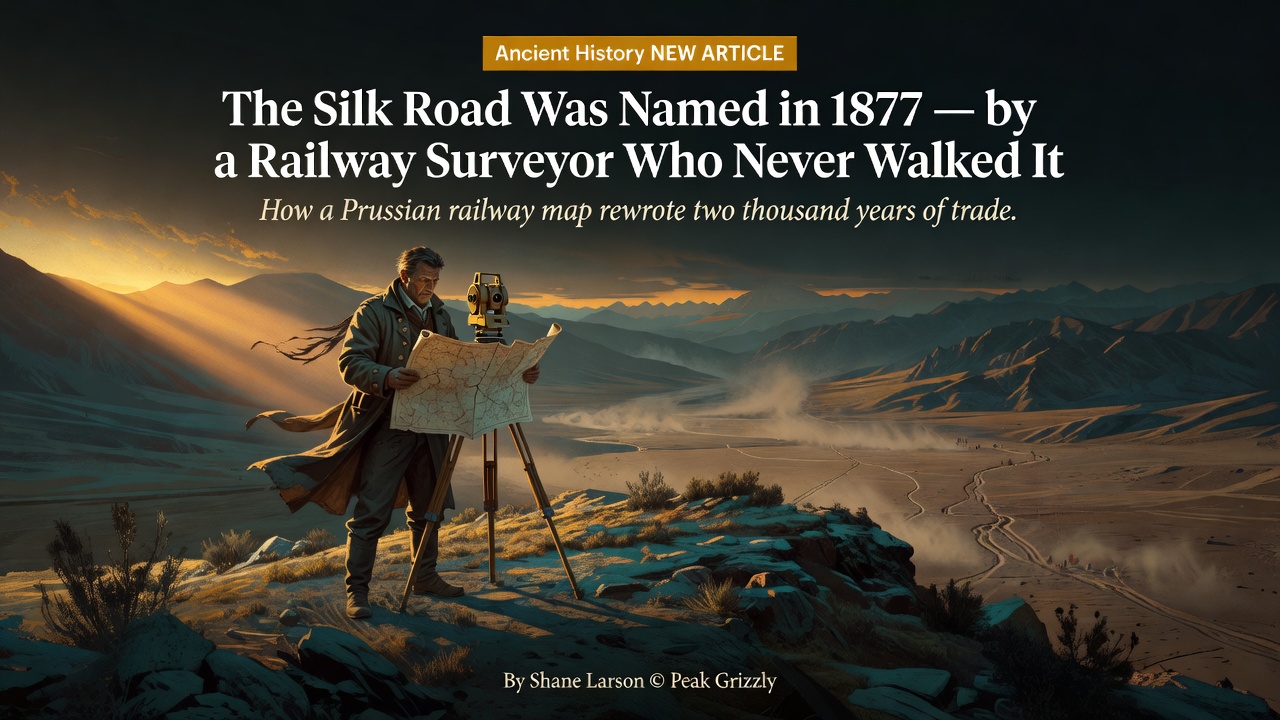
No merchant who crossed Central Asia ever heard the words "Silk Road." No Chinese official who paid a garrison in bolts of silk, no Sogdian caravan master haggling in Samarkand, no Roman moralist complaining about see-through fabric ever used the phrase or anything like it. The term was coined in 1877 — in German, as Seidenstrasse — by a geographer named Ferdinand von Richthofen, and he was not writing history. He was scouting railway routes.
A name invented for a prospectus
Richthofen was a Prussian aristocrat (his nephew, decades later, would become rather more famous as the Red Baron) and one of the most accomplished geographers of his century. Between 1868 and 1872 he made seven expeditions across China, mapping coal fields and mountain passes. His sponsors included men with a very practical question: could a railway be driven from Europe across Central Asia to the Chinese interior, and along what line?
Working through ancient Chinese and Greco-Roman geography for precedents, Richthofen found scattered references to a corridor along which Chinese silk had once reached the West. In the first volume of his enormous work on China, he labeled that ancient corridor die Seidenstrasse — the Silk Road — partly as a scholarly convenience and partly as something close to branding: a historical pedigree for the modern route his backers hoped to build.
The railway was never built along his line. The name outlived the project, the investors, and Richthofen himself. His student Sven Hedin used it as a book title in the 1930s, and by the second half of the twentieth century a phrase from a railway survey had become the standard name for two millennia of Eurasian exchange. It may be the most successful piece of marketing language in historiography.
Three things the name gets wrong
The trouble is that each word of the phrase smuggles in a claim, and each claim is false.
There was no road. What existed was a braid of possibilities: desert tracks that shifted with the water table, mountain passes open a few months a year, river valleys, and steppe corridors whose safety depended entirely on who ruled the grass that season. Routes rose and fell with politics. When one empire could no longer garrison a stretch of desert, the traffic moved — or stopped.
It was not mostly silk. Silk mattered, but for centuries it mattered as money rather than luxury: Chinese dynasties collected taxes in cloth and paid their frontier armies in it, pushing enormous quantities westward as payroll, not merchandise. Around and alongside it moved horses, glass, paper, jade, musk, furs, rhubarb, lapis lazuli — and people, including enslaved ones. The most consequential cargo was invisible: religions, technologies, and eventually the bacterium that became the Black Death, whose origin geneticists traced in 2022 to a fourteenth-century cemetery sitting directly on the route.
The Silk Road
Almost nothing went end to end. The romance imagines a merchant leaving China and arriving in Rome. In two thousand years of records, there is no good evidence any trader did that. Goods moved in relays, changing hands at oasis towns, each middleman carrying them a few hundred miles. A bolt of silk might pass through a dozen owners between loom and Mediterranean port. Rome and Han China knew of each other only as rumors at opposite ends of a chain neither could see down.
The people the legend forgot
Strip away the romantic name and something better appears underneath. The documentary record of the route — tens of thousands of contracts, receipts, letters, and lawsuits preserved by desert dryness at sites like Dunhuang and Turfan — shows mostly small, local, stubbornly human commerce: a dispute over a camel, a loan of grain, a will dividing a modest estate.
And it shows who was actually running things: the Sogdians, a merchant people from the oasis cities of Samarkand and Bukhara, who built a commercial diaspora stretching three thousand miles into China and operated it for six hundred years. Their language became the trade tongue of Inner Asia. Their caravan bosses held ranked office in the Chinese bureaucracy. In 1907, the archaeologist Aurel Stein found a mailbag in a ruined watchtower on the Chinese frontier — undelivered letters, sixteen hundred years old, written by Sogdian traders. One is from a stranded wife, abandoned in a frontier town, telling her absent husband precisely what she thinks of him. Her fury is still legible. Almost nobody outside a university has heard of her people.
That is what the pretty phrase cost us. "Silk Road" sold the caravan at sunset and buried the receipts, the relay stations, the garrison payrolls — and the Sogdians — under two words a railway surveyor chose for investors.
Why it still matters
None of this makes the route less important. It makes it differently important. The real network — subsidized by empires, run in short hops, carrying faiths and technologies and plagues further than any luxury — is a more interesting story than the legend, and a more honest one. It is a story about infrastructure and who pays for it, about what actually moves when worlds connect, and about the strange accidents (a sealed cave, an undelivered mailbag, a row of dated tombstones) through which we know any of it at all.
The name is not going anywhere; a century and a half of books, exhibitions, and atlases have seen to that. But it is worth remembering, every time you hear it, that the most famous road in history was named by a man planning a railway — thirteen centuries after the route's best years were over.
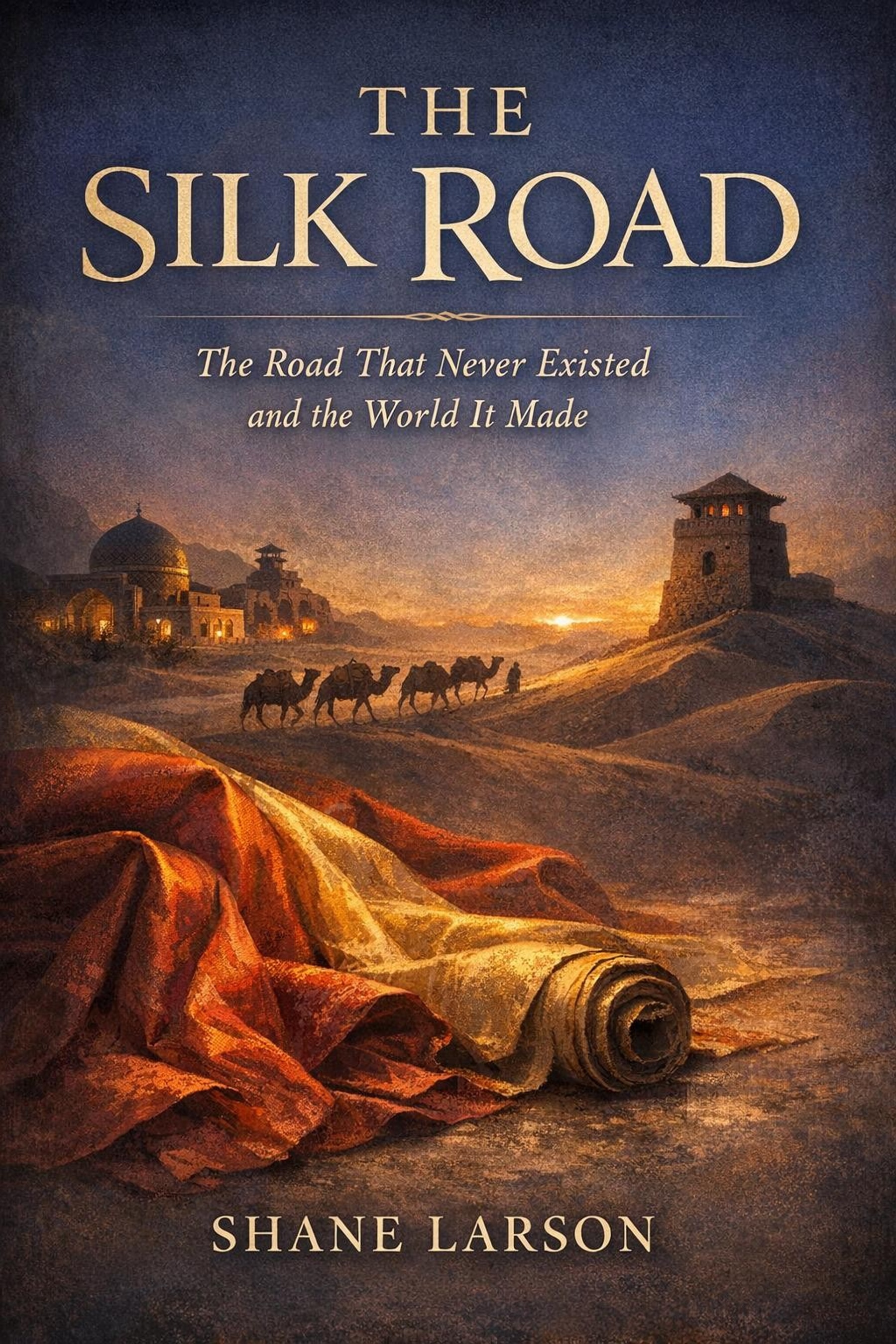
I reconstruct the real network from its documents, cargo, cities, and bodies — the Sogdian letters, the Dunhuang cave library, the smuggled silkworms, and the 2022 discovery that found the Black Death's origin sitting on the road — in The Silk Road: The Road That Never Existed and the World It Made.
The Silk Road
New posts and releases, straight to your inbox. No spam, unsubscribe anytime.