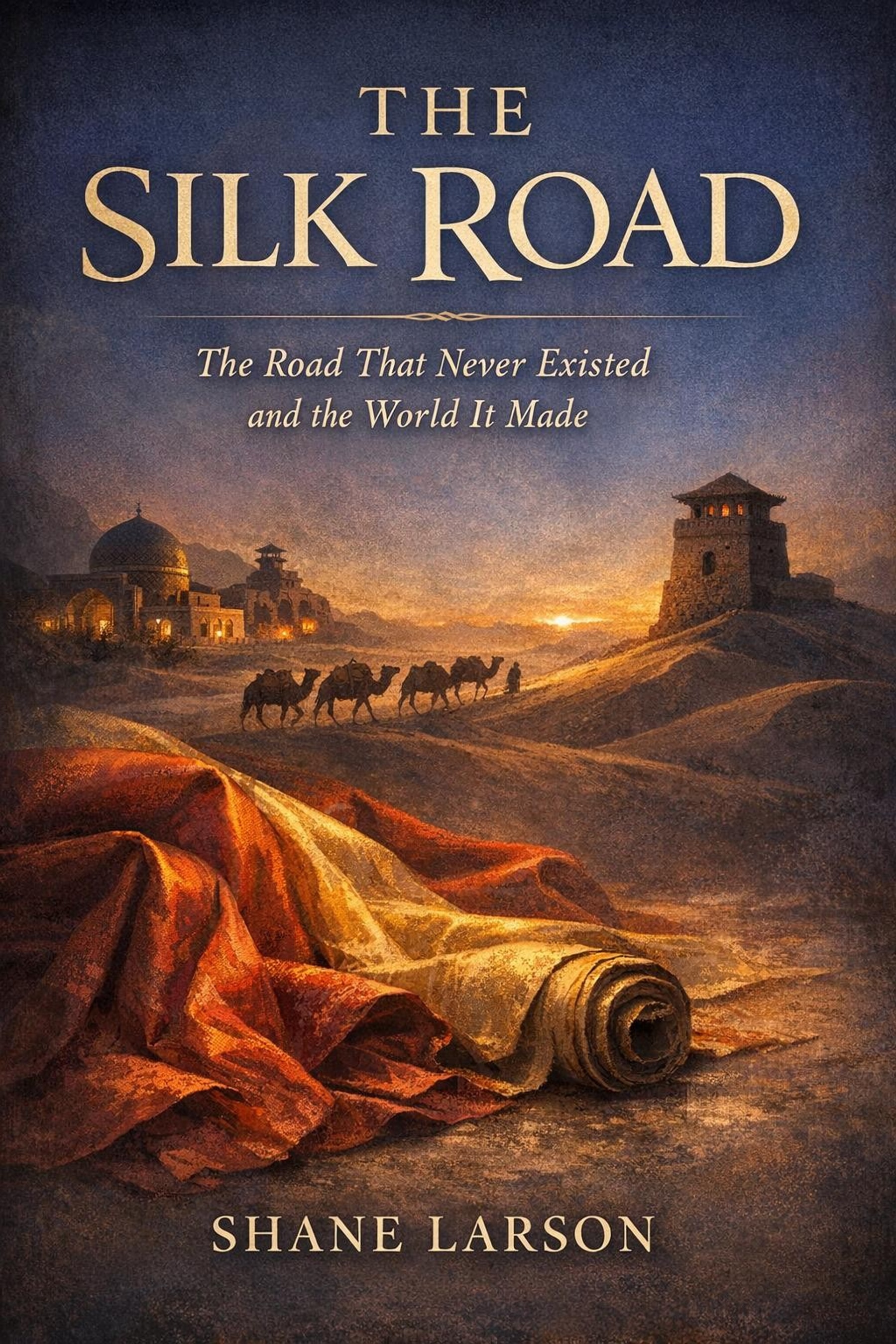
The Silk Road
The Road That Never Existed and the World It Made
By Shane Larson
About This Book
In 1907, a Hungarian-born archaeologist named Aurel Stein was working through the ruins of a watchtower on China's old western frontier when he found a mailbag. The letters inside had been written around AD 313 by merchants from Samarkand — men trading cloth and musk along the desert corridor into China — and they had never been delivered. They sat in that tower for sixteen hundred years. One of them was written by a woman named Miwnay, stranded in a frontier town by a husband who had gone off on business and stopped answering. Her letter survives in full, and her opinion of him has lost none of its heat in a millennium and a half.
That mailbag is the Silk Road — the real one. Not the caravan gliding at sunset from China to Rome, but a working world of contracts, debts, garrison payrolls, family arguments, and mail that didn't arrive. This book is a history of that world: the braid of desert tracks and mountain passes we now call the Silk Road, the people who actually worked it, and the cargo — commercial, spiritual, and microbial — that crossed a continent on its back.
The phrase itself turns out to be the first piece of evidence. It was coined only in 1877, for a railway survey, and every word of it misleads: there was no single road, silk was closer to currency than luxury for much of the route's life, and in two thousand years of records there is no good evidence that any trader ever travelled end to end. Goods moved in relays, a few hundred miles at a time, through the hands of middlemen who never saw either terminus. The route flourished when an empire was paying to garrison it and withered when the money stopped. What the legend sells as the romance of free-flowing commerce was, over and over, an artifact of military spending.
And yet the consequences were enormous — just not the ones the legend advertises. Buddhism moved east along these tracks with the merchants who financed its monasteries, and got carved into cliff faces from Afghanistan to the edge of China. Papermaking moved west and handed Baghdad the cheap writing material an empire of documents was waiting for. Silkworm eggs reached Constantinople in a smuggling operation the sources describe with a straight face. A branch of Christianity reached the Tang capital in 635 and raised a stone monument that still exists. And in the late 1330s a bacterium climbed out of the marmot country of the Tian Shan and onto the caravan routes; in 2022, geneticists sequencing DNA from a cemetery in Kyrgyzstan identified those graves as the starting point of the Black Death. The same network, the same relay stations, the same reasons — scripture and plague travelled identically.
Why I Wrote This
I had already written books about the empires at both ends of this route — Persia, the first Chinese emperors, the Mongols, the plague that came down it — and I kept noticing that I was gesturing at a corridor I had never actually explained. When I went looking for the explanation, the thing that hooked me wasn't the romance. It was the paperwork. Somewhere under the most over-romanticized name in history sits a documentary record of almost unbearable ordinariness — a dispute over a camel, a loan of grain, a wife's furious letter — preserved by nothing but desert dryness and luck. A famous legend resting on receipts nobody reads felt like exactly the kind of story worth telling properly.
Frequently Asked Questions
Was the Silk Road a real road?
No — and that's the starting point of the book rather than a footnote. What existed was a shifting network of desert tracks, mountain passes, and steppe corridors, with no fixed course and no single route. The name was invented in 1877, long after the traffic it describes had ended, and the book treats the gap between the label and the reality as its central subject.
Do I need to have read any other book first?
No. It's fully standalone. It does connect naturally to several other books in the catalog — it's the corridor that links the Persian, Chinese, Mongol, and plague histories — but it assumes nothing beyond curiosity.
Does the book cover the Black Death?
Yes — the final chapter follows the 2022 genetic identification of the pandemic's origin point at a cemetery in the Tian Shan mountains, and traces how the route's own infrastructure carried the disease west to the Mediterranean. It's the upstream story of what happened next in Europe, which the catalog covers in a separate book on the Black Death itself.
Is this about modern China's Belt and Road Initiative?
No. The book ends around 1500, when ocean shipping finally beat the overland routes, and stays there. Its subject is the historical network — the phrase's modern revival as branding gets exactly one sentence.
How current is the scholarship?
More current than any popular book on the shelf. The 2021 Tarim Basin ancient-DNA results and the 2022 plague-origin genomes both post-date every competing trade title, and both get full treatment here — presented as science, with their limits stated honestly.
How long is the book?
About 74,000 words — an introduction, fourteen chapters, a conclusion, and three appendices: a side-by-side chronology of who ruled what along the route, a graded cargo manifest separating documented goods from folklore, and a guide to the sources themselves.
If You Liked This, You Might Like
- The Mongol Storm — the empire that finally unified the whole corridor; this book shows what its post stations and passports actually carried.
- The Black Death — the downstream story: what happened when the cargo of this book's final chapter reached Europe.
- The Persian Empire — the power that stood across the route's western half centuries before the name existed.
- Zheng He's Treasure Fleets — the fleets whose voyages, and whose abandonment, close this book's story of how the sea finally won.
The road on the map never existed. The world it names did — and it is stranger, smaller, better documented, and more consequential than the legend ever let on.
What You'll Learn
- How a nineteenth-century railway surveyor's label became the standard name for two thousand years of history — and the three distortions it builds into every retelling
- Zhang Qian's embassy of 138 BC, and how Chinese trade with the West began as a military intelligence operation aimed at outflanking the steppe
- The Sogdians: the merchant families of Samarkand and Bukhara who ran a three-thousand-mile commercial diaspora for six centuries and taught the steppe empires to write
- A cargo audit with receipts — what actually moved (horses, glass, jade, furs, rhubarb, enslaved people), and why both the 'torrent of luxuries' and 'barely a trickle' versions are wrong
- The oasis world of the Taklamakan, and the 2021 genome study of the Tarim Basin mummies that dissolved a century of migration theories
- Why Buddhism, Manichaeism, Zoroastrianism, and the Church of the East all travelled the same tracks — and what transit did to each of them
- The sealed library at Dunhuang: forty thousand manuscripts walled into a cave around AD 1000, including the world's oldest dated printed book
- The Mongol century — the one era a single power held the whole corridor, and how its passport-and-post-station machinery delivered the Black Death to the Mediterranean in eight years
Included with Kindle Unlimited — read it free if you're a member.
New Ancient & Medieval History releases and free chapters — no spam, unsubscribe anytime.