The City That Left
August 2, 2026 · 6 min read
On Thera, Akrotiri, and why the obvious explanation is the wrong one
Everybody who has heard of the Thera eruption has heard the same short version of it. A volcano in the Aegean exploded. It was enormous. The Minoans, the great seafaring civilization of Crete ninety miles to the south, disappeared shortly afterward. One caused the other. Sometimes the version comes with Atlantis attached.
I spent a book on that short version, and almost every part of it needs work.
The eruption is real and it is as large as advertised. Around the middle of the second millennium BC — the exact year is the single most contested number in Bronze Age archaeology, and we'll get to that — the island of Thera ejected something on the order of sixty cubic kilometres of rock and ash. That is comfortably larger than Krakatoa in 1883, the eruption that produced a bang audible three thousand kilometres away. The centre of the island collapsed into the sea, leaving the crescent that tourists photograph today. Ash from it turns up in cores from the Nile Delta, the Black Sea, and the floor of the eastern Mediterranean.
The Minoans really did stop being an independent power within a few generations of it. When the record becomes legible again, the palace at Knossos is keeping its accounts in Greek.
It's the arrow between those two facts that doesn't survive contact with the evidence.
Crete was not buried
Start with the simplest version of the catastrophe story: ash smothered Cretan agriculture and the civilization starved.
Thera ash is chemically distinctive and geologists have been mapping its distribution for decades. The plume went east-southeast. The heavy fall landed on the southeastern Aegean islands and the Anatolian coast. Crete got a dusting — Thera ash occurs in Cretan contexts, but in modest quantities. Not a burial. A dusting.
That single finding removes the mechanism from the popular story. If the eruption ended Minoan civilization, it did not do so by burying Cretan farmland, because it did not bury Cretan farmland.
And the palaces didn't fall for another century
Here's the harder problem. The eruption falls in the archaeological phase called Late Minoan IA. The destruction of the Cretan palaces falls in Late Minoan IB. The interval between them is on the order of a century.
And that century is not a slow dying. LM IB is a period of high-quality Cretan material culture. The island rebuilt. In some respects it flourished. Whatever the volcano did, Crete absorbed it and kept going for the better part of a hundred years.
You cannot get from a single eruption to a collapse a century later by pointing at the eruption and saying "there." Something has to fill the gap.
What actually happened
The useful move is to separate two kinds of damage.
Direct damage is what the event did on the day: tsunami on the north-coast harbours, ships and boatyards destroyed, ashfall on the eastern approaches. Real, catastrophic locally, and recoverable.
Systemic damage is what the event did to the arrangement. The Minoan world was a maritime network, and the eruption removed a node from it, wrecked fleet capacity, disrupted trading partners across the southeastern Aegean, and — the subtlest one — put a question mark over a ruling order whose authority rested partly on ritual competence and on control of the sea. A palace elite that cannot protect the harvest or the fleet is a palace elite with a legitimacy problem.
Thera
None of that kills a civilization. What it does is spend the margin. It converts a system with slack into a system without any, and then the next thing that comes along — a bad run of harvests, an internal political fight, an opportunistic neighbour with better weapons — finds a society with nothing left to absorb it.
That's the honest verdict, and it's the one the book lands on. Thera did not destroy the Minoans. It removed the margin that would have let them survive what came next.
The town that saw it coming
The human centre of the story isn't Crete at all. It's on Thera itself.
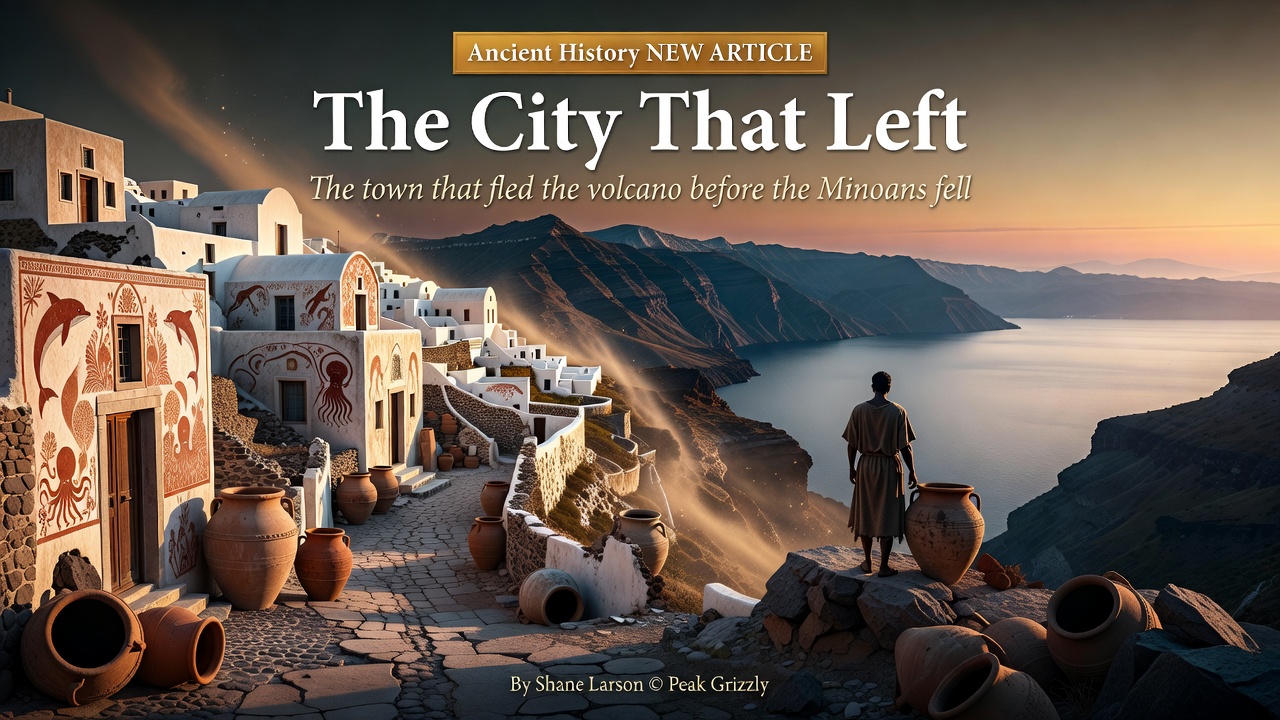
Under metres of pumice sits Akrotiri, a Bronze Age town preserved the way Pompeii was preserved. Houses two and three storeys tall. Drainage beneath the streets. Storage jars still in place. Walls painted with fleets, monkeys, lilies, and boys boxing — the richest snapshot of ordinary Bronze Age life outside Egypt.
And unlike Pompeii, it is empty.
No human remains. No valuables abandoned where someone dropped them running. Furniture moved. And in the ruins, a damage-and-repair sequence from the precursor earthquakes with the repair work stopped mid-job — the archaeological signature of people who were fixing their houses right up until the moment they decided fixing was pointless.
They saw it coming and they left, with time enough to plan. Then they disappear. There is no refugee population that shows up convincingly anywhere in the record. Whether they made it across ninety miles of water, and what happened to them if they did, is a genuinely open question rather than a rhetorical one.
Archaeology's hundred-year argument
I said we'd get to the date.
The scientific evidence — radiocarbon on short-lived samples, Bayesian modelling of stratified sequences, ice-core sulphate, tree-ring anomalies, and an olive branch that appears to have been buried alive in the pumice — clusters in the late seventeenth to early sixteenth century BC.
The archaeological evidence — Egyptian chronology, the pottery sequence, and the cross-dating synchronisms that tie Aegean layers to Egyptian ones — pulls the date roughly a century later.
Both sides are staffed by serious people. Both have real objections to the other. The gap has been open for decades and it is not a technicality, because the date decides who influenced whom across the entire Bronze Age Mediterranean, and it decides how much room there is between the eruption and everything that followed.
The book walks through both cases at chapter length, because the argument itself is the best detective story in the subject.
And Atlantis
Yes, it's in there. Late, where it belongs, and handled as historiography.
The short version: Plato's Atlantis appears in two late dialogues, one of which breaks off unfinished, and it functions inside those dialogues as a moral parable about a virtuous state that becomes corrupt. The location is wrong for Thera. The date is wrong for Thera even after you apply the famous factor-of-ten correction. Plato never mentions Crete.
And yet: a wealthy island civilization, seafaring and advanced, destroyed by the sea in a single day and night. That's a real thing that really happened in the Aegean, and Plato was an Aegean Greek.
The interesting question isn't yes or no. It's what four centuries of oral memory can plausibly carry — an event, a scale, an emotional register — versus what it certainly cannot: dates, measurements, geography, names. That question is unprovable, and its unprovability is the point.
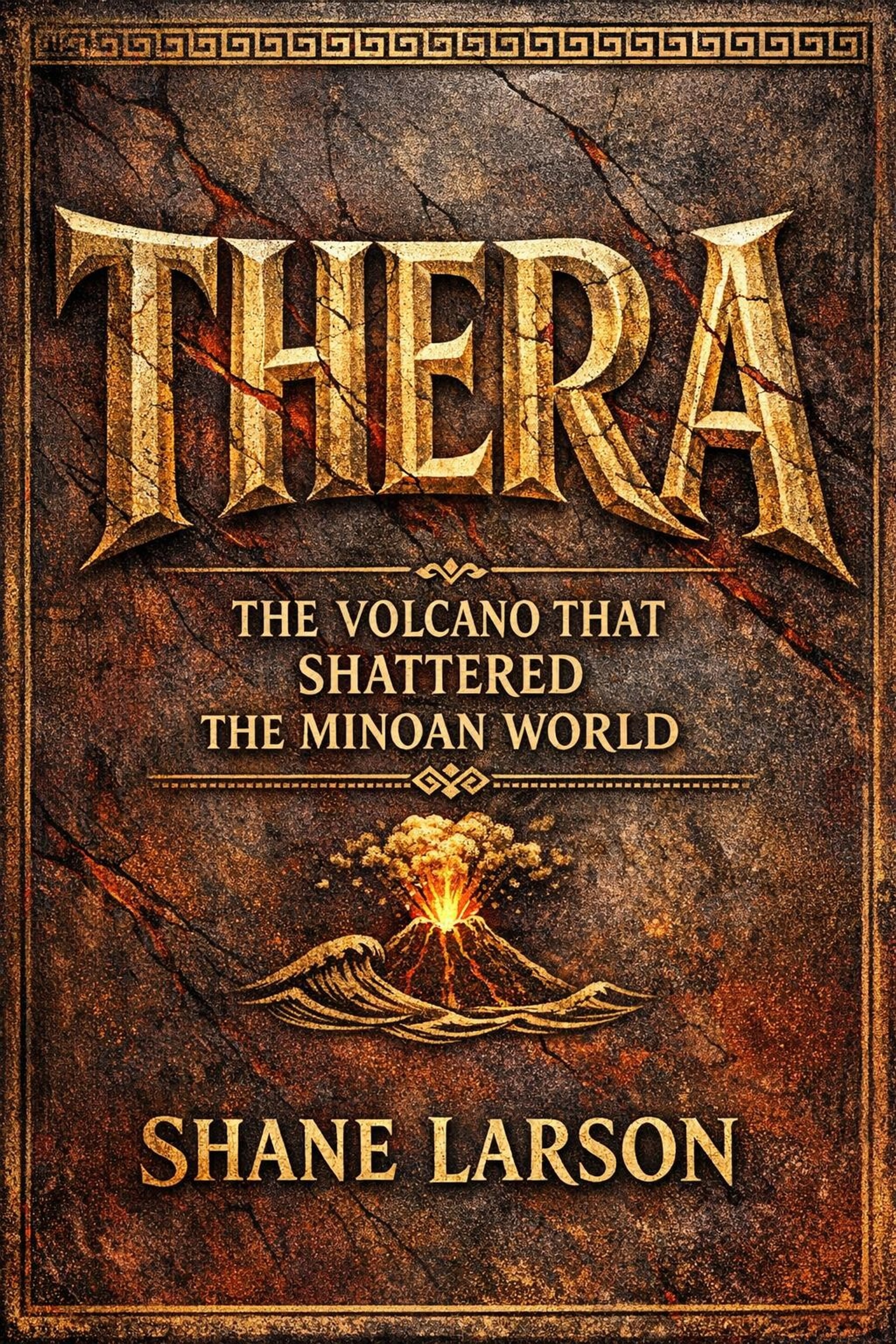
Thera: The Volcano That Shattered the Minoan World is available now on Kindle. It's the book I wanted after finishing The Minoans, and it didn't exist.
Thera
New posts and releases, straight to your inbox. No spam, unsubscribe anytime.