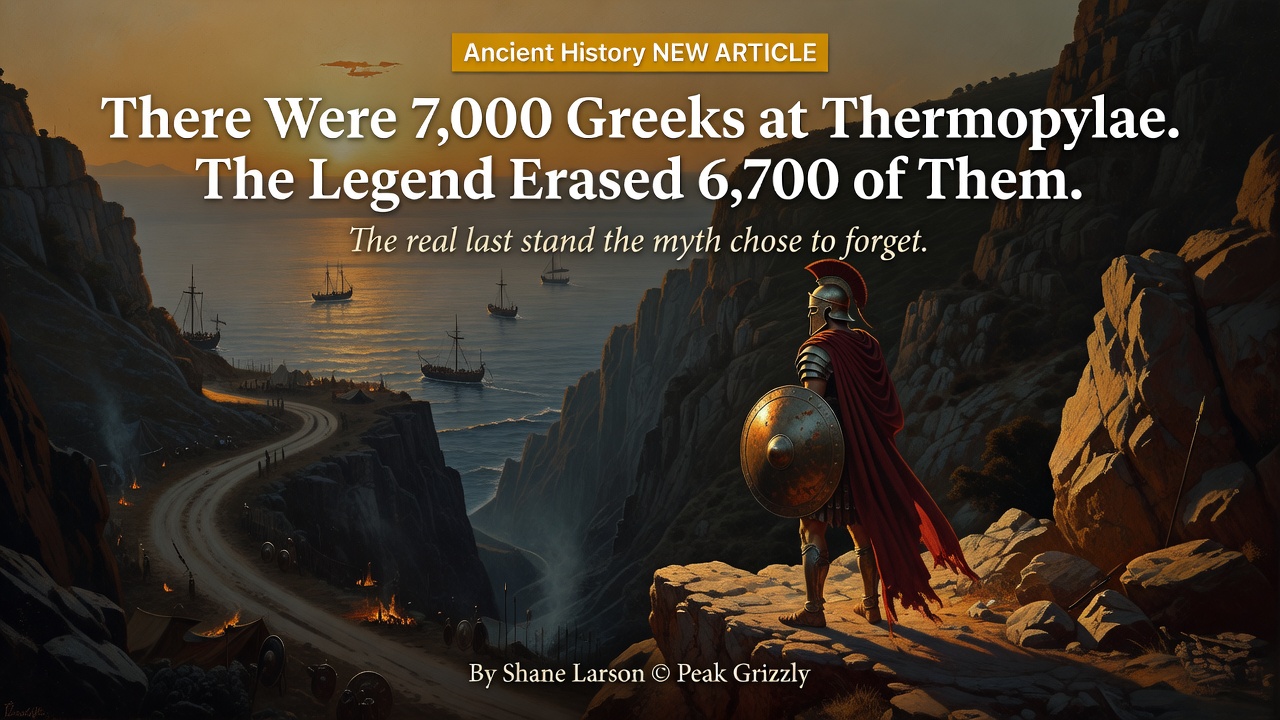
There Were 7,000 Greeks at Thermopylae. The Legend Erased 6,700 of Them.
July 27, 2026 · 5 min read
On the last morning at Thermopylae, when the position was lost and everyone knew it, roughly fifteen hundred men stayed behind to hold the pass while the rest of the army retreated south. About three hundred of them were Spartans, and they stayed under orders — their king had decided a Spartan withdrawal was impossible, whatever his exact reasons, and Spartans did not argue with kings.
Seven hundred of them were Thespians. Nobody ordered the Thespians to stay. Their commander, Demophilus, refused to leave, and his men — the entire hoplite strength of a small Boeotian city, every armored man Thespiae could put in the field — refused with him. When the end came a few hours later, the Thespians died in the same dust as the Spartans, for the same cause, having made a harder choice: the Spartans stayed because their law demanded it; the Thespians stayed because they decided to.
Within a generation, the legend had nearly erased them. Twenty-five centuries later, it has succeeded almost completely. There is a Hollywood franchise, a comic book, an entire cottage industry of THIS IS SPARTA merchandise — and no movie called 700.
I've just finished writing a book about Thermopylae, and that erasure is, in miniature, the whole story of the battle: what actually happened at the Hot Gates in 480 BC is consistently better — stranger, more human, more interesting — than the myth that buried it. Here are the three corrections that matter most.
It Wasn't 300. It Was a Small Army — and the Math Proves It.
The full roster of the force that marched to the pass, mostly from Herodotus' own list, the one the legend skips: around three hundred Spartiate citizens plus their helot attendants (enslaved Greeks who fought and died at the pass and whom the legend has never once counted), five hundred men of Tegea, five hundred of Mantinea, a thousand other Arcadians, four hundred Corinthians, contingents from Phlius and Mycenae — then, joining in the north, seven hundred Thespians, four hundred Thebans, a thousand Phocians, and the Opuntian Locrians in full strength. Roughly seven thousand men.
Here's why the real number matters beyond pedantry: it's the only way the battle makes tactical sense. The defenders held the pass for two full days of assault not through superhuman endurance but through rotation — contingents cycling to the front line by city, fresh shields replacing tired ones, in a corridor narrow enough that only a few hundred men fought at any moment. Seven thousand men can rotate for days. Three hundred would have been dead of exhaustion, arrows aside, by the first afternoon. The myth doesn't just shrink the roster; it deletes the actual military logic of the stand.
It Wasn't a Last Stand. It Was Half of a Two-Front Strategy.
The legend gives us doomed men marching to a heroic death. The record gives us something more impressive: a genuinely sophisticated coordinated defense.
Thermopylae was one of two bottlenecks. While the army held the land gate, the allied Greek fleet — 271 warships, the bulk of them Athenian — held the sea gate at Artemisium, off northern Euboea, close enough that the two forces exchanged messages. The geometry was the strategy: if the fleet abandoned the strait, the Persian navy could land troops behind the pass; if the pass fell, the fleet's position was pointless. Each front existed to keep the other's flank closed. And for three days both held — the same three days, in synchronized fighting, with the naval battle every bit as hard as the one on land. On the final day at sea, nearly half the Athenian ships took damage.
Thermopylae
The legend amputated the entire naval half of the campaign, because "three hundred men alone" is a cleaner story than "a competently coordinated joint operation." But the joint operation is what the Greeks actually built — and its collapse is a better drama than any suicide mission: a mountain path, a local man named Ephialtes who wanted a reward, a garrison on the heights that broke at dawn, and a sound plan failing at the human layer, the way plans actually fail.
It Was a Defeat — and the War Was Won by the People the Myth Forgot
The hardest correction, and the one I think honors the dead most: Thermopylae failed. The pass fell in three days. The delaying value was modest — Xerxes lost perhaps four days against his schedule. Central Greece lay open. Athens was evacuated and burned, its acropolis put to the torch.
The war was won afterward, by different means entirely. It was won at Salamis, where Themistocles — the most underrated commander of the age — lured the Persian fleet into a strait where its numbers meant nothing and broke it in an afternoon, collapsing the logistics that fed the whole invasion. And it was finished at Plataea the following summer, where the largest hoplite army the Greek world ever assembled — with the full Spartan levy finally in the field, doing what the three hundred had only previewed — destroyed the Persian land force. The victory belonged to a fractious, arguing, barely-holding-together coalition of fleets, armies, and statecraft.
So why do we remember a martyrdom instead? Because within months, Sparta needed one. A strategic failure was rebranded as the ultimate advertisement for the Spartan system — men who obey the law unto death — and the poet Simonides supplied epitaphs so perfect they've outlived the civilization that carved them. The Thespian volunteers didn't fit the Spartan story, so they faded. The helots never fit anyone's story, so they vanished. Herodotus, writing decades later, built the dramatic monument the ages have renovated ever since: Rome used it, the Enlightenment used it, nationalism used it, both World Wars used it, the Cold War used it, and the multiplex is still using it.
The legend is itself a historical artifact — a 2,500-year record of what each era wanted courage to look like. That's worth studying. But it isn't the battle. The battle was seven thousand men in a corridor by the sea, a fleet fighting in lockstep over the horizon, a betrayal on a mountain path, and a morning when seventeen hundred of them — ordered and unordered, free and enslaved, remembered and erased — decided the retreat needed covering.
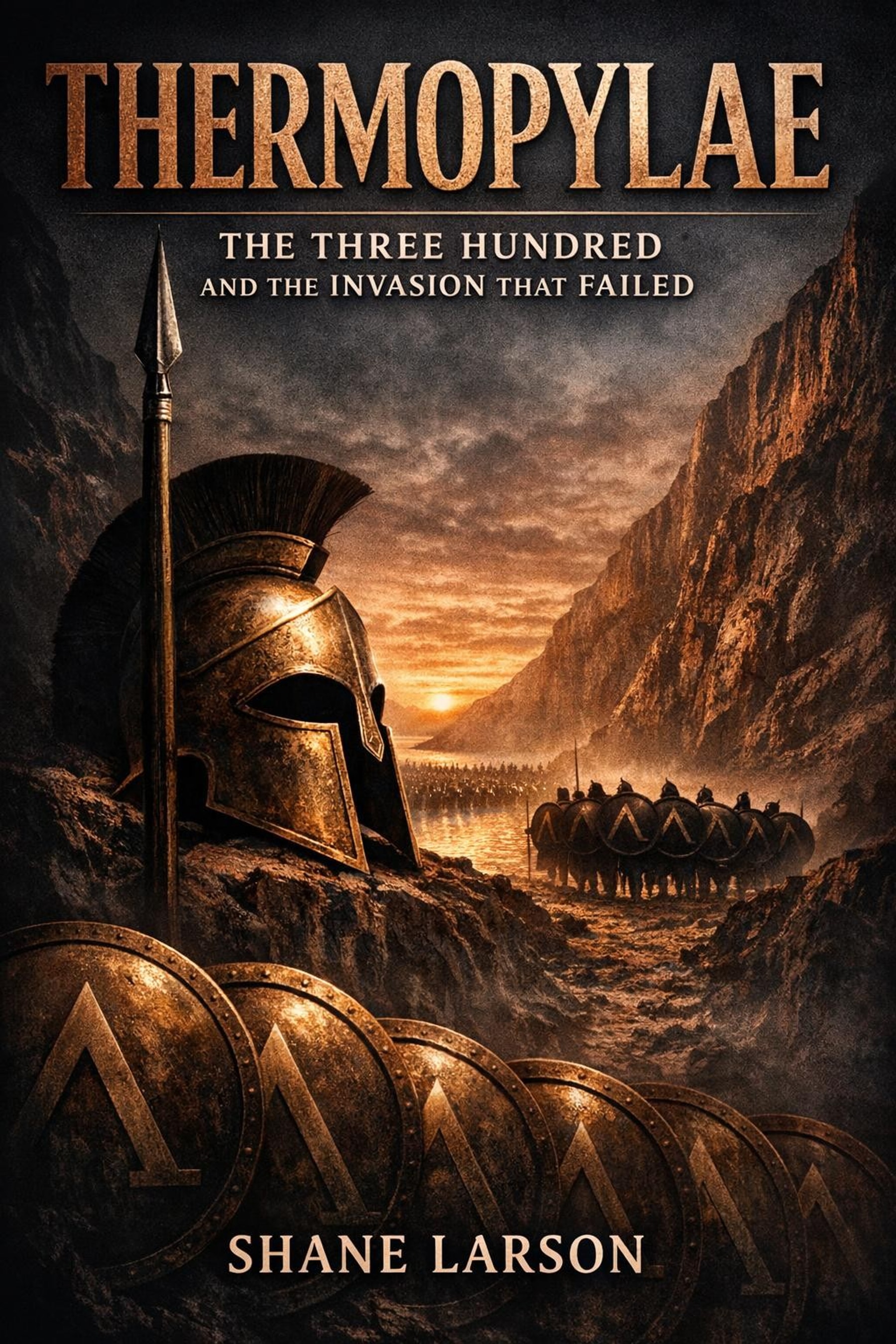
My new book, Thermopylae: The Three Hundred and the Invasion That Failed, tells both stories and keeps them scrupulously separate: the documented campaign, hour by hour, from the decision at Susa to Plataea — and then the manufacture of the myth, from the first epitaphs to the movies. The seven thousand deserve the fame of the three hundred. This is my attempt to pay some of it back.
Thermopylae
New posts and releases, straight to your inbox. No spam, unsubscribe anytime.