The War That Invented the Modern World
June 18, 2026 · 8 min read
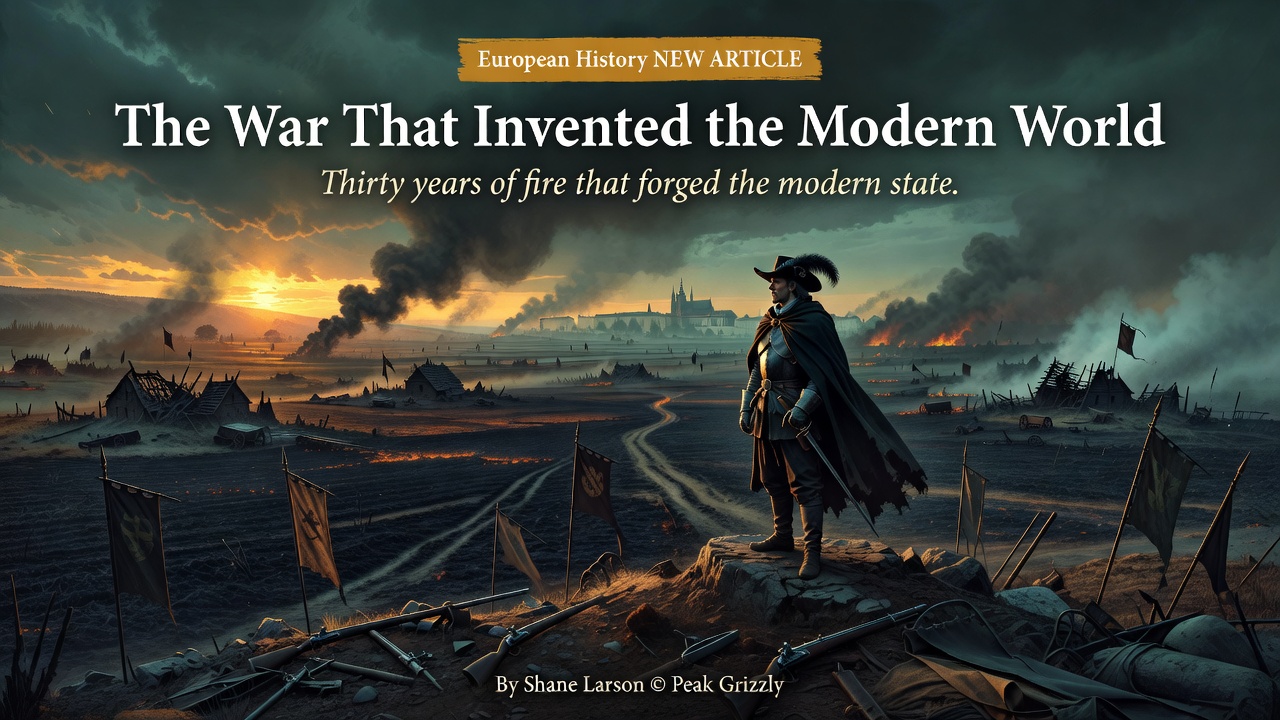
Three men were thrown out of a window in Prague in 1618. Thirty years later, a third of Germany was dead — and the modern world had been invented to make sure it never happened again.
That sentence sounds like exaggeration. It isn't. The Thirty Years' War is the conflict almost everyone has heard of and almost no one can actually explain. It doesn't fit neatly into a story of kings and countries, the way the Hundred Years' War or the Napoleonic Wars do. It has no single villain, no clean beginning, no obvious turning point you can point to and say here is where it was decided. It is a sprawling, grinding, thirty-year catastrophe with a cast of dozens and a body count that, proportionally, would not be matched in Europe until the trenches of the First World War.
And yet it matters enormously — maybe more than any other war between the fall of Rome and the twentieth century. Because when it finally ended, the exhausted men who negotiated the peace built something deliberately new out of the wreckage: the system of sovereign states that still organizes the entire planet. You live inside the rules they wrote in 1648. It's worth understanding how they came to write them.
A quarrel that should have stayed local
It started, as these things often do, as a local dispute that nobody expected to spread.
The Holy Roman Empire in the early seventeenth century was not an empire in any modern sense. It was a patchwork of something like three hundred semi-independent states — kingdoms, duchies, free cities, bishoprics — loosely held together under a Habsburg emperor who reigned far more than he ruled. It was also religiously split. A century after Martin Luther, the empire was a mosaic of Catholic and Protestant territories held in an uneasy, jury-rigged truce.
In Bohemia, that truce broke. Protestant nobles, furious at the Catholic Habsburg crown for trampling on their religious liberties, marched into Prague Castle and threw two royal officials (and a secretary, who tends to get forgotten) out of a high window. The Defenestration of Prague is one of history's great set pieces — the men survived the fall, which Catholics credited to angels and Protestants to a dung heap — but the symbolism was unmistakable. It was an act of open rebellion against the emperor.
It should have been a contained affair: a regional revolt, crushed or compromised within a few years. Instead, it caught fire. The emperor moved to stamp out the rebellion and restore Catholic authority. Protestant princes rallied to resist him. And then the outside powers began to circle.
Why thirty years?
Here is the thing nobody warns you about the Thirty Years' War: it isn't one war. It's four or five wars stacked end to end, each one dragging in a new power as the last burned out.
The Bohemian revolt collapsed quickly and brutally. But by then Denmark had entered the fight on the Protestant side, hoping to grab territory and influence in northern Germany. Denmark was beaten. Then Sweden came in — and Sweden changed everything. Then France, the great Catholic monarchy, joined the war on the Protestant side, and the whole conflict tipped from a religious struggle into a naked contest for European supremacy.
That last move is the hinge of the entire story, and it tells you what the war had really become. Cardinal Richelieu, the chief minister of Catholic France and a prince of the Catholic Church, chose to bankroll Protestant Sweden in order to break the power of the Catholic Habsburgs. Faith had become a banner. The real game was power — specifically, France's determination not to be encircled by Habsburg territory on every border.
The other reason it lasted so long is uglier and more mechanical. The armies of the period largely fed themselves by plundering the land they marched through. War, in a grim and literal sense, paid for war. As long as there was a countryside left to strip, an army could keep itself in the field. The fighting became self-sustaining, a fire that generated its own fuel, rolling back and forth across the German lands for a generation.
The cast
What rescues the Thirty Years' War from being an unreadable tangle is its people. Tell it through them, and it snaps into focus.
There is Gustavus Adolphus, the king of Sweden, the "Lion of the North" — a genuine military innovator who reorganized how armies fought, with lighter guns, faster maneuver, and disciplined combined arms. He turned a poor Baltic kingdom into a great power almost by force of will, swept into Germany as the Protestant champion, and then rode into the fog at the Battle of Lützen and was killed, his body stripped and lost on the field. He died at the height of his powers, and the Protestant cause never fully recovered the momentum he gave it.
The Thirty Years' War
There is Wallenstein, perhaps the most extraordinary figure of the age: a military entrepreneur who raised an enormous private army, financed it through his own vast estates and ruthless management, and made the emperor dependent on a contractor he could neither pay nor control. Wallenstein became so powerful, and so untrustworthy, that the emperor ultimately had him assassinated — murdered by his own side. His story is a permanent warning about what happens when an institution outsources its core function to someone more capable than itself.
There is Tilly, the austere, devout Catholic general whose army stormed the Protestant city of Magdeburg in 1631. What followed was the war's defining atrocity: the city was sacked and burned, and perhaps twenty thousand people died. "Magdeburg justice" entered the European vocabulary as a byword for total annihilation. It is the moment the war's human cost becomes impossible to look away from.
And behind them all, working the diplomacy, is Richelieu in Paris — cold, brilliant, and entirely indifferent to the religious labels everyone else was still fighting under.
The cost
It is hard to convey the scale of what the war did to Germany. Estimates vary, but the most credible suggest that somewhere between four and eight million people died — a fifth, a third, in some regions far more, of the population. Many were soldiers. Far more were ordinary people who died of the plague and famine that armies dragged behind them like a wake. Towns were depopulated. Farmland went feral. Some districts did not recover their pre-war population for a century.
This is where the war connects to a larger question I keep coming back to in my writing: how complex orders come apart. The fall of Rome, which I've written about elsewhere, runs on the same machinery — institutions hollowing out, a center losing its grip on the periphery, armies that stop serving the state and start serving themselves, and a shared framework of legitimacy that simply dissolves until no one can agree on who has the right to rule. The Thirty Years' War is the early-modern version of that pattern, compressed into three brutal decades and documented in agonizing detail. (If that theme interests you, I dig into it directly in The Collapse Pattern, available on the site.)
The peace that built our world
What makes the Thirty Years' War different from a simple story of collapse is what came afterward.
By the 1640s, everyone was exhausted. The war had achieved nothing that justified its cost; the armies could barely sustain themselves; the original religious questions had long since curdled into a stalemate nobody could win. So the powers did something genuinely new. They sat down in the Westphalian cities of Münster and Osnabrück and negotiated, for years, a comprehensive settlement — not just a ceasefire, but a new operating system for Europe.
The Peace of Westphalia, signed in 1648, established principles that sound utterly ordinary today precisely because they won: that states are sovereign within their own borders, that rulers decide the internal affairs of their own territories, that outside powers don't get to dictate another state's religion. It drew a line under the idea that a single universal authority — imperial or religious — could impose order across the continent. In its place it put a society of independent, formally equal states, managing their disagreements through diplomacy and the balance of power.
That framework — the sovereign state as the basic unit of international order — is so deeply woven into how we think about the world that we barely notice it. But it was invented. It was a deliberate response to thirty years of catastrophe, written by people who had seen exactly what the alternative cost. (I've written more about why Westphalia still shapes the modern world over on shanelarson.com.)
Why read about it now
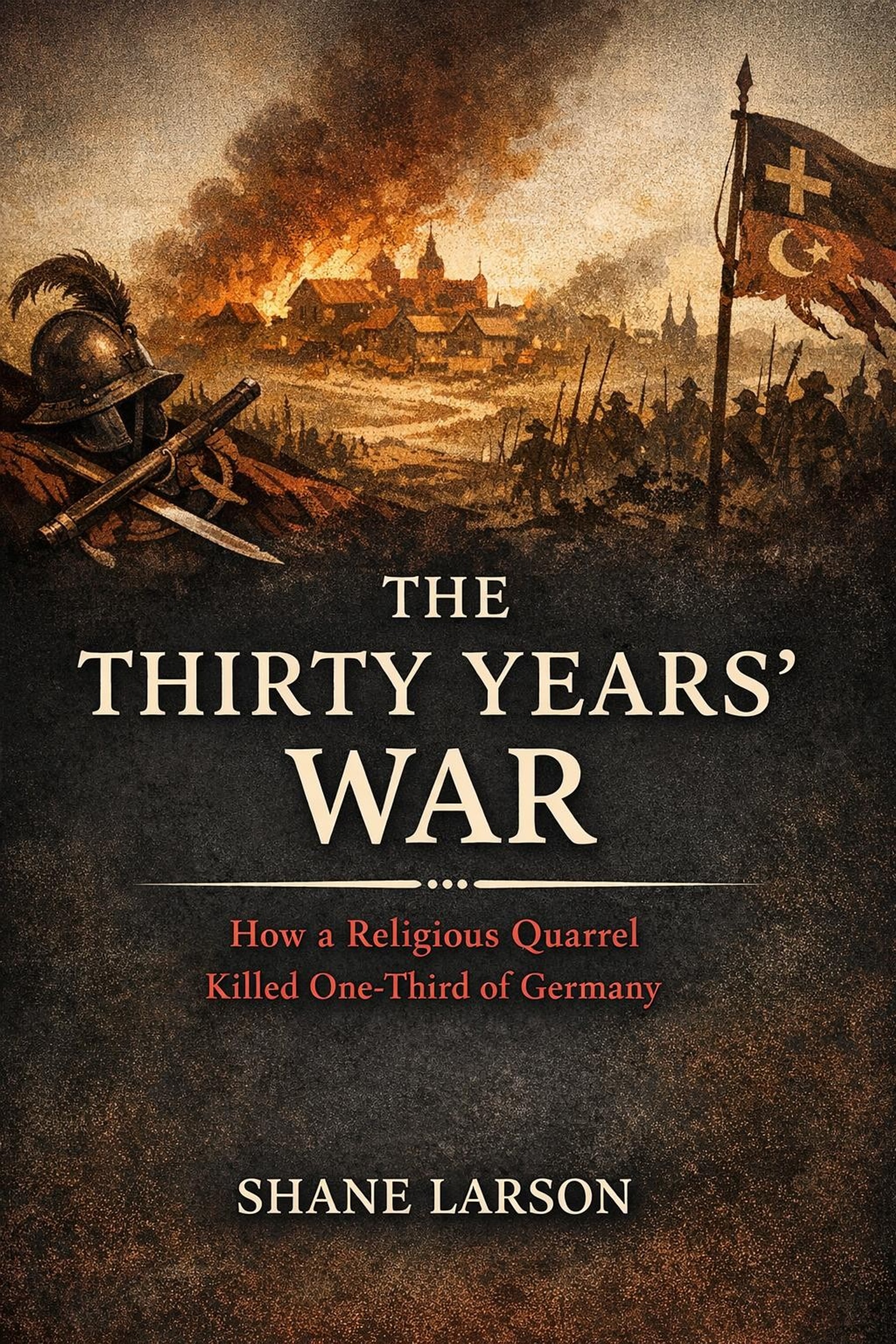
I wrote The Thirty Years' War: How a Religious Quarrel Killed One-Third of Germany because this is a story that deserves to be told as a story — character-driven, fast-moving, free of jargon — and because it so rarely is. The great scholarly accounts are magnificent and enormous. C. V. Wedgwood, Peter H. Wilson, Geoffrey Parker — these are essential works, and they are also very long. I wanted to write the book that gives you the whole arc, the people, the horror, and the meaning, in one clear narrative you can actually finish.
The window in Prague, the burning of Magdeburg, the king lost in the fog, the cardinal financing his enemies, the exhausted diplomats inventing a new world order — it's one of the great human dramas, and it explains an enormous amount about the world you live in.
If you've followed my work on Rome and on the patterns of collapse, this is the early-modern chapter of the same argument. And if you're new to it, this is the place to start.
The Thirty Years' War is out now for $3.99, and free to read on Kindle Unlimited.
The Thirty Years' War
New posts and releases, straight to your inbox. No spam, unsubscribe anytime.