The Strongest Evidence for the Trojan War Isn't in Greece. It's in Hittite Filing Cabinets.
July 17, 2026 · 5 min read
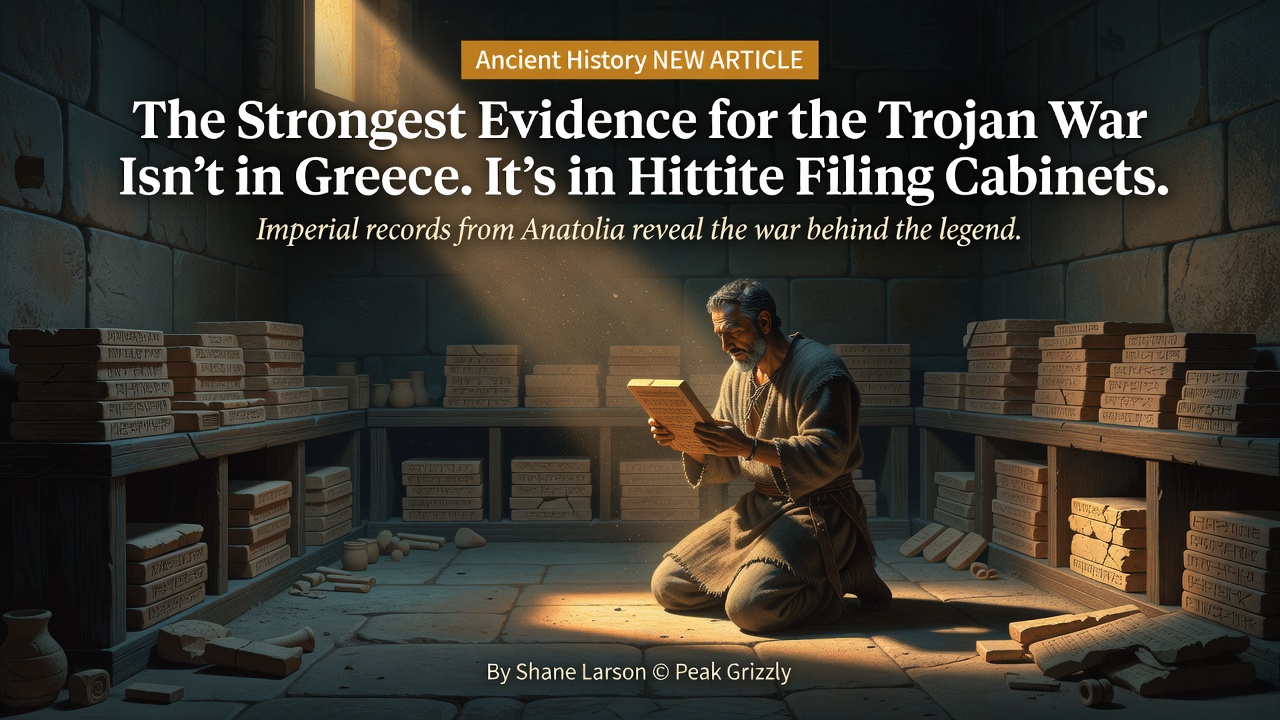
Ask whether the Trojan War really happened and most people picture the obvious places to look: the ruins at Hisarlik in Turkey, maybe the gold Heinrich Schliemann pulled out of the mound in 1873. Those matter. But the most startling evidence for a real Troy caught up in real wars sits somewhere less romantic: the imperial filing cabinets of the Hittite Empire.
The Hittites ran Anatolia from a capital near modern Ankara for most of the Late Bronze Age, and they were meticulous record-keepers. Treaties, royal correspondence, intelligence complaints — thousands of clay tablets survived the empire's collapse around 1180 BC. And scattered through that paperwork is a kingdom on the empire's far western edge called Wilusa.
Say it out loud. Now say the older Greek name for Troy — not Ilios but its original form, Wilios, before Greek dropped the "w" sound. Linguists noticed. So did the geographers reconstructing Hittite western Anatolia, whose placement of Wilusa lands it in the Troad — the region around Hisarlik. After a century of scholarly argument, the broad consensus is in: Wilusa is Troy, appearing in the diplomatic record of a Bronze Age superpower.
That alone would be remarkable. What the file actually contains is better.
A Treaty With a King Named Alaksandu
Around 1280 BC, the Hittite Great King Muwattalli II — the man who would shortly fight Ramesses II to a standstill at Kadesh — concluded a vassal treaty with the ruler of Wilusa. The treaty survives. It binds the two kings in mutual defense, guarantees the vassal's succession, and calls the gods to witness, among them a local divine protector whose name some scholars read as an early form of Apollo — the god who defends Troy in the Iliad.
The king of Wilusa's name was Alaksandu.
Homer calls Paris of Troy by another name, interchangeably, throughout the Iliad: Alexandros.
Be careful with this — history rewards care. Alaksandu was not Paris; he lived decades before any plausible Trojan War, and the treaty shows him as a loyal Hittite vassal, not an abductor of Greek queens. The name may even be Greek in origin, which would itself be fascinating — a Trojan royal house intermarried or entangled with the Aegean world. But at minimum, the treaty proves this: the name Greek tradition attached to a Trojan prince was a real royal name at Troy, in the right century, preserved across a Dark Age that erased nearly everything else. Four hundred years of illiterate bards carried that name from the Bronze Age to Homer. The oral tradition was garbled — but it was carrying something real.
The Empire Complains About the Greeks
The Wilusa file gets better still. Hittite correspondence repeatedly complains about a troublesome power across the sea called Ahhiyawa — a name that maps, in the consensus reading, onto the Mycenaean Greek world. (Homer's collective name for the Greeks at Troy? Achaioi. Achaeans.)
Troy
One letter — a masterpiece of clenched-teeth diplomacy from a Hittite Great King to his Ahhiyawan counterpart, addressed grudgingly as a fellow Great King — complains at length about a warlord named Piyamaradu who kept raiding the Anatolian coast with Ahhiyawan backing, hauling thousands of captives off to Greek-controlled territory. Mycenaean raiders, carrying people away from the coasts of Anatolia — which is precisely how Homer's heroes describe their own careers around Troy, when they aren't fighting under its walls.
And buried in that same letter is the line that stops historians cold: a passing reference to a past conflict — now resolved — in which the Hittite king and the Ahhiyawans had been at odds over Wilusa itself.
Read that again. A Bronze Age document, written within living memory of the era Troy VIIa burned, mentions Greeks and the Hittite Empire coming into conflict over Troy.
So Was There a Trojan War?
Here's where discipline matters, because the evidence is genuinely two-sided.
In the ground at Hisarlik: Troy VIIa — the cramped, crowded rebuild of magnificent earthquake-shattered Troy VI — burned violently around 1180 BC. Excavators found sling bullets and arrowheads in the destruction debris, and human remains lying unburied in the streets. Cities don't look like that after accidents. That is what a sacked city looks like.
But: no victor's inscription exists. No Hittite record describes a great coalition siege. The chronology is awkward — Troy VIIa burned in the same generation the Mycenaean palaces themselves were collapsing, which makes a massive unified Greek expedition hard to picture. And the burned city could as easily have fallen to the roving raiders of the general Bronze Age Collapse — the same catastrophe that took Ugarit, Hattusa, and the palaces of Greece — as to an Achaean armada.
The honest verdict, and the one I defend in the book: something real underlies the legend. Sustained Mycenaean military pressure on the Anatolian coast is documented over two centuries. A conflict over Troy specifically is documented. A violent destruction of Troy in the right era is in the ground. What poetry did — as poetry always does — was compress generations of raids, sieges, and burnings into one war, ten years, one cause, one queen. The ten-year siege over Helen is literature. The violence it remembers appears to be history.
To me that answer beats both alternatives. "Homer was a war correspondent" flattens a four-century oral tradition into stenography. "It's all fiction" requires ignoring an empire's worth of paperwork. The truth — a real border city, caught between two great powers, raided and finally burned as its world collapsed, remembered in song by the collapsing world's survivors — needs no embellishment at all.
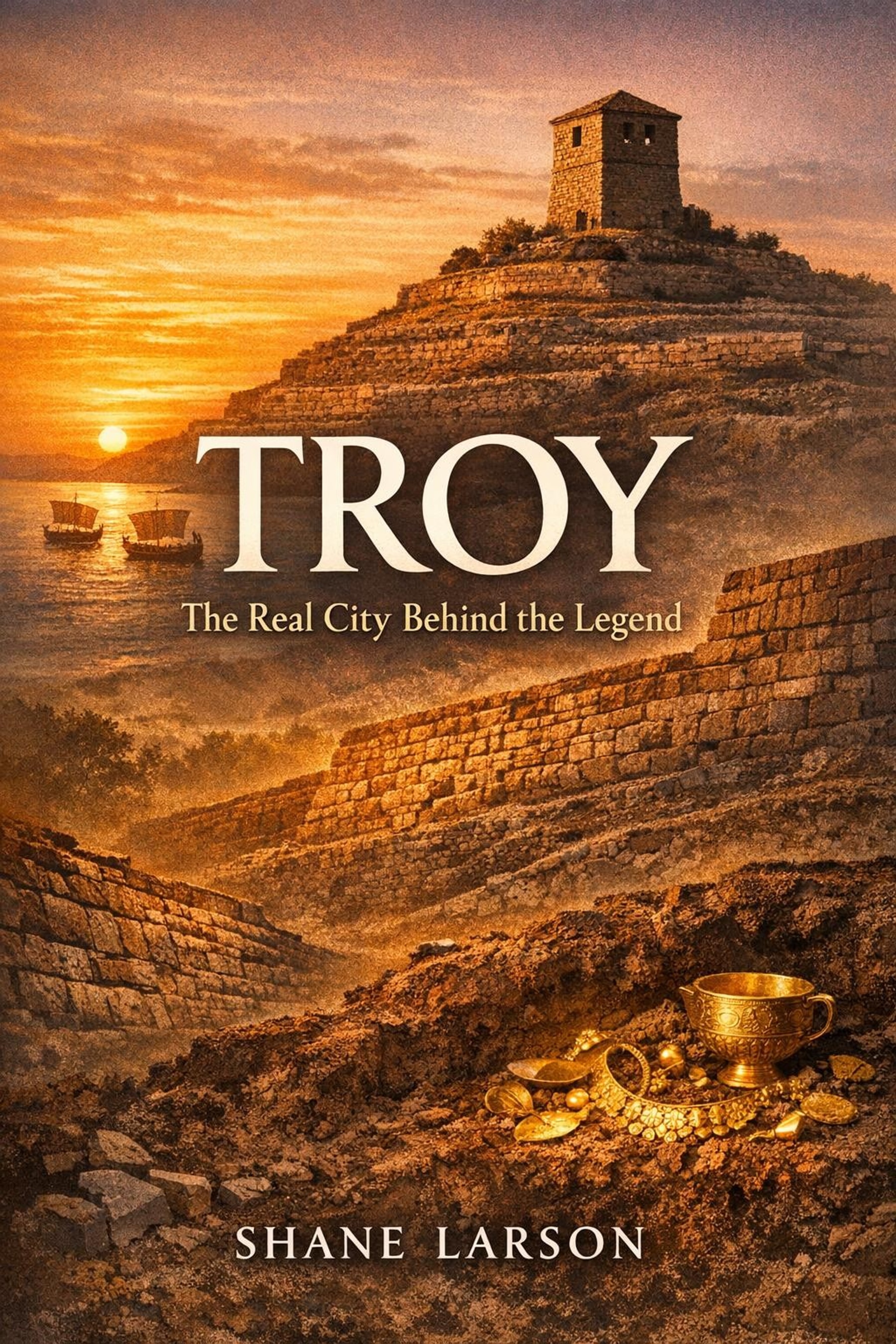
My new book, Troy: The Real City Behind the Legend, tells the whole story layer by layer: the nine superimposed cities of Hisarlik, the flamboyant and frequently dishonest millionaire who found them (and shoveled through the layer that mattered), Priam's Treasure's own epic of smuggling and disappearance, the full Wilusa file, and the burning of Troy VIIa inside the greater catastrophe that ended the Bronze Age. Evidence first, Homer second — and honest, at every layer, about where knowledge ends.
Troy
New posts and releases, straight to your inbox. No spam, unsubscribe anytime.