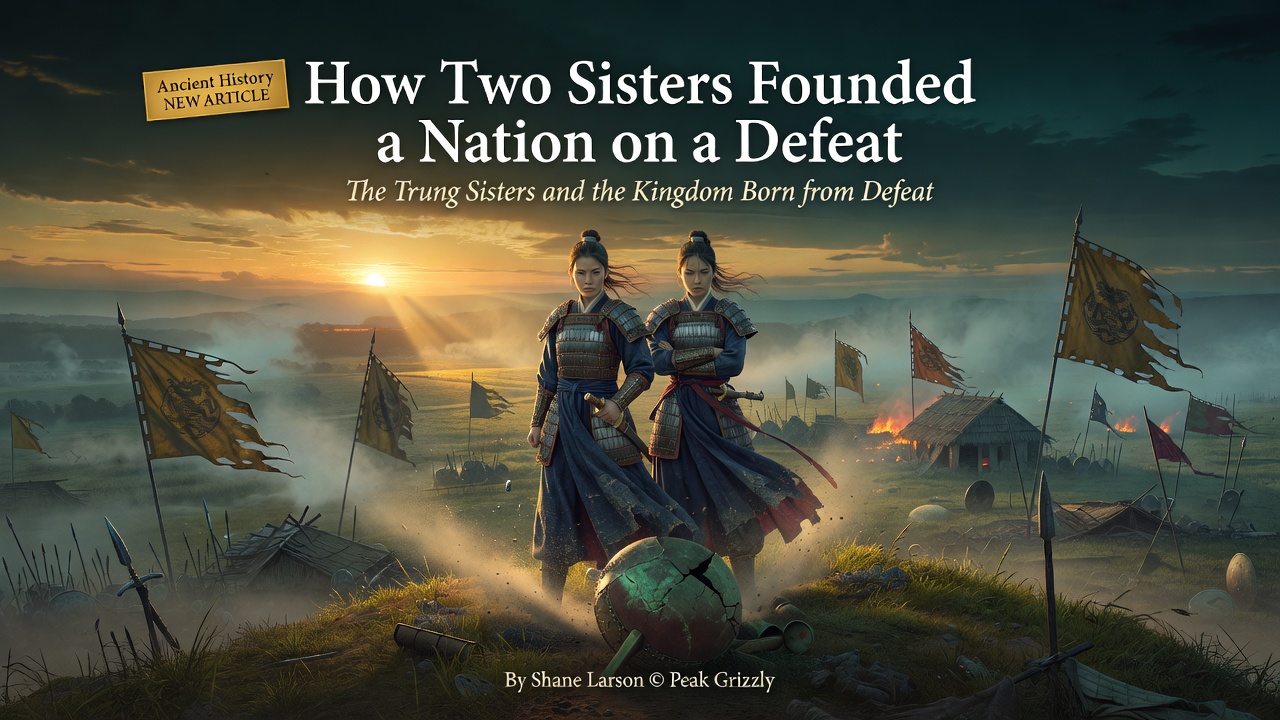
How Two Sisters Founded a Nation on a Defeat
June 24, 2026 · 6 min read
Two thousand years before anyone in the West had heard the word, two sisters founded a nation on the most unlikely thing imaginable: a defeat.
That sentence sounds like a contradiction, and it is. Nations are supposed to be founded on victories — a battle won, a treaty signed, a king crowned and left standing. The Trung Sisters of Vietnam founded theirs on a war they lost, a kingdom that lasted three years, and two deaths that may have been executions or may have been suicides depending on whose records you trust. And yet nineteen centuries later, they are still the first names in the story Vietnam tells about itself.
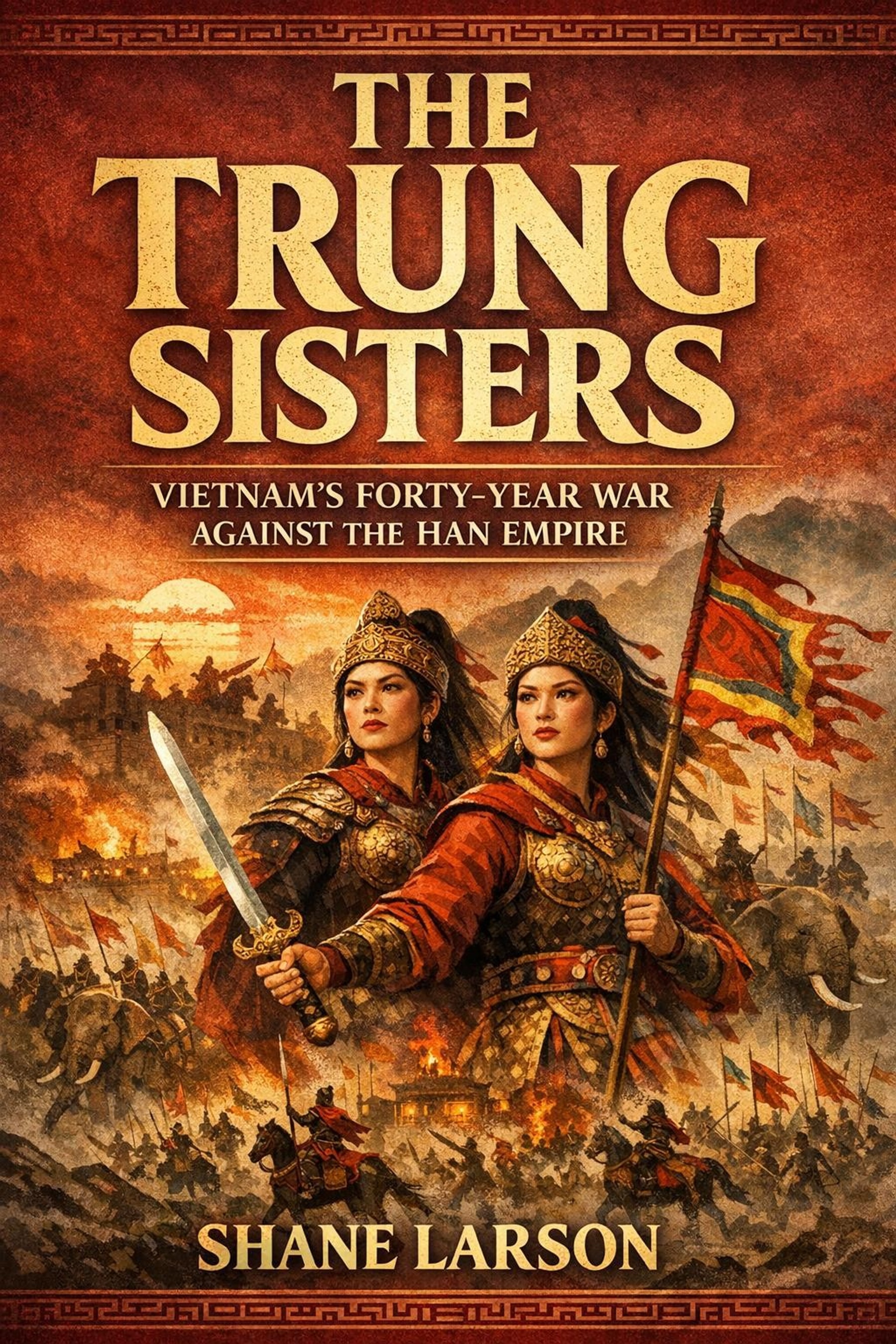
I wanted to understand how that happens. How does a failure become a foundation? My new book, The Trung Sisters: Vietnam's Forty-Year War Against the Han Empire, is the long answer. This is the short one.
The world they were born into
By the time Trung Trac and Trung Nhi were born, the Red River delta — the heartland of what would become northern Vietnam — had been under Han Chinese administration for more than a century. The Han Empire had absorbed the region in 111 BCE, and what began as loose oversight had hardened, generation by generation, into something heavier: imperial taxes, Chinese governors and garrisons, and a slow, deliberate pressure on local custom to bend toward the imperial center.
It is worth pausing on what the local world actually was, because the Chinese chronicles that survive are not interested in telling us. This was not a blank frontier waiting to be civilized. It was the inheritor of the Dong Son culture, a Bronze Age society famous for its magnificent ceremonial drums — huge bronze instruments cast with concentric bands of geometric pattern, processions, birds, and a radiating star at the center. The people of the delta had their own lords, their own social order, and — by every indication we can reconstruct — a place for women in public and family life that the patriarchal Han world found alien.
The sisters came from that lord class. Trung Trac was, by the Vietnamese tradition, married to a local noble named Thi Sach. And it was a Han governor's treatment of that family — in the standard telling, the killing of Thi Sach — that lit the fuse.
The revolt that worked
Here is what makes the Trung story electric, and why it has held its grip for so long: it worked. At first, completely.
The sisters did not petition the empire. They did not appeal to a distant court for redress. They raised an army. And the grievances they tapped into were so widespread that the rising spread faster than the Han administration could respond. The local lords joined them. Town after fortified town came over or fell. The traditional count — and these numbers always carry the weight of legend, which the book is honest about — is sixty-five citadels taken.
The Han governor fled north. And in the space the empire had vacated, Trung Trac was proclaimed queen.
Sit with that for a moment. In the year 40 CE, in a region the most powerful empire on Earth considered a settled province, a woman raised a rebellion, won it, and took the throne of a free kingdom. There is nothing else quite like it in the ancient record of East and Southeast Asia. If you want a Western analog, the closest is Boudica, the British queen who burned Roman towns a generation later — except that Boudica's rising was a fire that flared and died, and Trung Trac actually governed.
For three years, the kingdom stood.
The empire strikes back
Empires do not forget provinces. They especially do not forget provinces that have humiliated them.
The Han response, when it came, was professional and merciless. The court dispatched Ma Yuan, one of its most experienced generals, with a hardened army and a clear mandate: take it back, and make sure it stays taken. Ma Yuan ground his way south through difficult country and, by 43 CE, broke the rebellion in the field.
The Trung Sisters
The sisters died. And here the two great source traditions part ways, in a manner that tells you everything about how history gets written.
The Chinese chronicles — composed by the empire the sisters had defied — record, briefly and without ceremony, that the rebels were defeated and the Trung leaders were captured and executed, their heads sent north. The Vietnamese tradition remembers something different and far more lasting: that the sisters, rather than fall into Han hands, walked into the waters of the Hat River and gave themselves to it.
We cannot reconcile those two accounts, and the honest move — the one I take in the book — is not to pretend we can. The Chinese record is closer in time but hostile and terse. The Vietnamese memory is later and reverent and shaped by centuries of retelling. The truth, if there is a single one, sits somewhere we can no longer reach. What we can say with confidence is which version a people chose to carry. And Vietnam chose the river.
Why a lost war became a founding myth
So we return to the contradiction we started with. The Trung Sisters lost. The kingdom fell. The Han reconquest was so thorough that direct Chinese rule over the delta would last, with interruptions, for the better part of a thousand years.
And yet.
A defeat can do something a victory often cannot: it can become a promise. The Trung revolt proved that the delta could be free — that the empire was not a law of nature but a thing that had once been thrown off and could be again. Every subsequent generation of resistance had the sisters to point to. When Lady Trieu rose against Chinese rule in the third century, she rose in their shadow. When, in 938 CE, Ngo Quyen finally broke Chinese control for good at the Battle of Bach Dang — driving iron-tipped stakes into the riverbed to trap the imperial fleet — he was completing an arc the Trung Sisters had begun nine hundred years earlier.
That is the larger story the book tells: not just three years in the first century, but the thousand-year span of Vietnamese resistance, with the Trung Sisters as its opening chapter and its enduring symbol. They became the answer to a question every occupied people eventually asks itself — did we ever resist? Yes. From the very beginning. Two sisters, sixty-five citadels, a queen on a throne the empire said could not exist.
That is why they are honored in temples across Vietnam to this day. Not because they won. Because they tried, and won for three years, and chose the river over surrender, and gave everyone who came after them something to point to.
Where the Trung Sisters belong
I write a series about women who changed the course of nations — Boudica, Cleopatra, Hatshepsut, Nefertiti, Zenobia of Palmyra, Theodora, Wu Zetian. (You can find the full series on shanelarson.com.) The Trung Sisters belong squarely in that company, and yet outside Vietnam and its global diaspora, almost no one in the English-reading world knows their names.
That gap is exactly why I wrote the book. The Western canon of "great rebel women" tends to stop at the edges of the Roman world. But the ancient history of Southeast Asia is just as rich, just as dramatic, and far less told. If Boudica's story moved you — and if you'd like to read more on the women who took on empires — the Trung Sisters will too.
The Trung Sisters: Vietnam's Forty-Year War Against the Han Empire is available now on Kindle for $3.99, free to read on Kindle Unlimited. It draws on both the hostile Chinese chronicles and the living Vietnamese tradition, and it tries throughout to be honest about what we know, what we only remember, and the difference between the two.
Two sisters founded a nation on a defeat. Come find out how.
The Trung Sisters
New posts and releases, straight to your inbox. No spam, unsubscribe anytime.